Abstract
The use of ICT in educational settings is a catalyst for change. The paper has sought to explore the role of ICT in education as we progress into the 21st century. The first phase focuses on the conceptual framework of the use of ICT in education. In this model the dependent variable is education and its sub variables are educational level of teachers and students which is directly affected by the independent variables which are the use of ICTs, ICT infrastructure and staff development. The second phase is the pilot study to answer two major questions: (i) Is ICT mandatory or voluntary at your institutions? (ii) What are the greatest barriers to using ICT to you as an academician? The results show that majority of the academic staff (86%) responded that ICT is mandatory. However, the survey revealed that most of the part-time lecturers ticked the use of ICT as voluntary. Some of these part-time lecturers in the cadre of professors, responded to Q32 as (do not fit my program). Actually in their dispensation, lecturing was done using the chalk board only. The research confirms that two major barriers affect the use of ICT; they are lack of time to use ICT the systems and training opportunities. Respondents on these are 38% and 32% respectively. Based on these findings, the paper recommended that, all employed teachers in Federal, State and Private institutions should undertake mandatory training and retraining on ICT programmers. The government should develop ICT policies and guidelines for the application of ICT in education.
Keywords
- ICT Search this journal for ICT (opens in a new tab)
- Education Search this journal for Education (opens in a new tab)
- ICT Infrastructure Search this journal for ICT Infrastructure (opens in a new tab)
- Staff Development Search this journal for Staff Development (opens in a new tab)
- ICT Tools Search this journal for ICT Tools (opens in a new tab)
References
- Achimugu, P., Oluwagbemi, O., Oluwaranti, A. & Afolabi, B. (2009). Adoption of Information and Communication Technologies in Developing Countries: An Impact Analysis. JITI, 9(1), 37-46.
- Archibong, I. A. & Effiom, D. O. (2009). ICT in University Education: Usage and Challenges among Academic Staff. Africa Research Review, 3 (2), 404-414.
- Bridget, S. (2008). Factors Affecting Teachers'Pedagogical Adoption of ICT. International Handbook of Information Technology in Primary and Secondary Education, 449-460.
- Chiemeke, S. C. & Longe, O. B. (2007). Information communication Technology in Nigeria: Prospecta, Challenges and Metrics. Asian Journal of Information Technology, 45 , 12-19.
- DeLacey, B. & Leonard, D. (2002). Case study on technology and distance in education at the Harvard Business School. Education Technology and Society , 5(2), 2-26.
- Dutton, W. H. & Loader, B. D. (Eds.). (2002). Digital Academe: New Media and Institutions in Higher Education and learning . London: Routledge.
- GeSCI. (2007). Global e-schools and communities initiatives: Infrastructure and connectivity. http://www.gesci.org/policy.html.
- Ijeoma, A. A., Joseph, E. O. & Franca, A. (2010). ICT Competence among Academic staff in Unversities in Cross Rivers State, Nigeria. . Computer and Information Science, 3 (4), 109-115.
- Modupe, O. & Binuomote, M. O. (2007). Awarenss and Adoption of Infromation and Communication Technology among Secrtarial Staff of Ladoke Akintola University of Technology, Ogbomaso, Nigeria. Social Science, 2 , 57-59.
- Ololube, N. P. & Egbezor, D. E. (2009). Educational technology and Flexible education in Nigeria: Meeting the need for effective teacher education. In S. Marshal, W. Kinthia and W. Taylor (Eds), Bridging the Knowledge Divide. Educational technology for develpoment, 391-413.
- Oye, N. D., A.Iahad, N. & Ab.Rahim, N. (2011). Adoption and Acceptance of ICT Innovations in Nigerian Public Universities. International Journal of Computer Science Engineering and Technology, 1 (7), 434- 443.
- Oye, N. D., Salleh, M. & Iahad, N. A. (2010). Holistic E-learning in Nigerian Higher Education Institutions. Journal of Computing, 2 (11), 20-26.
- Radcliffe, D. (2002). Technological and pedagogical convergence work-based and campus-based learning. Educational Technology and Society , 5(2), http://www.ifets.info/journals/5_2/radcliffe.html.
- UNESCO. (2009). UNESCO portal on Higher Education Institutions : : Higher Education Institutions in Nigeria.
Downloads
No downloads have been recorded for this article yet. Figures appear here once readers begin downloading the full text.
How to Cite
Share this article
License
Copyright (c) 2011 N. D. Oye, N. A. Iahad, M. A. Shakil (Author)

This work is licensed under a Creative Commons Attribution 4.0 International License.
Author (s) should affirm that the material has not been published previously. It has not been submitted and it is not under consideration by any other journal. At the same time author (s) need to execute a publication permission agreement to assume the responsibility of the submitted content and any omissions and errors therein. After submission of revised paper in the light of suggestions of the reviewers, the editorial team edits and formats manuscripts to bring uniformity and standardization in published material.
This work will be licensed under Creative Commons Attribution 4.0 International (CC BY 4.0) and under condition of the license, users are free to read, copy, remix, transform, redistribute, download, print, search or link to the full texts of articles and even build upon their work as long as they credit the author for the original work. Moreover, as per journal policy author (s) hold and retain copyrights without any restrictions.
Keywords
- ICT Search this journal for ICT (opens in a new tab)
- Education Search this journal for Education (opens in a new tab)
- ICT Infrastructure Search this journal for ICT Infrastructure (opens in a new tab)
- Staff Development Search this journal for Staff Development (opens in a new tab)
- ICT Tools Search this journal for ICT Tools (opens in a new tab)
Section
Published in
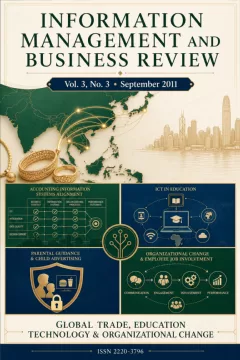 Vol. 3 No. 3 (2011)
Global Trade, Education Technology & Organizational Change
View issue contents
Published
Submissions
Have research to publish? Information Management and Business Review welcomes submissions.
Make a Submission