Abstract
Various models have been developed to manage the innovative product development process. However, most of them are complex and add more cost in managing new product development process. In this study, we present a simple and cost effective model of innovative product development process management. The specialty of this model is that it logically demonstrates how integration of encouraging leader and innovative mind in new product development process (NPD) can make it efficient and cost effective. It also shows how leadership can fully concentrate on the first phase of NPD and how crossfunctional and innovative teams can be merged in a single team to develop a workable product.
Keywords
- Innovation Process Search this journal for Innovation Process (opens in a new tab)
- Innovation Management Search this journal for Innovation Management (opens in a new tab)
- Encouraging Leader Search this journal for Encouraging Leader (opens in a new tab)
- Innovative Mind Search this journal for Innovative Mind (opens in a new tab)
References
- Abernathy, W. J. & Clark, K. B. (1985). Innovation: Mapping the winds of creative destruction. Research Policy , 14 , 3-22.
- Ali, M., Muhammad, A. & Park, K. (2011). A spiral process model of technological innovation in a developing country: The case of Samsung. African Journal of Business Management , 5(7), 2874-2889.
- Amabile, T. M. (1983). The social psychology of creativity . New York: Springer-Verlag.
- Amabile, T. M. (1997). Motivating creativity in organizations: On doing what you love and loving what you do. California Management Review, 40 (1), 39-58.
- Amason, A. & Schweiger, D. M. (1994). Resolving the paradox of conflict, strategic decision-making and organizational performance. International Journal of Conflict Management, 5, 239-253.
- Baregheh, A., Rowley, J. & Sambrook, S. (2009). Towards a multidisciplinary definition of innovation. Management Decision , 47(8), 1323–1339.
- Barnett, H. G. (1953). Innovation: the basis of cultural change. New York: McGraw-Hill.
- Bass, B. M. (1985). Leadership and performance beyond expectations. New York, NY: Free Press.
- Beard, C. & Easingwood, C. (1996). New product launch: Marketing action and launch tactics for high technology products. Industrial Marketing Management, 25 , 87-103.
- Becker, S. W. & Whisler, T. L. (Oct. 1967). The innovate organization: A selective view of current theory and research. The Journal of Business, 40 , 462-469.
- Beswick, C. & Gallagher, D. (2010). The road to innovation. UK: LTB Publishing.
- Bohinc, T. & Erichson, J. (2002). Innovations management. Telecommunication , 56 (7+8), 1-59.
- Birkinshaw, J., Hamel, G. & Mol, M. J. (2008). Management innovation. Academy of Management Review , 33 (4), 825-845.
- Brown, S. L. & Eisenhardt, K. M. (1995). Product development: Past research, Present findings, and future directions. Academy of Management Review, 20 (2), 343-378.
- Cardozo, R., McLaughlin, K., Harmon, B., Reynolds, P. & Brenda, M. B. (1993). Product market choices and growth of new businesses. Journal of Product Innovation Management, 10 , 331-340.
- Charbonnier-Voirin, A. & Akremi, A. E. (2011). The Effect of Empowerment on Employees' Adaptive Performance. Relations Industrielles/Industrial Relations , 66(1), Available at SSRN: http://ssrn.com/abstract=1802719
- Charbonnier-Voirin, A., Akremi, A. E. & Vandenberghe, C. (2010). A multilevel model of transformational leadership and adaptive performance and the moderating role of climate for innovation. Group & Organization Management, 35(6) 699–726.
- Chi, N. W., Huang, Y. M. & Lin, S. C. (2009). A double-edged sword? Exploring the curvilinear relationship between organizational tenure diversity and team innovation: The moderating role of team-oriented HR practices. Group & Organization Management , 34(6) 698–726.
- Cooper, R. G. (1979). The dimensions of industrial new product success and failure. Journal of Marketing, 43(3), 93-103.
- Cooper, R. G. (1990). Stage-gate systems: A new tool for managing new Products. Business Horizons, 44-54.
- Cooper, R. G. & Kleinschmidt, E. J. (1986). An Investigation into the New Product Process: Steps, Deficiencies, and Impact. Journal of Product Innovation Management, 3, 71-85.
- Choi, J. N., Anderson, T. A. & Veillette, A. (2009). Contextual inhibitors of employee creativity in organizations: The insulating role of creative ability. Group & Organization Management, 34 (3), 330-357.
- Christensen, C. M. (1997). Making strategy: Learning by doing. Harvard Business Review, 75(6), 141-156.
- Clark, K. B. & Wheelwright, S. C. (1993). Managing new product and process development . New York: Free Press.
- Craig, T. (1995) Achieving Innovation through bureaucracy: Lessons from the Japanese brewing industry. California Management Review, 8 (1), 8-36.
- Davies, B. J. & Davies, B. (2004). Strategic leadership. School Leadership & Management, 24(1), 29-38 .
- Day, G. S. (1994). The capabilities of market-driven organizations. Journal of Marketing , 58(4), 37-52.
- Dess, G. G. & Picken, J. C. (2000). Leadership in the 21st century. Organizational Dynamics, 5(2), 18-33.
- Dorfman, P. W. & House, R. J. (2004 ). Cultural influences on organizational leadership: Literature review, theoretical rationale, and globe project goals, in House, R.J., Hanges, P. J., Javidan, M., Dorfman, P. W. and Gupta, V. (Eds.), Culture, Leadership, and Organizations : The GLOBE Study of 62 Societies , Sage, Thousand Oaks, pp. 51–73.
- Dougherty, D. (1992). Interpretive barriers to successful product innovation in large firms. Organization Science, 3 (2), 179-202.
- Dougherty, D. & Hardy, C. (1996). Sustained product innovation in large, mature organizations: Overcoming innovation-to-organization problems. Academy of Management Journal , 39 (5), 1120-1153.
- Downs, C. W. (1988). Communication audits. Glenview: Scott Foresman IL.
- Drucker, P. F. (1998). The discipline of innovation. Harvard Business Review.
- Elenkov, D. S., Judge, W. & Wright, P. (2005). Strategic leadership and executive innovation influence: AN international multi-cluster comparative study. Strategic Management Journal, 26, 665–682.
- Ernst, H. (2002). Success factors of new product development: a review of the empirical literature. International Journal of Management Reviews, 4 (1), 1 – 40
- Evans, C. R. Dion, K. L. (1991). Group Cohesion and performance: A meta-analysis. Small Group Research , 22(7), 175-186.
- Goyal, S. & Pitt, M. (2007). Determining the role of Innovation: Management in facilities management. Facilities, 25 (½), 48-60.
- Griffin, A. & Hauser, J. R. (1996). Integrating R&D and marketing: a review and analysis of the literature. Journal of Product Innovation Management, 13, 191- 215.
- Guiltinan, J. P. (1999). Launch strategy, launch tactics and demand outcomes. Journal of Product Innovation Management, 16 (6), 509–529.
- Hargie, O., Dickson, D. & Tourish, D. (1999). Communication in management. Gower, Aldershot.
- Henderson, R. M. (1994). Managing Innovation in the Information Age. Harvard Business Review, 72(1), 100106.
- Hitt, M. A. & Ireland, D. R. (2002). The essence of strategic leadership: Managing human and social capital. Journal of Leadership & Organizational Studies, 9(1), 3-14.
- Huang, Y. (2010). A study of product innovation in new product development process. International Bulletin of Business Administration, 9, 64-73.
- Iansiti, M. (1995). Shooting the rapids: Managing product development in turbulent environments. California Management Review , 38(1), 37-58.
- Ilori, M. O., Oke, J. S. & Sanni, S. A. (2000). Management of new product development in selected food companies in Nigeria. Technovation, 20 (6), 333-342.
- Janis, I. L. (1982). Group thinks . Boston: Houghton Mifflin.
- Jehn, K. A., Northcraft, G. B. & Neale, M. A. (1999). Why differences make a difference: A field study of diversity, conflict, and performance in groups. Administrative Science Quarterly , 44, 741-763.
- Johannessen, J. A., Olesen, B. & Lumpkin, G. T. (2001). Innovation as newness: what is new, how new, and new to whom ? European Journal of Innovation Management, 4 (1), 20-31.
- Johnson, J. D., Donohue, W. A., Atkin, C. K. & Johnson, S. (2001). Communication, involvement and perceived innovativeness: Tests of a model with two contrasting innovations. Group & Organization Management, 26 , 24-42.
- Judge, W. Q., Fryxell, G. E. & Dooley, R. S. (1997). The new task of R&D management: Creating goal-directed communities in R&D units. California Management Review. 39(3), 72-85.
- Kelly, P. & Kranzburg, M. (1978). Technological Innovation: A Critical Review of Current Knowledge. San Francisco: San Francisco Press.
- Kotler, P., Keller, K. L., Koshy, A. & Jha, A. (2009). Marketing Management: A South Asian Perspective 13th Ed . New Delhi: Pearson Education.
- Kuhn, R. L. (1993). Generating Creativity and Innovation in Large Bureaucracies. Westport, CT: Quorum Books.
- Laufer, A., Denker, G. R. & Shenhar, A. J. (1996). Simultaneous management: the key to excellence in capital projects. International Journal of Project Management , 14, 189-199.
- Leonard, D. & Sensiper, S. (1998). The Role of Tacit Knowledge in Group Innovation. California Management Review, 40 (3), 112-125.
- Luecke, R. & Katz, R. (2003). Managing creativity and innovation. Boston, MA: Harvard Business School Press. Mansfield, E., Rapoport, J., Schnee, J., Wagner, S. & Hamburger, M. (1971). Research and innovation in the modern corporation . London. W. W. Norton & Co.
- McDonough III, E. F. & Leifer, R. P. (1986). Effective control of new product projects: The Interaction of organization culture and project leadership. Journal Product Innovation Management, 3, 149-157.
- McKeown, M. (2008). The truth about innovation . London: Prentice Hall.
- Mentzer, J. T. (2001). Supplier partnering , (Sheth and Parvatiyar Ed.), Handbook of Relationship Marketing. Sage.
- Miller, K. I. & Monge, P. R. (1986). Participation, satisfaction and productivity: A Meta analytical review. Academy of Management Journal, 29(4), 727-753.
- Milliken, F. J. & Martin, L. L. (1996). Searching for common threads: Understanding the multiple effects of diversity in organizational groups. Academy of Management Review, 21(2), 402-23.
- Moss, S. E., Sanchez, J. I., Brumbaugh, A. M. & Borkowski, N. (2009). (2009). The mediating role of feedback avoidance behavior in the LMX–performance relationship. Group & Organization Management, 34(6) 645–664.
- Nemeth, C. J. (1997). Managing innovation: When less is more. California Management Review, 40, 59-74. Pitta, D. A., Franzak, F. & Katsanis, L. P. (1996). Redefining new product development teams: learning to actualize consumer contributions. Journal of Product & Brand Management , 5(6), 48-60.
- Poolton, J. & Barclay, I. (1998). New product development from past research to future applications. Industrial Marketing Management, 27(3), 197-212.
- Schilling, N. A. & Hill, C. W. L. (1998). Managing the new product development process: Strategic Imperatives. Academy of Management Executive, 12(3), 67-81.
- Scott, S. G. & Bruce, R. A. (1994). Determinants of innovative behavior: A path model of individual innovation in the workplace. Academy of Management Journal, 37 (3), 580-607.
- Sethi, R., Smith, D. C. & Park, C. W. (2001). CROSS-functional product development teams, creativity and the innovativeness of new consumer products. Journal of Marketing Research, XXXVIII, 73–85.
- Sharma, A. (1999). Central dilemmas of managing innovation in large firms. California Management Review, 41(3), 146-164. Sheu, D, D. & Lee, H-K. (2011). A proposed process for systematic innovation. International Journal of Production Research , 49(3), 847-868.
- Singh, G., Sharma, R. & Singh, S. (2007). Managing innovation for competitive advantage: An integrated approach model. Indian Management studies Journal, 11, 161-169.
- Srinivasan, S. K. (2011). From jugaad to systematic innovation: the challenge for India. Information Management and Business Review, 2(1), 46-47.
- Sue-Chan, C., Chen, Z. & Lam, W. (2011). LMX, coaching attributions, and employee performance. Group & Organization Management, 36(4) 466–498.
- Thompson, V. A. (1965). Bureaucracy and innovation. Administrative Science Quarterly, 10(1), 1-20.
- Trott, P. (2005). Innovation Management and new product development. Prentice Hall. ISBN- 0273686437. Turner, M. E., Pratkanis, A. R., Probasco, P. & Leve, C. (1992). Threat, cohesion and group effectiveness: Testing a social identity maintenance perspective on groupthink. Journal of Personality and Social Psychology, 63 , 781-796.
- Twiss, B. (1980). Managing Technological Innovation. London: Longman.
- Urabe, K. (1988). Innovation and the Japanese management system . In K. Urabe, J. Child, & T. Kagono (Eds.), Innovation and management international comparisons. Berlin: Walter de Gruyter. Wang, G., Oh, I. S., Courtright, S. H. & Colbert, A. E. (2011). Transformational leadership and performance across criteria and levels: A meta-analytic review of 25 years of research. Group & Organization Management, 36(2), 223–270.
- Zahra, S. A. & Nielsen, A. P. (2002) Sources of capabilities, integration and technology commercialization. Strategic Management Journal, 23, 377–398.
Downloads
No downloads have been recorded for this article yet. Figures appear here once readers begin downloading the full text.
How to Cite
Share this article
License
Copyright (c) 2011 Imran Anwar Mir, Ijaz A. Qureshi (Author)

This work is licensed under a Creative Commons Attribution 4.0 International License.
Author (s) should affirm that the material has not been published previously. It has not been submitted and it is not under consideration by any other journal. At the same time author (s) need to execute a publication permission agreement to assume the responsibility of the submitted content and any omissions and errors therein. After submission of revised paper in the light of suggestions of the reviewers, the editorial team edits and formats manuscripts to bring uniformity and standardization in published material.
This work will be licensed under Creative Commons Attribution 4.0 International (CC BY 4.0) and under condition of the license, users are free to read, copy, remix, transform, redistribute, download, print, search or link to the full texts of articles and even build upon their work as long as they credit the author for the original work. Moreover, as per journal policy author (s) hold and retain copyrights without any restrictions.
Keywords
- Innovation Process Search this journal for Innovation Process (opens in a new tab)
- Innovation Management Search this journal for Innovation Management (opens in a new tab)
- Encouraging Leader Search this journal for Encouraging Leader (opens in a new tab)
- Innovative Mind Search this journal for Innovative Mind (opens in a new tab)
Section
Published in
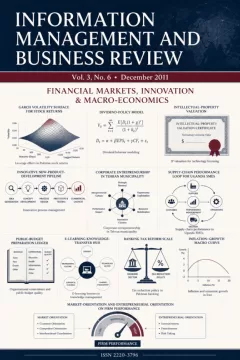 Vol. 3 No. 6 (2011)
Financial Markets, Innovation & Macro-Economics
View issue contents
Published
Submissions
Have research to publish? Information Management and Business Review welcomes submissions.
Make a Submission