Abstract
The study explores the relationship between organizational commitment of workers in public sectors and the quality of budget preparation. Through questionnaire survey, the study is conducted on people working on budget planning and preparation. The multi-layer regression analysis method implemented on empirical evidence finds that organizational commitment and task uncertainly each have significantly positive and negative effect on the quality of budget preparation, respectively, while under a high task uncertainty, the retrospective effects of independent variables have significant effect on quality of budget preparation. Based on the above findings, the study proposes that an enhancement on organizational commitment of budget preparers will help to increase the quality of budget preparation.
Keywords
- Public Budget Search this journal for Public Budget (opens in a new tab)
- Budget Quality Search this journal for Budget Quality (opens in a new tab)
- Organizational Commitment Search this journal for Organizational Commitment (opens in a new tab)
- Task Uncertainty Search this journal for Task Uncertainty (opens in a new tab)
References
- Barney, J. B. (1986). Strategic Factor Markets: Expectations, Luck, and Business Strategy. Management Science , 42, 1231-41.
- Caiden, N. (1981). Public Budgeting Amidst Uncertainty and Instability. Public Budgeting and Finance , 1(1), 6-19.
- Chang, Y. & Wei, R. (2005). The Effect of Recognizing Importance of Performance Measurement System on Overall Quality Management and Business Performance. The 17th Accounting Theory and Practice Conference (in Taipei).
- Cheng, B. (1992). Exploration on Effective Organizational Culture: the Relationship between Consistency in Organizational Value Perspective and Members’ Effectiveness. National Science Council Project Report.
- Chiang, Y., Shih, H. & Teng, K. (2006). The Relationship between High Performance Work System and Organizational Performance Mediated by Perceived Organizational Support, Organizational Commitment and Job Satisfaction. National Science Council Project Report.
- Dai, Y. (1995). Business Reformation and Improvement. Quality Management Control Monthly , 1(1), 25-32.
- Deming, W. & Edward, A. (1982). Quality Productivity and Competitive Position, Cambridge, MA, MIT Center, 50-61.
- Elster, J. (1986). Rational Choice, NY: New York University Press, 8-15.
- Fenno, R. M. (1966). The Power of the Purse: Appropriations Politics in Congress, Boston, Little, Brown and Company, 69-74.
- Galbraith, J. R. (1977). Organization Design, Massachusetts, Addison-Wesley, 39-41.
- Grant, R. M. (1996). Prospering in Dynamically Competitive Environments: Organizational Capability as Knowledge Integration. Organization Science, 7(4), 375-88.
- Hackerman, J. R. (1968). Effects of Task Characteristics on Group Interaction Process and Group Performance Effectiveness: A Review and Proposed Integration. Advances in Experimental Social Psychology , 8, 1-8.
- Harsanyi, J. C. (1969). Rational-Choice Models of Political Behavior vs. Functionalist and Conformist Theories. World Politics , 21, 513-38.
- Hiltz, S. R., Johnson, K. & Turoff, M. (1986). Experiments in Group Decision-making: Communication Process and Outcome in Face-to-Face Versus Computerized Conference. Human Communication Research , 13, 225-52.
- Hrebiniak, L. G. & Alutto, J. A. (1973). Personal and Role-Related Factors in the Development of Organizational Commitment. Administrative Science Quarterly , 17, 555-73.
- Hsu, R. (1996). Research Perspectives and Major Theories of Governmental Budget Theory. Collections of Public Administrative Papers , 10, 459-76.
- Huang, K. (1992). Information Technology and Value Perspectives. National Science Council Project Report.
- Huang, T. (2000). Public Strategy Planning and Performance Budget-Establishing Appropriate Evaluation Structure from Experience in US and Australia. Theory and Policy , 14(1), 23-42.
- Juran, J. M. (1986). Universal Approach to Managing for Quality. Quality Progress , 19, 10-24.
- Kohli, A. K. & Jaworski, B. J. (1990). Market Orientation: The Construct, Research Propositions, and Managerial Implications. Journal of Marketing , 54, 1-18.
- Kwon, T. H. & Zmud, R. W. (1987). Unifying the Fragmented Models of Information Systems Implementation’ in Boland and Hirschheim (Eds), Critical Issues in Information Systems Research . Wiley, Chichester, 227-52.
- Liao, M., Yu, T. & Stoo, D. (2007). A Study on the Influential Factors of Subsidiary Decision Quality-Using Taiwanese Subsidiaries in China as Example. Innovation and Management , 4(1), 165-88.
- Lin, S. (2005). The Effect of Budget Participation on Managerial Performance: Using Role Ambiguity and Organizational Commitment as Moderator. Journal of Business Administration , 64, 29-52.
- Mowday, R. T., Steers, R. M. & Porter, L. W. (1982). Employee organization link ages: the psychology of commitment, absenteeism, and turnover, New York, Academic Press.
- McGrath, J. E. (1984). Groups: Interaction and Performance, NJ: Prentice Hall, Englewood Cliffs, 108-17.
- Mizrahi, S., Vigoda-Gadot, E. & Cohen, N. (2010). Trust, Participation and Performance: The Case of the Israeli National Insurance Institute, Public Management Review , 12(1), 99-126.
- Neter, J., Wasserman, W. & Kutner, M. H. (1985). Applied Linear Regression Models, Irwin.
- Niskanen, W. A. (1971). Bureaucracy and Representative Government, Chicago: Aldine Atherton.
- Nouri, H. & Parker, R. J. (1998). The Relationship between Budget Participation and Job Performance: The Roles of Budget Adequacy and Organizational Commitment. Accounting, Organizations & Society , 23(1), 467-83.
- Olson, M. (1965). The Logic of Collective Action, Cambridge, Harvard University Press.
- Perrow, C. A. (1967). Framework for Comparative Analysis of Organization. American Sociological Review , 7, 194-218.
- Porter, L. W. & Smith, F. J. (1970). The Etiology of Organizational Commitment, University of California, Trine, 84-99.
- Poter, L. W., Steers, R. M., Mowday, R. T. & Boulian, P. V. (1974). Organizational Commitment, Job Satisfaction and Turnover among Psychiatric Technicians. Journal of Applied Psychology , 19, 475-79.
- Rubin, I. S. (1992). Budget Theory and Budget Practice: How Good the Fit? Public Administration in Action, Cal., Brooks/Cole, 29-41.
- Shaw, M. E. (1981). Group Dynamics: The Psychology of Small Group Behavior in A.
- Schick (1990 Eds), the Capacity to Budget. Washington D.C.: The Urban Institute Press, 77-80.
- Schick, A. (1986). Macro-Budgetary Adaptations to Fiscal Stress in Industrialized Democracies. Public Administration Review , 46, 124-34.
- Schick, A. (1988). Micro-Budgetary Adaptations to Fiscal Stress in Industrialized Democracies. Public Administration Review , 48, 523-33.
- Shetty, Y. K. & Ross, J. E. (1985). Quality and Its Management in Service Business. Industrial Management, Nov.-Dec, 10-12.
- Van de Ven, A. H. & Delbecq, A. L. (1974). A Task Contingent Model of Work-Unit Structure. Administrative Science Quarterly , 19, 183-197.
- Whyte, W. (1956). The Organization Man, New York: Doubleday Anchor Books.
- Wildavsky, A. (1964). The Politics of the Budgetary Process, Boston: Little, Brown and Company, 37.
Downloads
No downloads have been recorded for this article yet. Figures appear here once readers begin downloading the full text.
How to Cite
Share this article
License
Copyright (c) 2011 Z-John Liu, Justine Chang (Author)

This work is licensed under a Creative Commons Attribution 4.0 International License.
Author (s) should affirm that the material has not been published previously. It has not been submitted and it is not under consideration by any other journal. At the same time author (s) need to execute a publication permission agreement to assume the responsibility of the submitted content and any omissions and errors therein. After submission of revised paper in the light of suggestions of the reviewers, the editorial team edits and formats manuscripts to bring uniformity and standardization in published material.
This work will be licensed under Creative Commons Attribution 4.0 International (CC BY 4.0) and under condition of the license, users are free to read, copy, remix, transform, redistribute, download, print, search or link to the full texts of articles and even build upon their work as long as they credit the author for the original work. Moreover, as per journal policy author (s) hold and retain copyrights without any restrictions.
Keywords
- Public Budget Search this journal for Public Budget (opens in a new tab)
- Budget Quality Search this journal for Budget Quality (opens in a new tab)
- Organizational Commitment Search this journal for Organizational Commitment (opens in a new tab)
- Task Uncertainty Search this journal for Task Uncertainty (opens in a new tab)
Section
Published in
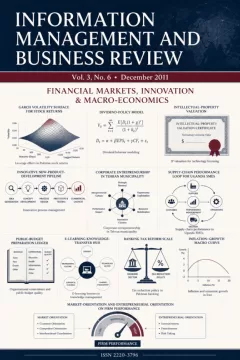 Vol. 3 No. 6 (2011)
Financial Markets, Innovation & Macro-Economics
View issue contents
Published
Submissions
Have research to publish? Information Management and Business Review welcomes submissions.
Make a Submission