Articles 1–10 of 27

  • Article 1 in this issue

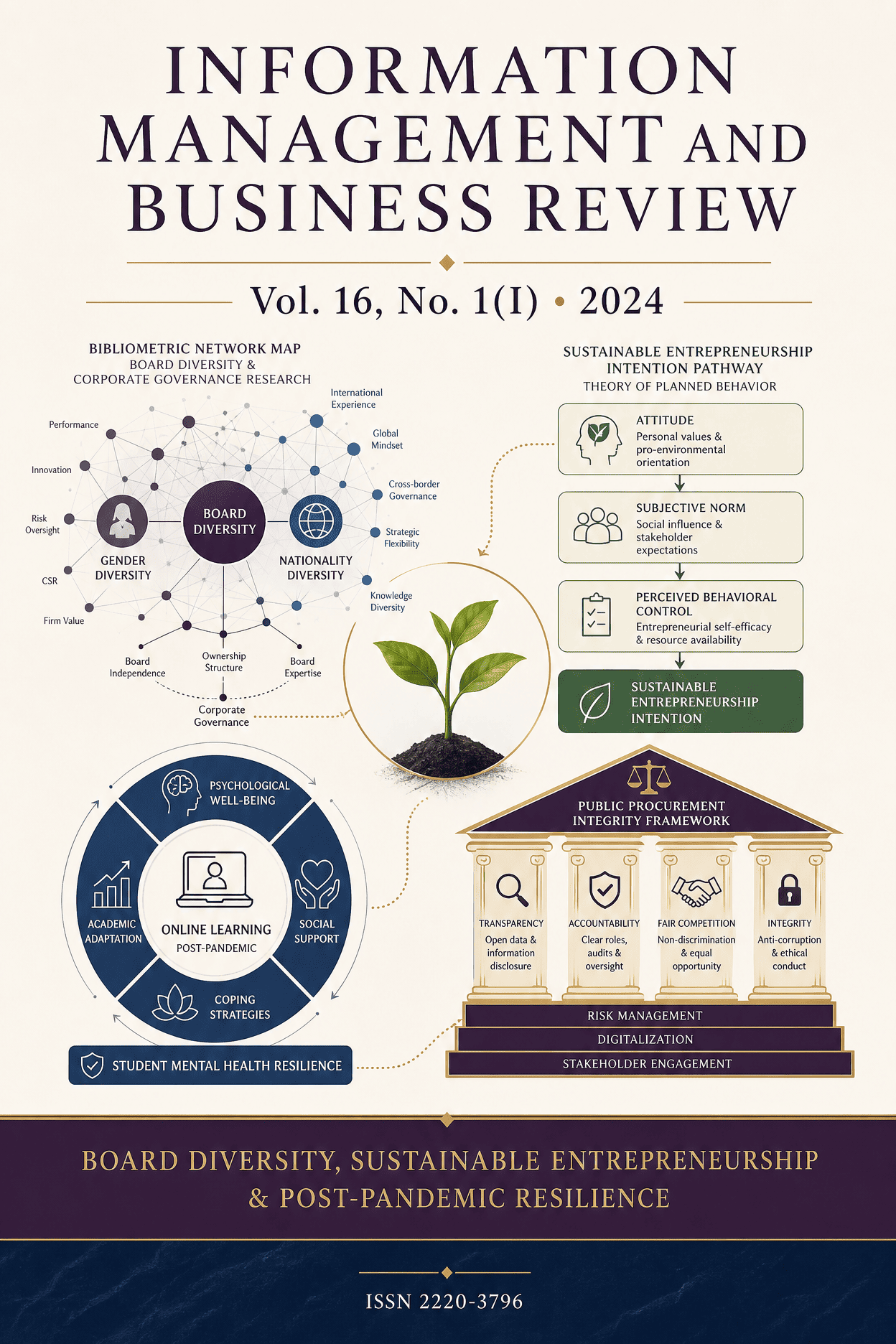
    Unveiling the Trajectory of Board Diversity Research: A Bibliometric Study

    • Author: Roshidah Safeei, Azyyati Anuar, Wan Adibah Wan Ismail, Nor Azrina Mohd Yusof

    This study aims to investigate board diversity using bibliometric analysis. This study examines publication sources, authorship, citations, distribution of publications, and other bibliometric indicators. This study focuses on 290 articles published from 2013 to 2022. Using an automated process, these articles were extracted from the Scopus database and analyzed using bibliometric indicator analysis, VOSviewer, Microsoft Excel, OpenRefine and Perish or Publish. A total of 290 research articles and reviews on board diversity were included in this study. The present study found that the United States was the most productive country (n = 61), followed by the United Kingdom (n = 42), Australia (n = 29), and China (n = 27). The Centre National de la Recherche Scientifique (CNRS), France (n = 8) was the most prominent institution. This study unveils relevant articles, authors, and journals that have discussed board diversity. This study's findings can inform practitioners of the state of the art and the particulars of the most prolific studies. In addition, this study aims to clarify the project themes and tools utilized most frequently in these works. The locations of influential articles and their authors are disclosed. In addition, a list of often-used terms aids in developing a research agenda that highlights pertinent themes, methods, and industries.

    Pages 1-15

    PDF - Unveiling the Trajectory of Board Diversity Research: A Bibliometric Study (opens in a new tab)
  • Article 2 in this issue

    Emerging Trends in Sustainable Entrepreneurial Behaviour: Bibliometric Data Insights

    • Author: Nurul Hayani Abd Rahman, Zuraidah Mohamed Isa, Azyyati Anuar

    The present study explores the current trends in sustainable entrepreneurial behavior to contribute fundamental knowledge for future academic research in the dynamic field of sustainable entrepreneurship. This study employs a bibliometric analysis using the Scopus database to identify significant changes and emerging topics in academic discourse about the selected keywords. By employing a systematic approach, one can attain a comprehensive understanding of the subject matter and establish a solid foundation for subsequent research. The analysis comprises a total of 666 articles obtained from Scopus. This study utilizes methodological tools like Microsoft Excel, Harzing’s Publish or Perish program, and VOS viewer. These tools were used to quantify and evaluate citation frequencies. This method enables the assessment of the academic output and influence exerted by document type, evolution of published studies, subject area, and prominent keywords. Nevertheless, there are several constraints associated with this study, including the omission of articles published after 2022 and a specific emphasis on English-language publications from 1991 to 2022. Notwithstanding these limitations, there has been a substantial and continuous academic emphasis on the study of sustainable entrepreneurial behavior. Future research should investigate sustainable behavior within the context of social entrepreneurship. The government and policymakers have the ability to significantly contribute to the creation of an ecosystem that promotes sustainable entrepreneurship and sustainable development.

    Pages 16-30

    PDF - Emerging Trends in Sustainable Entrepreneurial Behaviour: Bibliometric Data Insights (opens in a new tab)
  • Article 3 in this issue

    Factors Influencing Job Performance among Academic Staff in Malaysian Public University

    • Author: Che Mohd Syaharuddin Che Cob, Ummi Kalsom Zakaria, Mohd Hafeez Al-Amin Abdul Wahab, Julaina Baistaman, Siti Nur Zahirah Omar, Nor Baizura Osman

    Extensive research has been conducted on the factors that determine job performance. The current study was required by a lack of research relating to the factors of job performance among academic staff in Malaysian public universities. The purpose of this study is to investigate the effects of personality traits, motivation, leadership style, and learner autonomy on job performance. D ata was collected from the academic staff of a public university in Malaysia. The probability technique, which is simple random sampling was used in this study. The study is guided by an adapted ten-point Likert Interval Scale structured questionnaire as the main instrument used in collecting the data. Furthermore, the analysis of data was undertaken by using Confirmatory Factor Analysis (CFA) procedures. Structural equation modeling (SEM), a multivariate approach, was used to empirically evaluate and estimate the hypothesized link between constructs using Analysis of Moment Structure (AMOS) software version 20.0. The findings indicate that job performance is significantly and positively related to personality traits, motivation, leadership style, and learner autonomy. Motivation is a significant predictor of job performance when compared to other variables. T he study proves that the combination of personality traits, motivation, learner autonomy, and leadership style on job performance may contribute to the optimal service delivery to stakeholders within Malaysia's educational system. Therefore, the implications of the findings, potential limitations, and directions for future research are also discussed.

    Pages 31-42

    PDF - Factors Influencing Job Performance among Academic Staff in Malaysian Public University (opens in a new tab)
  • Article 4 in this issue

    Investigating Factors Affecting Fans’ Intention to Attend Anime Events: Conceptual

    • Author: Mashita Abdul Jabar, Shareenie Shera Abdul Hamid, Zaity Akhtar Mukhtar, Nik Rozilaini Wan Mohamed, Shahira Abdul Jabar, Mohd Shafiq Abdul Jabar

    This study proposes a conceptual framework to investigate the factors influencing anime fans' intention to attend anime events. As the popularity of Japanese animation (anime) proliferates globally, anime events have emerged as a distinct tourism market segment. However, academic research on anime event attendance factors is limited. This study aims to address this gap by developing a framework integrating three key factors frequently highlighted in the general event and fan culture literature: event image, travel motivations, and media information. Event image denotes attendees' holistic perceptions encompassing cognitive and affective dimensions. Travel motivations refer to internal and external drivers stimulating the intention to attend, such as escapism, socialization, and novelty-seeking. Media information represents sources informing attendees' perceptions and decisions through platforms like social media and websites. The framework posits that these three factors directly influence fans' intention to attend anime events. A quantitative methodology will be utilized to collect survey data from anime communities and analyse the model via PLS SEM techniques. The framework contributes a theoretical understanding of anime event attendance, validates linkages between factors, and provides practical implications for event organizers and marketers to enhance the appeal and competitiveness of anime events. Further research could extend the model’s generalizability, explore causal mechanisms between factors, examine additional variables, and conduct longitudinal studies on evolving attendee behaviour and preferences.

    Pages 43-50

    PDF - Investigating Factors Affecting Fans’ Intention to Attend Anime Events: Conceptual (opens in a new tab)
  • Article 5 in this issue

    Entrepreneurial Specific Factors, Support Factors and Micro enterprises Performance: The Case of Malaysian Microcredit Program

    • Author: Norlaila Ibrahim, Rosman Mahmood, Ahmad Suffian Mohd Zahari, Mulyana Mulyana

    The objective of the study is to analyze the influence of several elements related to entrepreneurialspecific factors and support factors on the performance of micro-enterprises. The study sample consisted of a total of 756 micro-entrepreneurs who were involved in the two main microcredit programs in Malaysia, namely Amanah Ikhtiar Malaysia (AIM) and The Venture Group Economic Fund (TEKUN). The study’s findings, obtained through multiple regression analysis, revealed that factors such as personal entrepreneurial competencies, management practice, microcredit programs and government support exert a significant influence on the performance of micro-enterprises. This finding is consistent with the Resource Base View (RBV) theory which links the importance of internal and external resources as a catalyst for competitive advantage and the performance of a business. The influence of family and commitment to religious principles is less significant. It was associated with the attitude factor of micro-entrepreneurs, who frequently disregard the fundamental principles of religion while making judgments. The impact of family influence on micro enterprises' performance was determined to be negligible. Family members make minimal contributions in terms of finances, energy, or moral support. The formulation of policies is crucial for these insights, which highlight the importance of providing entrepreneurship training and implementing excellent management practices. Additionally, financial support is necessary to promote the growth of micro-enterprises in Malaysia. The government plays a crucial role in facilitating the growth of micro companies by implementing various support programs. An efficient distribution system can minimize the leakage of programs and maximize benefits for the recipients who are intended.

    Pages 51-63

    PDF - Entrepreneurial Specific Factors, Support Factors and Micro enterprises Performance: The Case of Malaysian Microcredit Program (opens in a new tab)
  • Article 6 in this issue

    Predictors of Severe Anxiety Among Bumiputera Students

    • Author: Siti Fairus Fuzi, Siti Ramizah Jama, Nordianah Jusoh, Siti Nursyahira Zainudin, Bushra Abdul Halim, Nurul Emyza Zahidi, Wan Hartini Wan Hassan

    Despite widespread vaccination efforts, the ongoing Covid-19 pandemic continues to affect the population globally. In mitigating and exerting control over the spread of the virus, a variety of measures have been carried out by countries worldwide. As a result, this has detrimental effects on citizens’ mental health. University students are particularly among those significantly affected where they face challenges stemming from the pandemic and academic pressures. The purpose of this study was to explore anxiety along with the contributing factors of anxiety itself specifically among the students of Bumiputera at public university. The survey, conducted through a Google Docs Form, was distributed online from 13 August to 12 September 2021. Descriptive analysis was employed in assessing the anxiety levels of the Bumiputera students. Initially, in identifying the academic features, psychosocial attributes, Covid-19-related factors, socio-demographic characteristics, challenges in open and distance learning (ODL), previously achieved academic performance, current academic performance, and overall satisfaction with ODL that exhibit significant associations with anxiety, an independent-samples t-test or a one-way analysis of variance (one-way ANOVA) was performed. Finally, in identifying protective and risk factors related to anxiety among significant socio-demographic characteristics, ODL challenges, academic characteristics, psychosocial characteristics, COVID-19-related factors, and overall satisfaction towards ODL, multinomial logistic regression was conducted. Gender, sharing laptops/computers, difficulties in catching up with tough online courses, depressive thoughts, and experience of being quarantined because of close contact with positive COVID-19 individuals were identified as protective factors against anxiety symptoms while the field of study and overall satisfaction towards ODL were risk factors of developing severe anxiety.

    Pages 64-75

    PDF - Predictors of Severe Anxiety Among Bumiputera Students (opens in a new tab)
  • Article 7 in this issue

    Exploring the Usability and Engagement of Students in an Educational Board Game on Personal Financial Planning

    • Author: Idris Osman, Norraeffa Md Taib, Zarinah Abu Yazid, Shahreena Daud, Mohd Zailani Othman

    Traditional teaching approaches lack engagement, personalization, flexibility, and effective evaluation, thereby limiting learning outcomes. Consequently, these systems face challenges in engaging students, meeting their individual needs, adapting to diverse learning situations, and accurately assessing their competency. Educational board games (EBGs) offer a dynamic and engaging learning experience through play and personalized learning, promising optimal outcomes to overcome these obstacles. The objective of this study is to investigate how usability influences student engagement using the MEEGA+ evaluation approach during EBG play in a Personal Financial Planning course at Universiti Teknologi MARA (UiTM) Cawangan Melaka, Kampus Bandaraya Melaka. This quantitative study involved a self-administered questionnaire and a purposive sample of 200 bachelor’s degree students in the course. PLS-SEM was utilized to assess the model and hypothesized relationships. The operability and accessibility of educational games significantly enhanced student engagement, underscoring the utility of board games for learning through play. Usability, experience, and engagement should be integral considerations in instructional game design. The MEEGA+ assessment model can be applied to evaluate game-based learning across various EBGs. Board games have the potential to enhance educational outcomes, underscoring the necessity for further research in game-based learning. The study also suggests that the MEEGA assessment model can assist designers and educators in developing effective game-based learning experiences.

    Pages 76-85

    PDF - Exploring the Usability and Engagement of Students in an Educational Board Game on Personal Financial Planning (opens in a new tab)
  • Article 8 in this issue

    The Impact of Stock Market Development on Economic Growth a Case of Malaysia

    • Author: Khairunnisa Zulkifli, Sharulshahida Shakrein Safian, Razida Hanem Mohd Radzil, Norhasimah Shaharuddin

    The stock market is important among many financial markets. Stock Market Development is one of the enabling factors for Economic Growth. The recession crisis occurred a few times and badly affected Malaysia's Economic Growth (GDP) and Stock Market Development (SMD). Also, during the recent pandemic of COVID-19, there was a different reaction by investors and individuals overall towards the economy in Malaysia. There were inconsistent trends when the global recession in 2008 happened and COVID-19 started to spread in Malaysia for both SMD and GDP. This study aims to determine the relationship between SMD and GDP in Malaysia. Using Market Capitalization (MCAP) (as a proxy to (SMD)), Exchange Rate (EXC) and Trade Openness (TRADE) as independent variables and GDP as the dependent variable. Data from 1981 to 2020 is analyzed using Granger causality, and the ARDL method along with applying the Endogenous Growth theory. The findings of the ARDL long-run test suggested that SMD and TRADE have a positive and statistically insignificant relationship with GDP. EXC has a negative and statistically significant relationship with GDP. Granger causality test suggested a bidirectional relationship between EXC and TRADE with GDP. There is a unidirectional causality between SMD and GDP where GDP Granger causes SMD. To improve market regulation, The government should ensure the stock market is well-regulated and transparent, boost investor confidence, and increase market investment. Encouraging trade openness and exports can also help increase exchange rates and boost ringgit's demand.

    Pages 86-104

    PDF - The Impact of Stock Market Development on Economic Growth a Case of Malaysia (opens in a new tab)
  • Article 9 in this issue

    Circular Supply Chain Management in Developing Countries: Challenges, Opportunities and Pathways to Sustainability

    • Author: Fadhlur Rahim Azmi, Mastura Roni, Megawati Sa’at

    This paper offers a comprehensive exploration of circular supply chain management (CSCM) in the context of developing countries, unveiling a multifaceted landscape of challenges, opportunities, strategies and future prospects. Challenges facing these nations in embracing CSCM include a lack of waste infrastructure, limited awareness and education, financial constraints, a shortage of technical expertise, barriers to accessing global markets, and a dearth of data and information. These challenges underscore the need for tailored, context-specific solutions to establish a robust foundation for CSCM. The study looks ahead and predicts that soon there will be more circular business models, less waste management and more resource optimization, more local circular ecosystems, and more streamlined circular supply chains. Technological advancements, such as blockchain, the Internet of Things (IoT) and data analytics, are poised to revolutionize CSCM. Increased global awareness of environmental issues and sustainability will be a driving force for change, with academia, businesses, and governments playing pivotal roles in shaping this future. This paper emphasizes the pivotal role of CSCM in advancing sustainable development, both in developing countries and globally. It underscores the critical importance of a steadfast commitment to sustainability, circularity, and responsible resource management for the future of these nations and the entire planet.

    Pages 105-115

    PDF - Circular Supply Chain Management in Developing Countries: Challenges, Opportunities and Pathways to Sustainability (opens in a new tab)
  • Article 10 in this issue

    Successful Leadership Styles from the Lense of Qualitative Perspective: A Conceptual Visit

    • Author: Nur Hidayah Hud, Ahmad Fadhly Arham, Zulkefli Muhamad Hanapiyah

    This paper explores the relevancy of transformational and servant leadership styles in Small and Medium Enterprises (SMEs) in Malaysia. The topic of leadership has been studied extensively throughout the years, with various leadership theories have been proposed. Previous studies have also highlighted on how leadership style is crucial in influencing the performance of an organization. Moreover, these two wellknown leadership styles are believed to sit well with the concepts and strategies practiced among SMEs in this country. This study seeks to offer literature and practical insights into why these two styles of leadership are relevant and practical for the distinctive circumstances of Malaysian SMEs. Therefore, the researcher concluded with a rationale that applying the right and suitable leadership styles will influence the performance and success of Malaysian SMEs in the future.

    Pages 116-123

    PDF - Successful Leadership Styles from the Lense of Qualitative Perspective: A Conceptual Visit (opens in a new tab)