Articles

  • Article 1 in this issue

    Multiprotocol Label Switching in Vehicular Ad hoc Network for QoS

    • Author: Kashif Naseer Qureshi, Abdul Hanan Abdullah

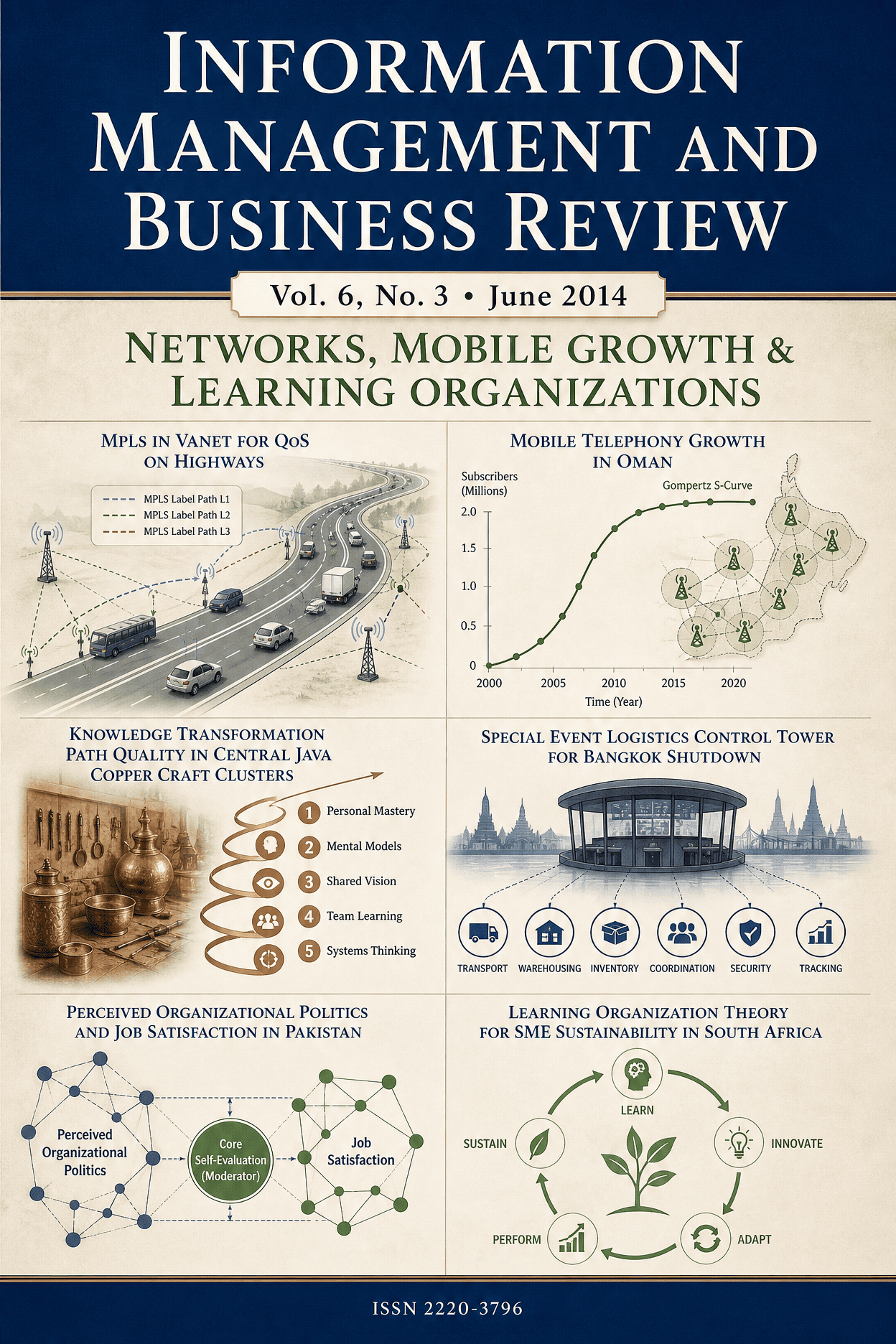
    Vehicular Ad hoc Networks (VANET) provides a wireless communication between vehicles. VANET applications play a significant role in the transportation sector such as vehicle safety, environmental efficiency, traffic control etc. Vehicular Ad hoc network is a subclass of Mobile Ad hoc networks. One of the main concerns in transportation is quality of service (QoS). In VANET, various solutions proposed for quality of services and these solutions applied on layer 2 and layer 3. In this paper, we proposed a Multiprotocol Label Switching. MPLS is an efficient and effective technique that forwards the packets across the network by using the contents of the labels attached to the IP packets. MPLS is known to be a layer 2.5 technology because it supports both data link layer or layer-2 and layer-3. The use of MPLS as backbone networks has increased over the past few years as compared to traditional IP networks, which were based on Iayer-2 technologies. MPLS is a forwarding method used for backbone network. In this paper, we improve quality of service in term of delay, packet loss and throughput in highway areas.

    Pages 115-120

    PDF - Multiprotocol Label Switching in Vehicular Ad hoc Network for QoS (opens in a new tab)
  • Article 2 in this issue

    Statistical Models for Mobile Telephony Growth in Oman

    • Author: M. I. Ahmad, M. K. Alsaadi, A. Almamri

    This study examines the growth of mobile telephony in Oman and investigates the determinants of this growth. The growth rates were estimated by fitting four statistical models namely, Logistic, Gompertz, Exponential and Autoregressive to fifteen years of data on annual numbers of mobile subscribers. The in-sample and out-of-sample forecasting performance of these models was assessed by Mean Absolute Deviation (MAD) and Mean Square Error measures. Based on this criterion it was observed that the Gompertz model outperformed the other models under consideration and gave the minimum forecast error. This model was then used to estimate the speed of diffusion which was regressed on potential factors that could affect the growth of mobile telephony. The factors considered were fixed line service, prepaid service, per capita income, consumer price index and the number of operators. All these factors were found to have significant effect on the speed of diffusion of the mobile telephony in Oman.

    Pages 121-127

    PDF - Statistical Models for Mobile Telephony Growth in Oman (opens in a new tab)
  • Article 3 in this issue

    Analysis of Quality of Knowledge Transformation Path to Learning Organization at Copper Carving Cluster in Central Java

    • Author: Widiartanto, Wiwiek Harwiki

    The purpose of this study was to determine the effect among variables of disciplinary learning organization (personal mastery, mental models, shared vision, thinking systemic, and team learning). The benefit of this research is to develop a model of knowledge transformation path quality as one of the strategies to manage environment change around Copper Craft Cluster. Samples of 90 workers were chosen by Slovin at 10% critical value of 716 populations as workers at the Copper Carving Cluster Tumang Boyolali, Central Java as a chosen research location. The technique sampling was proportional random sampling. The validity and reliability were tested. The data analysis method has been used descriptive analysis and inferential statistics (used path analysis). The benefit of this research was to develop a model of quality of knowledge transformation path as one of the strategies to manage environment’s change at the Copper Craft Cluster. The results showed that there were a positive and significant influences among variables as follow: personal mastery discipline on mental models discipline ; personal mastery discipline on shared vision discipline; personal mastery discipline on systemic thinking discipline; mental models discipline on shared vision discipline; mental models discipline on systemic thinking discipline; systemic thinking discipline on shared vision discipline; mental models discipline on team learning discipline; systemic thinking discipline on team learning discipline; and shared vision discipline on team learning discipline.

    Pages 128-134

    PDF - Analysis of Quality of Knowledge Transformation Path to Learning Organization at Copper Carving Cluster in Central Java (opens in a new tab)
  • Article 4 in this issue

    Special Event Logistics Geopolitical Event Bangkok

    • Author: Hermann Gruenwald

    Special event logistics covers a broad area from concerts, trade fairs, to public gatherings and beyond. This qualitative research is looking at special event logistics from a technical logistics management standpoint. The paper focuses on the logistics issues of the geopolitical events of the so called Shut down of Bangkok in 2014. The paper does not address the political issues surrounding the events and takes a neutral position only focusing on the technical logistics elements of the special event. Geopolitical special events are different as they involve thousands of volunteers at various levels of engagement over a more or less undetermined period of time with very fluid dynamics of the event. The emotions of the volunteers and participants are running high as it involves political and ideological viewpoints and therefore provides a high tension high pressure environment with a great level of uncertainty and risk. Supply chain risk management (SCRM) takes on a new meaning in the context of special events. Security is a major issue which goes beyond normal SCRM and business continuity planning. There needs to be access and crowd control as well as VIP and critical infrastructure protection. The logistics issues that need to be addressed include: site selection and preparation down to site dissolution, various sorts and types of assets and supplies from numerous and often daily varying sources need to be mobilized and demobilized. Infrastructure has to be provided and in some cases created including public utilities such as electricity, water, sewer, phone, fax, internet and mobile telephones, cable, wireless networks, satellite up and down links, to ATM machines which have to be brought to the site. Food and beverages (F&B) services range from drinking water to feeding thousands to special diets for vegetarians, Buddhist monks and Muslim participants. Storage on-site and off-site involves coldsupply chain (CSC) as well as perishable items and bulk items ranging from less than a truck load (LTL) to large bulk shipments. Audio visual (AV) services and multi-media needs to be covered both on a close circuit (CCTV) network for the site as well as national and international news and media coverage. There are also the demand planning and transportation issue, goods and people have to be transported to and from and in between often multiple venues which adds to the complexity.

    Pages 135-145

    PDF - Special Event Logistics Geopolitical Event Bangkok (opens in a new tab)
  • Article 5 in this issue

    Effect of Perceived Organizational Politics and Core Self Evaluation on Job Satisfaction

    • Author: Mehwish Javed, Muhammad Abrar, Inamul Haq, Milha Shabir

    Many studies explore the effect of perception of organizational politics on job satisfaction but a very few investigate for the factors that are salient to this relationship. Perceptions of politics have been considered to be a source of stress at workplace which has detrimental consequences on the desired outcomes. Current study aims to explore the effects of perception of organizational politics (POP) and core self-evaluation (CSE) on employee job satisfaction. The present research also examines core self-evaluation as a moderator in the relationship between perception of organizational politics and job satisfaction. With a sample size of 100 respondents drawn from the health sector of 3rd largest city of Pakistan, named Faisalabad, the current study tested the main effects of POP and CSE on job satisfaction by using a self-administered survey having a total of 30 items. For analyzing the data, SPSS was used. As hypothesized, results show that perceived organizational politics had a significant negative relationship with job satisfaction but the results for CSE were not significant. Furthermore, CSE moderated the relationship of POP and job satisfaction, such that the negative relationship between perception of organizational politics and job satisfaction was weaker when core self-evaluation was high.

    Pages 146-155

    PDF - Effect of Perceived Organizational Politics and Core Self Evaluation on Job Satisfaction (opens in a new tab)
  • Article 6 in this issue

    How does learning keep a small company afloat?

    • Author: Genevieve Hundermark

    Small and medium enterprises in South Africa experience one of the highest failure rates in the world with approximately 90% failing in their first ten years, suggesting that few are sustainable entities. In order to be sustainable, organisations should be learning ones. Senge’s (1990) ground-breaking model of a learning organisation, previously researched in large global companies, was used as the basis of researching a small company in South Africa. The study explored whether by being a learning organisation, the company could sustain itself. Senge’s model includes five disciplines, with embedded adult learning theories. An ethnographic case study attempted to identify whether the company drew on these learning theories in its operations, and if this contributed to its development as a learning organisation. The study revealed an interesting blend of a business management concept with adult education principles that gave insight into developing the small company as a learning organisation.

    Pages 156-167

    PDF - How does learning keep a small company afloat? (opens in a new tab)