Articles

  • Article 1 in this issue

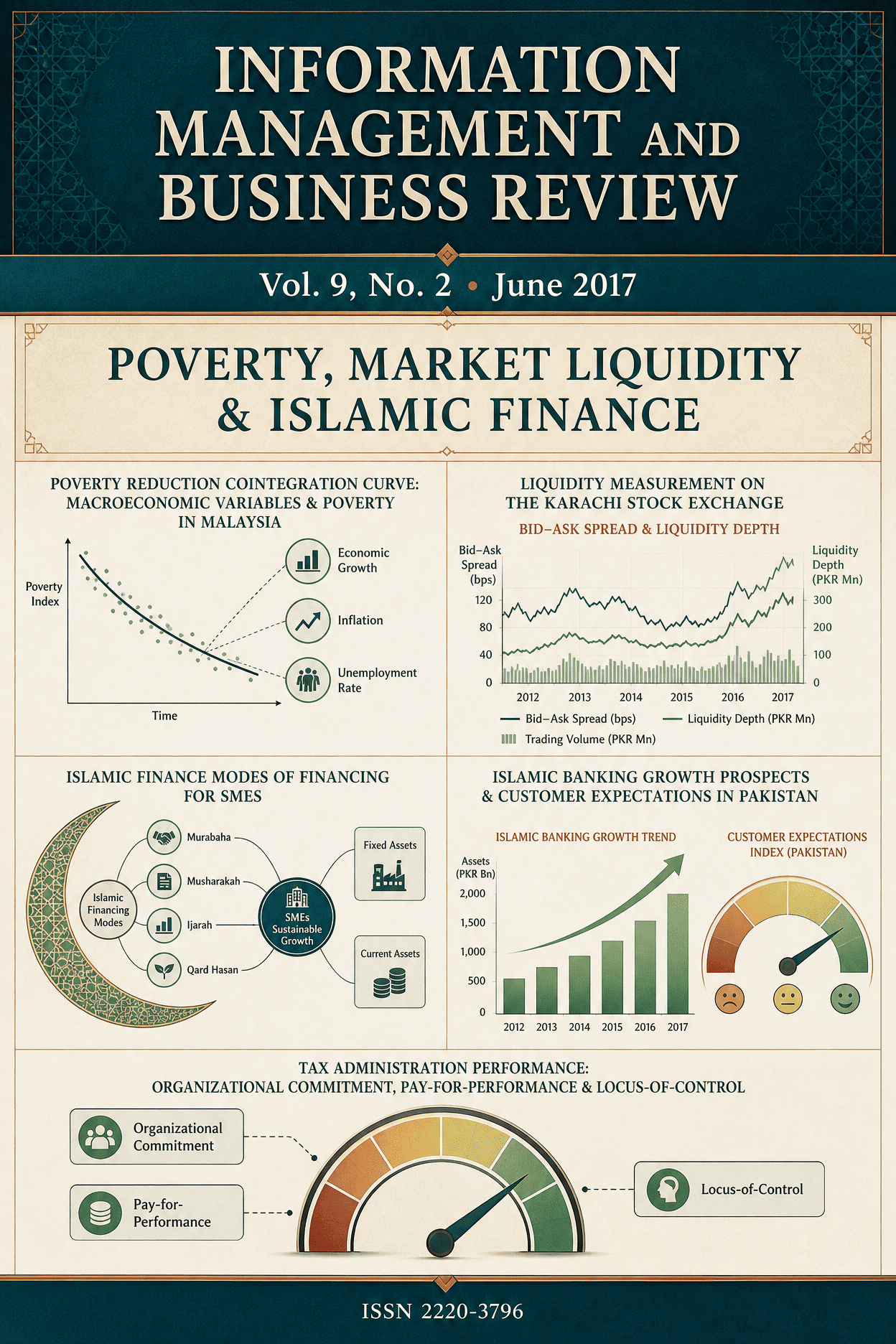
    Examining the Linkage between Poverty and Macroeconomic Variables in Malaysia: A Co-integration Analysis

    • Author: Gurmit Kaur, Siti Ayu Jalil

    The purpose of this paper is to examine the linkage between the macroeconomic variables i.e. gross domestic product per capita (GDP), unemployment (UNE), tourist receipts (TOU), consumer price index (CPI) and poverty rate (POV) in Malaysia from 1969-2014. The econometric techniques used are unit root test and the Johansen Cointegration. The Granger Causality test using Block Exogeneity Wald test was added to analyze the causal relationships between the variables. The unit root test showed that all variables were stationary at first difference and thus the Johansen Co-integration test is an appropriate technique to employ. The evidence from co-integration test indicates that all the five series have three (3) co-integrating equations and significance at 1 percent level of significance. The causality test indicated there is a significant unidirectional causality between POV on GDP, CPI on POV, POV on TOU, GDP on UNE, GDP on TOU and CPI on TOU and bidirectional causality between POV and UNE. This paper is possibly the first to discuss these relationships in Malaysian context using Co-integration analysis. The finding implies that poverty is the key issue that should be addressed to achieve a high-income country status in the year 2020.

    Pages 6-15

    PDF - Examining the Linkage between Poverty and Macroeconomic Variables in Malaysia: A Co-integration Analysis (opens in a new tab)
  • Article 2 in this issue

    Testing Microstructure Theory on Karachi Stock Exchange

    • Author: Nadeem Nazir, Hamad Raza

    We are analyzing the various measures of liquidity of Karachi Stock Exchange Market on the basis of microstructure theory. The concept of microstructure is focusing on the difference between the supply price and demand price of securities in any market. In other words, the price formation of the bid-ask spread is based on the supply and demand prices. Empirical studies conducted by different researchers have made a lot of contribution in this regards. As they concluded that bid-ask spread is constituted on the basis of different theories of liquidity. Historical background of microstructure literature shows that bid–ask spread constitutes the fundamental measure of the liquidity in any market. As a result of this it contributes to identify the best structure of stock market. There may be other admitted measures of liquidity. In the opinion of different researchers the internationally accepted measures of liquidity formation in any market include the Lambda, Turnover of the concerned security, Depth of that market, The Cost of Trip, Trade of security, etc. And they work as strong indicators of liquidity. Our study is a contribution to the literature as we try to explore those correlated variables that can be significantly and sequentially change. And they are serving a measure of the individual’s securities that are already traded in Karachi Stock Exchange Market. These admitted variables of our study are trading volumes of securities, number of transactions in the market, security return, volatility of securities prices, arrival of new information etc. we take a sample of 350 quoted securities in Karachi Stock Exchange Market, from 1990-2015. As far as result is concerned, depth showed a negative correlation with all spread measures in the Karachi Stock Exchange Market. But at the same time, perfect positive correlations are shown between spread measures in the analysis. It is a perfect proof of existence and validity of these liquidity measures in KSE. The results is evidencing that the arrival of new information, return on investment, volume of traded securities; are contributing a lot to explain significantly the sequential changes in KSE. At the same time various measures of the securities regarding liquidity are proving and confirming the previous researcher’s claim. In the end, analysts are in a better position to explain that the arrival of new information from different sources and different groups is functioning as a principal aspect for the variant contributories of liquidness of the Karachi Stock Exchange.

    Pages 16-24

    PDF - Testing Microstructure Theory on Karachi Stock Exchange (opens in a new tab)
  • Article 3 in this issue

    Impact of Financing on Small and Medium Enterprises (SMEs) Profitability with Moderating Role of Islamic Finance

    • Author: Saqib Muneer, Azhar Ali, Rao Abrar Ahmad

    Small and medium enterprises (SMEs) are the very significant for the development of economy of the country, grasp the attention of government and policy makers in developed as well as in developing countries. SMEs in Pakistan have their vital role in economic growth. Therefore, it is essential that SMEs have right to use sources of finance. The study used the quantitative approach that was accomplished by survey questionnaires. Two hundred SMEs and seventy bank branches were selected in Faisalabad region in Pakistan, to get response on questionnaires about their financing patterns and effects of Islamic financing as moderator in their fixed assets, set up and current assets financing. The study showed that fixed assets, set up and current asset financing have positive relation with the growth of SMEs and Islamic modes of financing was not behaved as moderator in Faisalabad city in Pakistan.

    Pages 25-32

    PDF - Impact of Financing on Small and Medium Enterprises (SMEs) Profitability with Moderating Role of Islamic Finance (opens in a new tab)
  • Article 4 in this issue

    Growth Prospects and Customer Expectations in Islamic Banking

    • Author: Saqib Muneer, Muhammad Shahid Tufail, Ahsan Zubair

    Islamic Banking has gained enormous popularity in Pakistan in a short span of time and still has a huge potential to grow in the market. Many Conventional Banks having Islamic Banking windows and a few fullfledged Islamic banks are striving hard to remain alive in the stiff competition for market share, resulting in more banking choices for the customers. Still there is lot to be achieved and the whole banking system has to get rid of the curse in the form of Riba, which has strongly been denounced and prohibited in the Holy Quran. Islamic Banks at the moment hold merely 9.4% of the whole banking Market which is far below than desired. In this study, an attempt will be made to analyze the growth trends in the Islamic banking and its implications for the society and the economy in particular. Customers’ perceptions & expectations and certain myths regarding Islamic banking will also be captured during the study. This will not only help us in understanding the potential and opportunities available in the industry but also give an idea that what the customers want and expect from Islamic banking. Moreover, the study will also add to the latest pool of knowledge on the subject. There seems a dearth of updated quality research on the matter and this will serve as an important reference and latest work on Islamic Banking in Pakistan.

    Pages 33-41

    PDF - Growth Prospects and Customer Expectations in Islamic Banking (opens in a new tab)
  • Article 5 in this issue

    Locus of Control as a Moderator of the Effects of Organizational Commitment and Pay-forPerformance on Performance of Tax Officers

    • Author: Agus Bandang, Asri Usman, Made Gde Satria Bela

    This study aims to determine the effect of organizational commitment and pay-for-performance on performance of tax officers with locus of control as moderating variable. This research is a quantitative descriptive study. Data on this research was obtained through questionaires. Population of this study consists of 104 tax officer of South Makassar Small Taxpayers Office of which is randomly chosen 83 tax officers as a sample to answer research questionnaires. Analysis of this study is using regression analysis with residual analysis method to test the effect of moderating variable. The results of this research indicate that (1) organizational commitment has a positive effect on performance of tax officers, (2) locus of control is able to moderate the effect of organizational commitment on performance of tax officers, (3) pay-for-performance has a positive effect on performance of tax officers, and (4)) locus of control is able to moderate the effect of pay-for-performance on performance of tax officers.

    Pages 42-55

    PDF - Locus of Control as a Moderator of the Effects of Organizational Commitment and Pay-forPerformance on Performance of Tax Officers (opens in a new tab)