Articles

  • Article 1 in this issue

    The Impact of Structural Changes in the Indian Manufacturing Industries: 1980-2013

    • Author: Gholamreza Fathipour, Pratibha S. Gaikwad

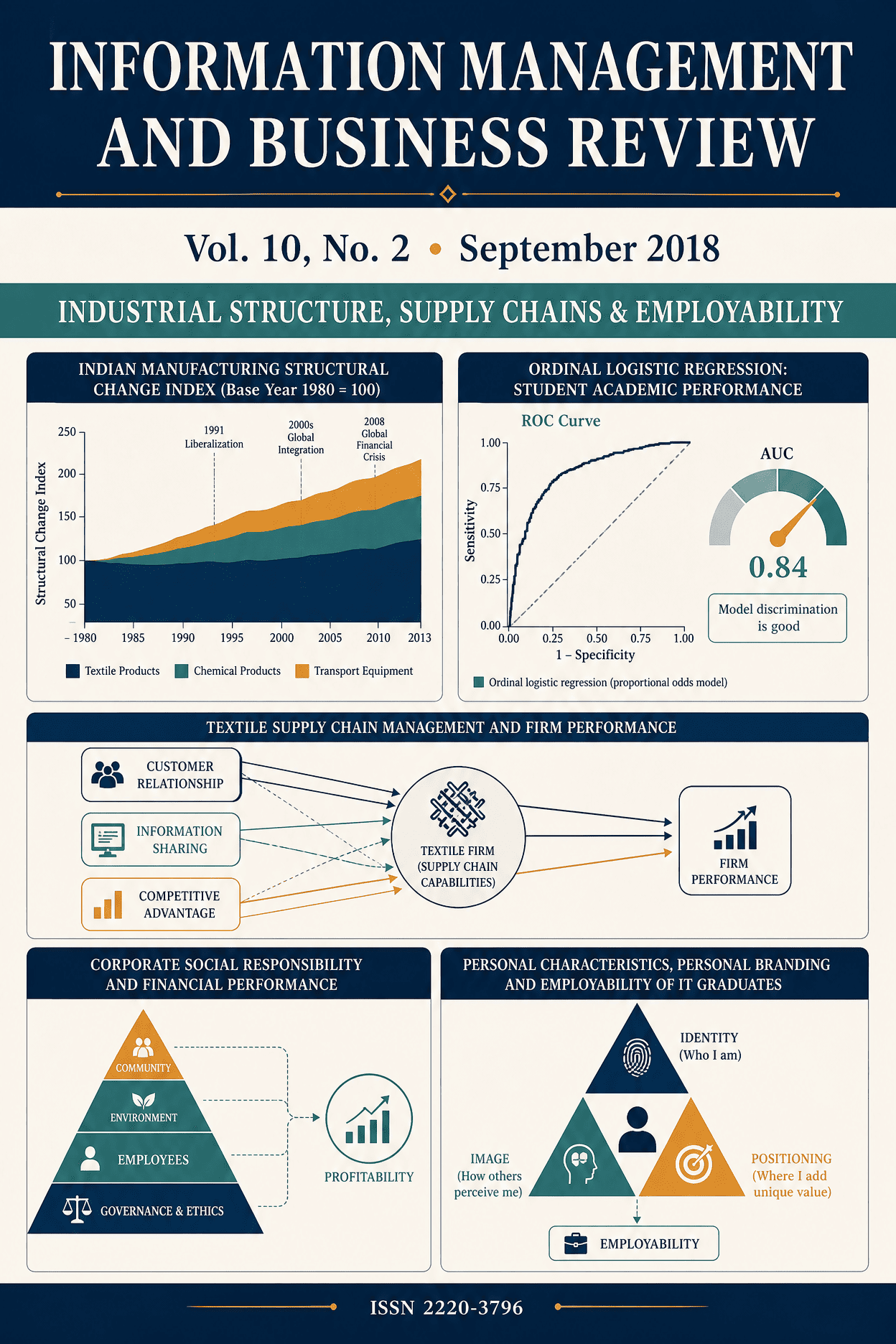
    With regard to the importance of the manufacturing, industrial sector for economic growth and its priority for motivating other sectors to development, the paper is aimed to study the structural changes condition in the Indian manufacturing industries. The changing in value-added of industrial activities due to industrial and economic policies is an important indicator for the recognition of manufacturing industries structure. We have analyzed the industrial structure and competitiveness of each industrial activity by using data value-added of manufacturing industries and common indexes such as the structural changes index in the period of 1980-2013. The results of structural index analysis showed that of textile products; leather; basic chemicals and chemical products in the periods of 1980-98 and also in the periods after 2000industries wearing apparel; dressing and dyeing of fur tanning and dressing of leather ; wood and products of wood; motor vehicles, trailers and semi-trailers; recycling; other transport equipment have been the industrial activities that their structural changes indexes has been positive and they have had the highest competitiveness in comparison to other industrial activities and the greatest opportunities to create value-added.

    Pages 6-16

    PDF - The Impact of Structural Changes in the Indian Manufacturing Industries: 1980-2013 (opens in a new tab)
  • Article 2 in this issue

    Ordinal Logistic Regression for Students Academic Performance in Kurdistan Region of Iraq

    • Author: Nozad H. Mahmood, Sherko H. Murad, Karwan Kakabra Kakamad

    The First Attempt Exam is the first final exam for students after their first academic year to show their academic performance. According to the outcomes of our project, some factors influence students’ academic performance. These factors include (Sex, Car Ownership, Relationships, Smoking, Hours of Study, Facebook Use, Father Alive, Mother-Edu, and Father-Edu). These factors have a high effect on the results of the First Attempts Exam. Furthermore, females are more likely to pass the first attempts exam than the males. Also, students with cars, relationships, who smoking, use Facebook regularly, and whose mothers have higherlevels of education are negatively affected by the student’s academic performance. On the other hand, mother alive, higher level education of father, and increasing one-hour daily study are positively affected on the students’ academic performance.

    Pages 17-22

    PDF - Ordinal Logistic Regression for Students Academic Performance in Kurdistan Region of Iraq (opens in a new tab)
  • Article 3 in this issue

    Uncovering the Relationship of Supply Chain Management and Firm Performance: Evidence from Textile Sector of Pakistan

    • Author: Zahid Hussain, Dr. Ahmad Bin Jusoh, Muhammad Sarfraz, Khalil Ur Rehman Wahla

    The purpose of this research paper was to find the impact of the supply chain on firm performance in Textile firm of Pakistan. Data was collected through questioners in the month of March 2018, Approximately 30 questioners were distributed among the managers of the ten textile organizations in Faisalabad which are expected to have the best knowledge about the supply chain operations and its impact on the performance of the organization, all of them responded positively. It is found that dimensions associated with SCM methods as well as explain the connection amongst SCM methods, aggressive benefit, as well as firm performance. The actual study focuses on the causal associations in between SCM exercise, aggressive benefit as well as firm performance as well as ignores the actual feasible recursive associations.

    Pages 23-29

    PDF - Uncovering the Relationship of Supply Chain Management and Firm Performance: Evidence from Textile Sector of Pakistan (opens in a new tab)
  • Article 4 in this issue

    The Impact of Corporate Social Responsibility on Firm’s Financial Performance

    • Author: Tanvir Ahmed, Babar Zaheer Butt, Waleed Khalid

    Corporate Social Responsibility (CSR) is now an integral part of business model of most of the modern organizations. Companies are making efforts to play their role in improving society in one or other ways. The scope of efforts ranges from donating money to nonprofit organizations to employing environmental-friendly policies in their workplace. As per the general global perception the corporate sector of Pakistan has been lacking behind in respect of CSR implementation. It has largely concentrated on profit minting rather than taking care of the welfare aspects of employees and other stakeholders. This attitude has affected the business and as a result industry has failed to keep pace with the modern industry. The objective of this study is to analyze the impact of CSR on firm’s financial performance. The research therefore predicates that increase in CSR activities of poor CSR firms shall have a negative effect on the company’s financial performance. Whereas, Middle CSR firms having a positive relationship with Excess Value (EV) will enhance the project performance, financial stature and future prospect of the firms. However, the firms with the best CSR will always have a positive relationship with the firm’s financial performance but its impact will not be observed significantly on the firm’s financial condition.

    Pages 30-37

    PDF - The Impact of Corporate Social Responsibility on Firm’s Financial Performance (opens in a new tab)
  • Article 5 in this issue

    The Impact of Personal Characteristics on Personal Branding in Reflection to the Employability

    • Author: Prassanna Pathmanathan, Nadeeja Dodamgoda

    Unemployment is a major problem Sri Lanka is facing over the years. Although 22,000 graduates pass out every year from state and private universities, there is always a gap between what employers expect in a graduate and what the graduate could offer to the employer. This research focus on the employability of the IT graduates passing out from state and private universities, with specific reference to their personal characteristics and personal branding. Personal branding is a major concern with respect to the recruitment of any graduate. IT graduates especially are expected to have certain personal characteristics which determine their personal branding and influence their employability. The main objective of this research is to determine the impact of the personal characteristics such as personal identity, personal image and personal positioning on employability of IT graduates and to analyze their mediation effect with the personal branding. Further, an attempt is made to determine whether the personal branding and employability of IT graduates significantly differ based on the university type (state and private). The research mainly focuses on quantitative analysis by piloting a questionnaire to 300 IT graduates following a hypothetical deductive method. The findings through the quantitative data are followed up based on qualitative data collected through semi-structured interviews with HR and Recruitment Managers of IT companies. Findings of this research revealed that personal characteristics have a strong impact on the employability of an IT graduate and this relationship is mediated by personal branding. Further, IT graduates passing out from private sector universities have stronger personal characteristics and personal branding compared to the graduates passing out from state sector universities. Thus, they are more employable compared to IT graduates passing out from state sector universities in Sri Lanka.

    Pages 38-50

    PDF - The Impact of Personal Characteristics on Personal Branding in Reflection to the Employability (opens in a new tab)