Articles

  • Article 1 in this issue

    Infollution (Information Pollution) Management, Filtering Strategy, Scalable Workforce, and Organizational Learning: A Conceptual Study

    • Author: Qaisar Iqbal, Shaohua Yang, Rashid Nawaz, Yifeng Lin

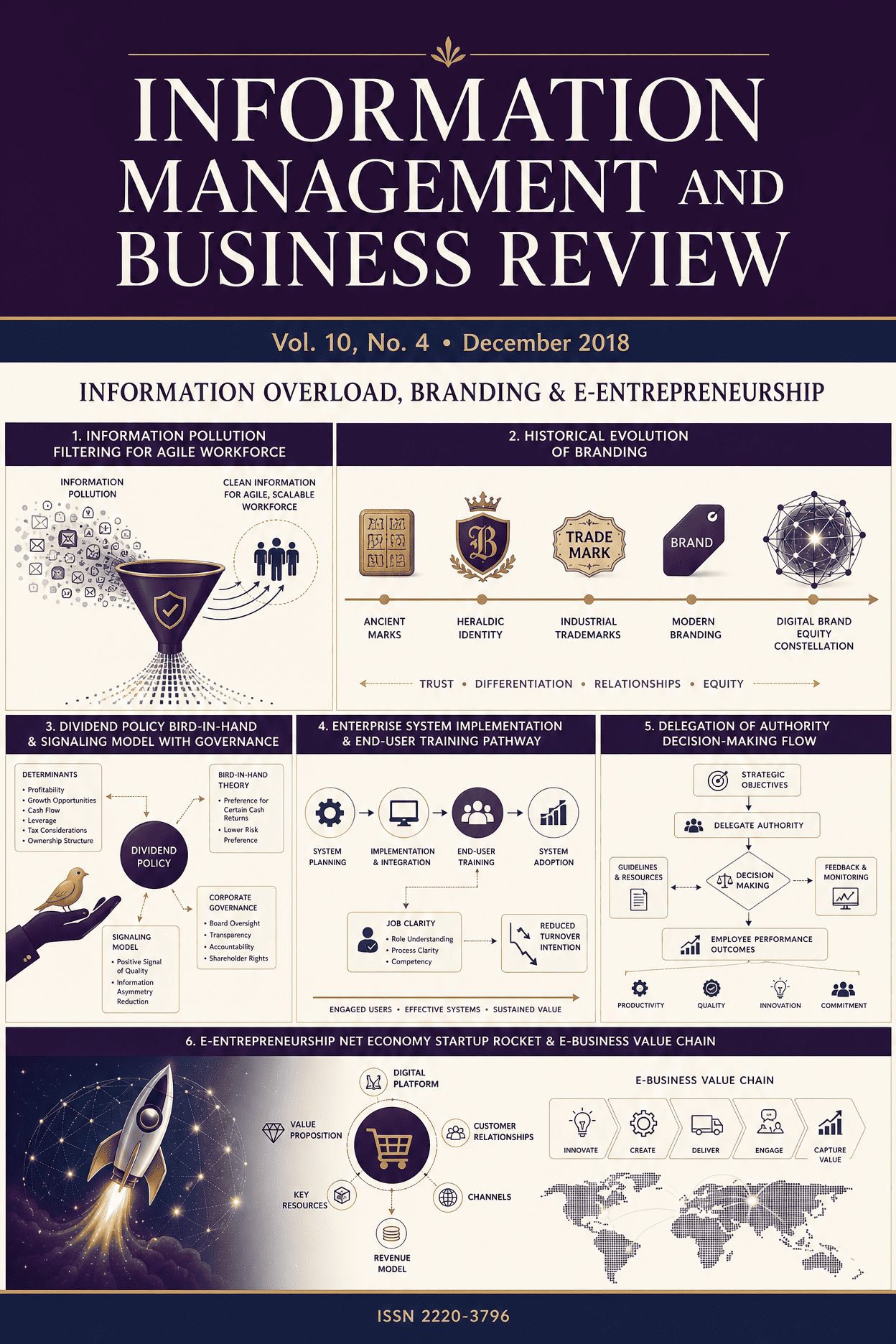
    Information generation is increasing rapidly on a global scale. The exponential advancement in information technology and communication has accentuated the problem of effective information management. Yet, employees’ cognitive ability to process information has not increased in parallel with information generation. With the exponential rise of information, information pollution (infollution) emerges as a problem on an exponential basis. Infollution is among the greatest challenges of the 21st century. Nevertheless, based on information processing theory and dynamic capability, researchers have conceptualised that agile organisations can cope with information pollution by promoting scalable workforce and organisational learning. By employing coping strategies, filtering has been hypothesised as moderating the association of scalable workplace and organisational learning with infollution management. This research will extend the literature in the domain of information management and agile organisations. It will be particularly useful for information processors to identify quality information for improved decision-making.

    Pages 1-7

    PDF - Infollution (Information Pollution) Management, Filtering Strategy, Scalable Workforce, and Organizational Learning: A Conceptual Study (opens in a new tab)
  • Article 2 in this issue

    What is Brand? Some Insights in the Historical Development

    • Author: Fazal Ur Rehman, Rosman Bin Md Yusoff, Fadillah Binti Ismail, Farwida Javed

    The aim of this study is to enhance understanding in the philosophy of the brand along with its historical development around the world. Its main purpose is to clarify the nature of the brand, its origination, ancient phase, digital phase and the future of branding. This study is based on the secondary source to clarify the gap of knowledge, understand the thought of branding and review the literature in regard to its historical development and evaluation around the world. It has found that brand is a tangible and non-tangible asset of a business that presents a unique identity and reputation among a wide set of competitors, and is perceived as a market leader in a particular industry. The study has found that branding is the best practice to enhance the image and value of business among targeted consumers. It has anticipated that branding is the technique to gain competitive advantage and accomplish the objectives of a business. This study presents a comprehensive overview of the nature of branding along with its wide historical development (origin, ancient phase, digital phase, future phase) around the world.

    Pages 8-13

    PDF - What is Brand? Some Insights in the Historical Development (opens in a new tab)
  • Article 3 in this issue

    Analysis of the Interaction between Dividend Policy and Firm Performance in Manufacturing Sector

    • Author: Shankar Kumar Singh Jha, Usama Aziz

    The purpose of this study is to investigate internal determinant factors of dividend policy in manufacturing firms. The study considers the impact of dividend payout ratio, signalling, earnings per share and risk on firm performance. This research also tries to create a link between dividend policy and firm performance. In the same way, the research is also aimed to create a link between these factors. Such as, the current link between the dividend policy and firm performance. It will elaborate this through current and previous studies as a whole. This study used primary data from the listed manufacturing firms in order to check the effects of dividend policy on firm performance. Data was collected from the primary source. The survey questionnaire was used to collect data from top management in order to highlight the impact of dividend policy on firm performance. Multi-regression analyses were undertaken to identify attributes that influence dividend policy. The results of the study demonstrate that all the variables are significant thus they have a positive impact on firm performance. The study established the findings that dividend payout, earning per share, signalling and risk positively and significantly influence the firm’s value. Moreover, companies should consider dividend policy in order to make the financial decision more efficiently. This study tells us that decisions about dividend policy should be made by considering other variables. The study has both practical and theoretical implication for top management in order to consider the dividend policy and its impact on firm performance.

    Pages 14-21

    PDF - Analysis of the Interaction between Dividend Policy and Firm Performance in Manufacturing Sector (opens in a new tab)
  • Article 4 in this issue

    Influencing the Relationship between Job Clarity and Turnover Intention through User Training During Enterprise System Implementation

    • Author: Rick L. Brattin, Joshua M. Davis, Sheryl Brahnam

    Enterprise system (ES) implementations introduce pervasive and disruptive change to organizations. End-users struggling to cope with such change often develop an internal self-preservation narrative that, if not managed, can lead to employee turnover. Turnover is a visibly-assertive response to ES implementations that has lasting negative effects on organizations. The job role literature suggests that an individual’s intention to leave an organization is greater when they lack clarity concerning their own work tasks and their role in achieving broader organizational goals. These clarity perceptions evolve during ES implementations as individuals become aware that their existing job context is no longer relevant to the postimplementation organization. It seems likely that the strength of relationship between job clarity and turnover intention will also evolve during this time. Accordingly, this study uses PLS-SEM multi-group analysis to examine changes in this relationship during an ES implementation at a Fortune 100 manufacturer and finds a significant increase in the influence of job clarity deficiencies on turnover intention following enduser training. These results suggest that ES implementation teams should focus their efforts on building job clarity of the post-implementation work context.

    Pages 22-37

    PDF - Influencing the Relationship between Job Clarity and Turnover Intention through User Training During Enterprise System Implementation (opens in a new tab)
  • Article 5 in this issue

    The Mediating Role of Employee Performance on the Relationship between Delegation of Authority and Decision Making

    • Author: Adnan Alhosani, Rosman Md Yusoff, Fadillah Ismail, Fazal ur Rehman

    The aim of this study is to enhance understanding in the animated extent of delegation authority and its role in decision making. Precisely, the prime objective of this study is to visualize the concept and propose the effects of delegation authority on decision making along with the mediating role of employees’ performance in the Police department at Dubai. Based on an inclusive and systematic literature review of delegation authority, decision making, and employee’s performance, this study will collect data through self-administered questionnaires based survey in a quantitative manner. The collected data will be analyzed through smart partial least square structure equation modelling for validating the model, testing hypothesis, and finding results. This study will highlight some new insights into the relevant knowledge area. Specifically, the results will contribute to enhance the motivational synergy of upper management to include the employees in decision-making process to improve their performance. This study is only limited to the police department of Dubai and future studies can examine the relationship between defined constructs in other service sector and the moderating role of employees’ performance. By integrating delegation authority, decision making, and employee’s performance literature, the prime contributions of this study are the analysis of defined variables in the police department of Dubai with emphasize on new challenges and to boost up the gap of relevant literature.

    Pages 38-43

    PDF - The Mediating Role of Employee Performance on the Relationship between Delegation of Authority and Decision Making (opens in a new tab)
  • Article 6 in this issue

    E-Entrepreneurship for E-Startups: Potentials, Common Challenges and Way Forward

    • Author: Mohammad Aminul Islam, Mohammed A Alghobiri

    In today’s economic world, the advancement in technology has opened up new forms of economic activities, particularly business. Whilst entrepreneurship is a major factor in business, e-entrepreneurship has become a buzzword facilitated by the rapid advancement of internet and developments in Information and Communication Technologies (ICTs). E-entrepreneurship, in the name of transforming business from the local marketplace to the global one, has revolutionized the entire business processes. This set of new business mechanism has created new opportunities for the startups, which in this regard is termed as e-startups. The purpose of this paper, therefore, is to develop a comprehensive understanding of the concept of eentrepreneurship by addressing related potentials and challenges. Extant literature has been reviewed to this end. The analysis indicated that flexibility of and accessibility to technology and products, less capital and risk in comparison to physical businesses are the major advantages that an e-entrepreneur might enjoy while commencing an e-startup. On the other hand, lack of institutional support, digital security threat, tough competition with established brands, less innovation and lack of academic and practical exposure in terms of business and marketing are some barriers that challenge the operation of e-startups. The conclusion of the paper draws on some recommendations accordingly.

    Pages 44-50

    PDF - E-Entrepreneurship for E-Startups: Potentials, Common Challenges and Way Forward (opens in a new tab)