Abstract
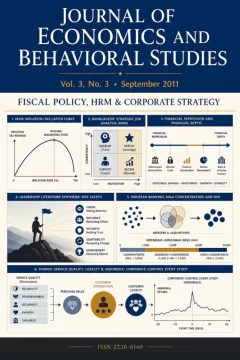
The purpose of this paper is examining the Laffer curve for inflation tax. To do so we have used Hansen (1996, 2000), threshold regression model to study whether a non-linear relationship between inflation Tax and inflation based on two regimes of inflation (low and high inflation regimes). Our findings support a standard Laffer curve shape in Iran with a threshold inflation rate of 15.24 percentage points. In other words, only at inflation below this rate inflation tax will increase as a result of higher inflation.
Keywords
References
- Bailey, M. J. (1956). The Welfare Cost of Inflationary Finance. Journal of Political Economy, 64, 93-110.
- Barro, R. J. (1972). A Theory of Monopolistic Price Adjustment. Review of Economic Studies , 39, 17-26.
- Barro, R. J. (1983). Inflationary Finance under Discretion and Rules. Canadian Journal of Economics , 16(1), 1 16.
- Berle, A. A. & Means, G. C. (1932). The Modern Corporation and Private Property (New York: Macmillan).
- Bruno, M. & Fischer, S. (1990). Seignorage, Operating Rules and the High Inflation Trap. Quarterly Journal of Economics , 105(421), 353-374.
- Cagan, P. (1956). Monetary dynamics in hyperinflation. In: M. Friedman, ed. Studies in the quantity theory of money. Chicago: University of Chicago, 25-117.
- Ehrhart H., Minea, A. & Villieu, P. (2009). Deficit, Seigniorage and the Growth Laffer Curve in Developing countries Paper provided by CERDI in its series Working Papers with number 200926.
- Fischer, S. F. (1983) In: P. Aspe, R. Dornbusch and M. Obstfeld, Editors, Seigniorage and Fixed Exchange Rates: An Optimal Inflation Tax Analysis in Financial Policies and the World Capital Market, University of Chicago Press, Chicago, IL.
- Friedman, M. (1971). Government Revenue from Inflation. Journal of Political Economy , 79(4), 846-56.
- Friedman, M. (1953). Discussion of the Inflationary Gap: Essays in Positive Economics (University of Chicago Press.
- Combes, J. L. P., Combes-Motel, A. M. & Villieu, P. (2010). Disinflation against the Environment? An application to the trade-off between seigniorage and deforestation, CERDI, Etudes et Documents, E 2010.14.
- Hansen, B. E. (1996). Inference When a Nuisance Parameter Is Not Identified under the Null Hypothesis. Econometrica , 64 (2), 413–30.
- Hansen, B. E. (2000). Sample Splitting and Threshold Estimation. Econometrica, 68(3), 575–603.
- Jafari-samimi, A. (1994). Relationship between Inflation and Seigniorage in Developing Countries an Estimation of the 'Laffer curve. Discussion papers in economics / University of Reading, Dept. of Economics - VI (1993/94), 282,
- Jafari-samimi, A. (1997-98). Relatioship between inflation and Seigniorage I developing countries: an estimation of laffer curve. Tthe Indian Economic Journal , 45(1), July-September.
- Johnson, H. G. (1969). A Note on Seigniorage and the Social Saving from Substituting Credit for Commodity Money:’ in Robert A. Mundell and Alexander K. Swoboda, eds., Monetary Problems of the International Economy (University of Chicago Press).
- Korap, L. (2006). An Empirical Analysis of Turkish Inflation (1988-2004): some non-monetarist estimations. MPRA Paper 19630, University Library of Munich, Germany.
- Melnick, R. & Sokoler, M. (1984). The Government's Revenue Creation and the Inflationary Effect of a Decline in the Rate of Growth of GNP. Journal of Monetary Economics , 13, 225-236.
- Phelps, E. (1973). Inflation in a Theory of Public Finance. Swedish Journal of Economics, 75, 67–82.
- Tahsin, S. S. (2003). Optimal Seigniorage in Developing Countries: an Empirical Investigation CERDI, Etudes et Documents.
Downloads
No downloads have been recorded for this article yet. Figures appear here once readers begin downloading the full text.
How to Cite
Share this article
License
Author (s) should affirm that the material has not been published previously. It has not been submitted and it is not under consideration by any other journal. At the same time author (s) need to execute a publication permission agreement to assume the responsibility of the submitted content and any omissions and errors therein. After submission of revised paper in the light of suggestions of the reviewers, the editorial team edits and formats manuscripts to bring uniformity and standardization in published material.
This work will be licensed under Creative Commons Attribution 4.0 International (CC BY 4.0) and under condition of the license, users are free to read, copy, remix, transform, redistribute, download, print, search or link to the full texts of articles and even build upon their work as long as they credit the author for the original work. Moreover, as per journal policy author (s) hold and retain copyrights without any restrictions.
Keywords
Section
Published
Submissions
Have research to publish? Journal of Economics and Behavioral Studies welcomes submissions.
Make a Submission