Current Issue

View All Articles

Vol. 18 No. 2(J) (2026)

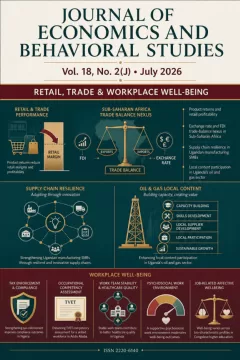
Retail, Trade & Workplace Well-Being

This issue links retail analytics, external-sector economics and workplace well-being across African contexts. Contributions include a transaction-level framework for product returns and retail profitability; GMM analyses of the exchange-rate–trade balance and FDI–trade balance nexus in Sub-Saharan Africa; environmental uncertainty, supply chain innovativeness and resilience among Ugandan manufacturing SMEs; determinants of local content participation in Uganda's oil and gas sector; tax enforcement and compliance in Southwestern Nigeria; occupational competency assessment and TVET-industry partnership in Addis Ababa; work team stability and healthcare quality in Ugandan Health Centre IVs; the moderating role of health centre characteristics on psychosocial work environment and healthcare quality; and bio-characteristic determinants of job-related affective well-being in Congolese higher education.

2026-07-07 10 Articles 10.22610/jebs.v18i2(J) (opens in a new tab)
  • Article 1 in this issue

    Do Product Returns Distort Retail Profitability? Evidence from Transaction Data
    • Author: José Manana Esono Mbasogo

    This study examines how product returns affect retail profitability using transaction-level data. While returns are often treated as a routine operational issue, their financial implications are not always fully captured in standard performance metrics. The analysis introduces a return-adjusted profitability framework and applies it to a multi-year retail dataset, allowing for a detailed examination of how returns influence margins across transactions and product categories. The results show that returns are generally associated with lower profitability, although the magnitude of the effect varies depending on product characteristics and over time. The study contributes to the literature by providing a practical and replicable approach to incorporating returns into profitability measurement at a granular level. It also highlights how conventional performance indicators may overestimate economic performance when transaction reversals are not explicitly considered. These findings are particularly relevant for retail environments where analytical systems are still developing and where reliance on aggregated indicators may limit the accuracy of decision-making.

    Pages 1-15

    PDF - Do Product Returns Distort Retail Profitability? Evidence from Transaction Data (opens in a new tab)
  • Article 2 in this issue

    Foreign Exchange Rate-Trade Balance Nexus in Sub-Saharan Africa

    • Author: Patrick Kagambo John Nahabwe, Willy Rwamparagi Kagarura, Benjamin Musiita

    We examine the nexus between foreign exchange rate (FER) and trade balance in Sub-Saharan Africa (SSA). We utilize balanced annual panel data for 20 SSA countries spanning 2005–2024, sourced from the World Bank. To address endogeneity, unobserved country-specific effects, and dynamic panel bias, we apply the Generalized Method of Moments (GMM) estimator. Results reveal significant persistence in trade balance, with the lagged coefficient (0.215576) indicating that about 21.6% of past trade balance conditions persist into the current period, reflecting partial adjustment and structural inertia. Crucially, FER exhibits a negative and statistically significant effect (−0.899849), implying that a 10% depreciation leads to an approximate 9% deterioration in the trade balance, ceteris paribus. This contradicts the Marshall–Lerner condition and underscores the dominance of import dependence, weak export diversification, and structural rigidities in SSA economies. We conclude that currency depreciation is counterproductive to external balance in SSA. We therefore advocate for strong and stable currencies, alongside policies promoting export diversification, domestic production, and structural transformation to achieve sustainable trade balance outcomes.

    Pages 16-28

    PDF - Foreign Exchange Rate-Trade Balance Nexus in Sub-Saharan Africa (opens in a new tab)
  • Article 3 in this issue

    Foreign Direct Investment – Trade Balance Nexus in Sub-Saharan Africa

    • Author: Patrick Kagambo John Nahabwe, Willy Rwamparagi Kagarura, Benjamin Musiita

    We investigate the nexus between foreign direct investment (FDI) and trade balance in Sub-Saharan Africa (SSA). We employ balanced annual panel data for 20 SSA countries spanning the period 2005–2024, sourced from the World Development Bank. To address potential endogeneity, unobserved heterogeneity, and dynamic panel bias, we utilize the Generalized Method of Moments (GMM) estimator. Empirical results reveal that both lagged trade balance and FDI exert a positive and statistically significant influence on the current trade balance. The coefficient of the lagged trade balance (0.2617) indicates partial adjustment dynamics, suggesting that approximately 26.2% of past trade balance conditions persist into the current period. Furthermore, the FDI coefficient (0.1035) implies that a 10% increase in FDI inflows leads to an estimated 1.03% improvement in the trade balance, ceteris paribus. The findings underscore the critical role of FDI in strengthening external sector performance in SSA by enhancing export capacity, improving productive efficiency, and alleviating foreign exchange constraints. We conclude that FDI is a significant driver of trade balance sustainability in the region. We recommend policies aimed at attracting export-oriented FDI, enhancing domestic absorptive capacity through strategic investments in human capital and infrastructure, and implementing complementary trade and industrial policies to maximize FDI spillovers.

    Pages 29-41

    PDF - Foreign Direct Investment – Trade Balance Nexus in Sub-Saharan Africa (opens in a new tab)
  • Article 4 in this issue

    Environmental Uncertainty and Supply Chain Resilience among Manufacturing Firms in Uganda: The Mediating Role of Supply Chain Innovativeness

    • Author: Wilbroad Aryatwijuka, Henry Mutebi, Ronald Twongyirwe, Naster Tumebembeire, Miriam Tugiramasiko, Atwine Aquilionus, Hassan Musoke

    This study examines the relationships between environmental uncertainty (EU), supply chain innovativeness (SCI), and supply chain resilience (SCRE) among manufacturing small and medium-sized enterprises (SMEs) in Uganda. Specifically, it investigates the mediating role of supply chain innovativeness in the relationship between environmental uncertainty and supply chain resilience. A cross-sectional quantitative survey was conducted using structured questionnaires administered to 400 manufacturing SMEs located in Kampala, Wakiso, Mukono, and Jinja districts. The data were analyzed using Partial Least Squares Structural Equation Modelling (PLS-SEM) with SmartPLS 4. The results reveal that environmental uncertainty positively influences both supply chain resilience and supply chain innovativeness. Supply chain innovativeness also exerts a significant positive effect on supply chain resilience and partially mediates the relationship between environmental uncertainty and supply chain resilience. These findings suggest that manufacturing SMEs enhance resilience by developing innovative capabilities that enable them to anticipate, adapt to, and recover from environmental disruptions. The cross-sectional design limits causal inference and the ability to capture resilience development over time. Future studies should employ longitudinal or mixed-methods approaches to examine the dynamic processes through which firms build resilience under environmental uncertainty. Manufacturing SMEs should strengthen innovation capabilities by investing in flexible production systems, digital technologies, collaborative relationships, and continuous product and process innovation to improve resilience against supply chain disruptions. This study contributes to the supply chain resilience literature by integrating Resource-Based Theory and Dynamic Capability Theory to explain how supply chain innovativeness transforms environmental uncertainty into resilience.

    Pages 42-62

    PDF - Environmental Uncertainty and Supply Chain Resilience among Manufacturing Firms in Uganda: The Mediating Role of Supply Chain Innovativeness (opens in a new tab)