Abstract
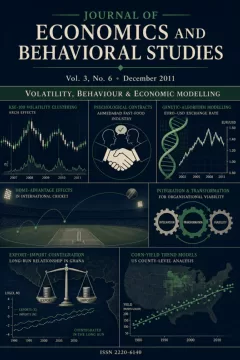
Playing at home ground gives advantage to the home side always, though the strength of the teams also plays a major role in the eventual outcome of a given match. It is observed that India is remarkable when it plays at home; however, it becomes quite an ordinary side when it plays at opponents’ home ground. Meanwhile, Australia, which has been the most consistent team for several decades played well both at home and away. After studying the 50-years data of home and away matches for all major cricket playing teams via split technique, it was found that the teams won their matches more, when they play at their home grounds, while playing at opponent’s home-ground may snatch away the victory from them.
Keywords
References
- Abbas, Z. (2010). I was born in the wrong era. Retrieved July 24, 2011 from http://www.jang.com.pk/thenews/oct2010-weekly/nos-07-11-2010/spo.htm.
- Bruce, M. & Dennis, T. (2005). An Investigation of Home Advantage and other factors affecting outcomes in English One Day Cricket Matches. Journal of Sports Sciences , 23(3), 261-268.
- Courneya, K. & Carron, A. V. (1992). The Home Advantage in Sports competition. Journal of Sport & Exercise Psychology (JESP) , 14 (I),13-27.
- Schwartz, B. & Barsky, S. F. (1977). The Home Advantage. Social Forces , 55, 641-661.
- Smith, D. R., Ciacciarelli, Serzan & Lambert. C. (2002). The Home Advantage Revisited: Winning and Crowd Support in an era of National Publics. Sociology of Sports Journal (SSJ) , 17(4), 364-385.
- Miandad, J. (2010). Ships of Fools, Cricket: The ins, outs, and overs. Retrieved June 9, 2011 from http://forum.ship-of-fools.com/cgi bin/ultimatebb.cgi?ubb=printopic;f=28;t=001297. Neville, A., Balmer, N. J. & William, A. M. (2002). The Influence of Crow Noise and Influence upon Referring Decision in Football. Psychology of Sport and Exercise , 3, 261-272.
- Pollard, R. (1986). Home Advantage in Soccer: A Retrospective Analysis. Journal of Sports Sciences (JSS) , 4, 237-24.
- Qasim, I. (2006). Qasim terms Pak favorite. Retrieved June 12, 2011 from http://www.paktribune.com/sports/newsdetail.php?nid=599
Downloads
No downloads have been recorded for this article yet. Figures appear here once readers begin downloading the full text.
How to Cite
Share this article
License
Author (s) should affirm that the material has not been published previously. It has not been submitted and it is not under consideration by any other journal. At the same time author (s) need to execute a publication permission agreement to assume the responsibility of the submitted content and any omissions and errors therein. After submission of revised paper in the light of suggestions of the reviewers, the editorial team edits and formats manuscripts to bring uniformity and standardization in published material.
This work will be licensed under Creative Commons Attribution 4.0 International (CC BY 4.0) and under condition of the license, users are free to read, copy, remix, transform, redistribute, download, print, search or link to the full texts of articles and even build upon their work as long as they credit the author for the original work. Moreover, as per journal policy author (s) hold and retain copyrights without any restrictions.
Keywords
Section
Published
Submissions
Have research to publish? Journal of Economics and Behavioral Studies welcomes submissions.
Make a Submission