Abstract
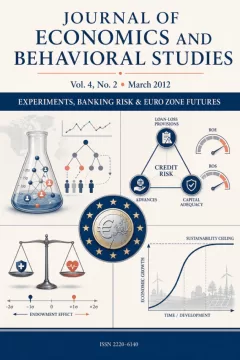
The present study examines the role of credit risk in value creation process in banking system of Pakistan. This study here develops a conceptual model with three antecedents to credit risk. These antecedents are loan loss provision, advances, and capital adequacy ratio. The study analyzes the impact of these antecedents on accounting return on equity (ROE) and market return on shares (ROS). The data come from 20 banks listed on Karachi Stock Exchange (KSE) for 2004-2009. The study includes panel data analysis to analyze the relationship between the selected variables. The results of this study expose a minimal role of credit risk in value creation process in banking system of Pakistan. The results further reveal that banks with higher advances in their portfolio are successful in getting the confidence of shareholders.
Keywords
- Credit Risk Search this journal for Credit Risk (opens in a new tab)
- Shareholders' Value Search this journal for Shareholders' Value (opens in a new tab)
- Banking Sector Search this journal for Banking Sector (opens in a new tab)
- Loan Loss Provision Search this journal for Loan Loss Provision (opens in a new tab)
- Capital Adequacy Ratio Search this journal for Capital Adequacy Ratio (opens in a new tab)
- Return on Equity Search this journal for Return on Equity (opens in a new tab)
References
- Akhtar, S. (2007). Pakistan: changing risk management paradigm – Perspective of the Regulator, ACCA Conference - CFOs: The Opportunities and Challenges Ahead, Karachi.
- Ali, F. & Luft, C. (2002). Corporate risk management: costs and benefits. Global Finance Journal, 13(1), 2938.
- Allen, F. & Santomero, A. M. (1996). The theory of financial intermediation, working paper, Financial Institutions Centre, The Wharton School, University of Pennsylvania, Philadelphia.
- Al-Tamimi, H. H. & Al-Mazrooei, F. M. (2007). Banks’ risk management: a comparison study of UAE national and foreign banks. The Journal of Risk Finance, 8(4), 394-409.
- Altman, E. I., Caouette, J. B. & Narayanan, P. (1998). Credit-risk measurement and management: The ironic challenge in the next decade. Financial Analysts Journal, 54(1), 7-11.
- Angkinand, A. P., Sawangngoenyuang, W. & Wihlborg, C. (2010). Financial liberalisation and banking crises: a cross-country analysis. International Review of Finance, 10(2), 263–292.
- Baele, L., Jonghe, O. D. & Vennet, R. V. (2006). Does the stock market value bank diversification? Working paper, Faculty of Economics and Business Administration, Ghent University, Ghent, Belgium.
- Baele, L., Vennet, R. V. & Landschoot, A. V. (2005). Bank risk strategies and cyclical variation in bank stock returns, working paper, Faculty of Economics and Business Administration, Ghent University, Ghent, Belgium.
- Baltagi, H. B. (1995). Econometric Analysis of Panel Data, New York: John Wiley and Sons.
- Basel Committee on Banking Supervision. (1999). Principles for the management of credit risk, Consultative Paper, Basel: Bank for International Settlements.
- Berger, A. & Humphrey, D. (1997). Efficiency of financial institutions: international survey and directions for future research. European Journal of Operational Research, 98(2), 175-212.
- Brooks, C. (2008). Introductory Econometrics for Finance (2nd ed.). New York: Cambridge University Press.
- Carty, L. V. (2000). Corporate credit-risk dynamics. Financial Analysts Journal, 56(4), 67-81.
- Chaplin, G., Emblow, A. & Michael, I. (2000). Banking System Liquidity: Developments and Issues. Financial Stability Review, 93-112.
- Duca, J. V. & McLaughlin, M. M. (1990). Developments affecting the profitability of commercial banks. Federal Reserve Bulletin.
- Fatemi, A. & Fooladi, I. (2006). Credit risk management: a survey of practices. Managerial Finance, 32(3), 227-233.
- Goodhart, C. E. (2005). Financial regulation, credit risk and financial stability. National Institute Economic Review, 192, 118-129.
- Gujarati, D. N. & Sangeetha, S. (2004). Basic Econometrics (4th ed.), McGraw-Hill Education (India) Pvt. Ltd.
- Honohan, P. & Laeven, L. (2005). Systemic Financial Crises: Containment and Resolution, New York: Cambridge University Press.
- Kao, D. L. (2000). Estimating and pricing credit risk: An overview. Financial Analysts Journal, 56(4), 50-66.
- Keasey, K. & Veronesi, G. (2008). Lessons from the Northern Rock affair. Journal of Financial Regulation and Compliance, 16(1), 8-18.
- Lopez, J. A. (2001). Financial instruments for mitigating credit risk. FRBSF Economic Letter.
- Miller, S. M. & Noulas, A. G. (1997). Portfolio mix and large-bank profitability in the USA. Applied Economics, 29(4), 505-512.
- Ojo, M. (2010). The growing importance of risk in financial regulation. The Journal of Risk Finance, 11(3), 249-267.
- Pagano, M. S. (2001). How theories of financial intermediation and corporate risk-management influence bank risk-taking behaviour. Financial Markets, Institutions and Instruments, 10(5), 277-323.
- Pesaran, M. H. & Schuermann, T. (2003). Credit risk and macroeconomic dynamics. Centre for financial institutions working papers, Wharton School Centre for Financial Institutions, University of Pennsylvania, New York, USA.
- SBP. (2009). Guidelines on internal capital adequacy assessment process. State Bank of Pakistan, Karachi.
- SBP. (2008). Pakistan is banking system remarkably resilient despite challenging economic environment. SBP’s Financial Stability Review, State Bank of Pakistan, Islamabad.
- SBP. (2005). Risk Management: Guidelines for Commercial Banks and DFIs. State Bank of Pakistan, Karachi.
- SBP. (2010). The state of Pakistan's economy. Central Board of State Bank of Pakistan, State Bank of Pakistan, Islamabad.
- Sensarma, R. & Jayadev, M. (2009). Are bank stocks sensitive to risk management? Journal of Risk Finance, 10(1), 7-22.
- Sufian, F. (2009). Factors influencing bank profitability in a developing economy: Empirical evidence from Malaysia. Global Business Review, 10(2), 225-241.
Downloads
No downloads have been recorded for this article yet. Figures appear here once readers begin downloading the full text.
How to Cite
Share this article
License
Copyright (c) 2012 Ahmed Arif, Afsheen Abrar, Mohammad Afzal (Author)

This work is licensed under a Creative Commons Attribution 4.0 International License.
Author (s) should affirm that the material has not been published previously. It has not been submitted and it is not under consideration by any other journal. At the same time author (s) need to execute a publication permission agreement to assume the responsibility of the submitted content and any omissions and errors therein. After submission of revised paper in the light of suggestions of the reviewers, the editorial team edits and formats manuscripts to bring uniformity and standardization in published material.
This work will be licensed under Creative Commons Attribution 4.0 International (CC BY 4.0) and under condition of the license, users are free to read, copy, remix, transform, redistribute, download, print, search or link to the full texts of articles and even build upon their work as long as they credit the author for the original work. Moreover, as per journal policy author (s) hold and retain copyrights without any restrictions.
Keywords
- Credit Risk Search this journal for Credit Risk (opens in a new tab)
- Shareholders' Value Search this journal for Shareholders' Value (opens in a new tab)
- Banking Sector Search this journal for Banking Sector (opens in a new tab)
- Loan Loss Provision Search this journal for Loan Loss Provision (opens in a new tab)
- Capital Adequacy Ratio Search this journal for Capital Adequacy Ratio (opens in a new tab)
- Return on Equity Search this journal for Return on Equity (opens in a new tab)
Section
Published
Submissions
Have research to publish? Journal of Economics and Behavioral Studies welcomes submissions.
Make a Submission