Abstract
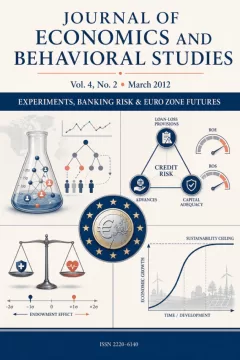
The current problems on the aftermath of the global credit crunch left the weakest Euro countries in the turbulence of a debt crisis, which has been spread in five countries (Greece, Ireland, Portugal, Italy and Spain respectively) and raised the question of a Euro zone future survival. The surviving barriers have to do with limitations and restrictions on the single market, the lack of political union and different monetary policy targets. Incentives to secede are also present. However, a possible withdraw of a country would have high cost for all the participants and it could lead to monetary union’s demolition. The costs related with a possible withdraw are high, thus it is difficult for a country to leave a union. In the recent debt crisis, the countries accepted bailouts from their counterparts and international organizations in order to prevent the Euro zone collapse spreading the crisis further. Three possible Euro zone future scenarios are analyzed. The volunteer or not breakup of the union and reintroducing of national currencies, the breakup of the Euro zone to two currencies consisting Optimal Currency Areas (OCAs)is analyzed by using thirteen equally weighted optimum area criteria and the imposition of an interest equalization tax(IET) in order to make the Euro zone a single OCA. The results show that the asymmetries lead to the crisis persists in a possible two Euros area and this scenario cost is higher than union dissolution’s. An IET can help Euro zone in the short time to develop sustainable characteristics.
Keywords
- Asymmetries Search this journal for Asymmetries (opens in a new tab)
- OCA Search this journal for OCA (opens in a new tab)
- Monetary Policy Search this journal for Monetary Policy (opens in a new tab)
- Interest Equalization Tax Search this journal for Interest Equalization Tax (opens in a new tab)
- Dissolution Search this journal for Dissolution (opens in a new tab)
References
- Bae, K. H. & Bailey, W. (2011). The Latin monetary union. Some evidence on Europe’s failed common currency. Review of development finance, 1, 131-149.
- Benavie, A. & Froyen, R. (1992).Optimal monetary policy with an interest equalization tax. Journal of Macroeconomics , 14(3), 449-466.
- Blanchard, O. (2006). An adjustment within the Euro: The difficult case of Portugal. Unpublished manuscript, MIT, Boston.
- Boonstra, W. (2010). Breaking up the Euro: Blessing or disaster. Rabobank economic research department working papers . Netherlands.
- Cohen, B. (1993). Beyond EMU: “The problem of sustainability” , Basil Blackwell Ltd., Cambridge MA.
- Cohen, B. (2003). Are monetary unions inevitable? International Studies perspectives, 4, 275-292.
- Costa, F. A. & Mota, P. (2011). The roots of the Euro zone sovereign crisis: PIGS vs Non. PIGS . Panoeconomicus , 5,631-649.
- De Grauwe, P. (2003). Economics of monetary union.7th edition.Oxford press.
- De Grauwe, P. (2011). Joint issue of Eurobonds . CESifo Forum 2/2011.
- De Grauwe, P. & Moesen, W. (2009). Gains for all: A proposal for a common Euro bond. Inter Economics University of Leuven, May /June .
- Fidrmuc, J. & Horvath, J. (1998). Stability of monetary unions: lessons from the breakup of Czechoslovakia. Netherlands organization of scientific research.
- Fuchs, W. & Lippi, F. (2005). Monetary union with voluntary participation . Stanford Institute for economic research . Stanford University.
- Georgioni, G. & Holden, K. (2000). The crisis of the CFA Franc zone. Working paper, Economic modeling.
- Gros, D. & Thygesen, N. (1998). European monetary integration. 2nd edition Longman.
- Heritage Foundation. (2010). Index of economic freedom 2011. The Heritage Foundation, Washington DC.
- Krugman, P. & Obstfeld, M. (2011). International economics, theory and policy. 9th edition, Prentice Hall, Boston.
- Masson, P. (2011). Fiscal asymmetries and the survival of the Euro zone. The Centre for governance innovation , 1, 1-23.
- Monga, C. (1997). A currency reform index for Western and Central Africa. The world economy, Blackwell publisher’s ltd., 103-125.
- Mundell, R. (1988). Uses and Abuses of Gresham's Law. In the History of Money , Columbia University.
- Pszezolka, I. (2004). Advantages and disadvantages of Introducing Euro. Working paper.
- Schinasi, G. & Texeira, P. (2006). The lender of last resort in the European single financial market. IMF working paper.IMF.
- Robichaud, F. (2011). Lender of last resort in the Euro zone. Who will stand up and do the job? Central European university department of political science, Budapest Hungary.
- Tootel, G. (1990). Central bank flexibility and the drawbacks to currency unification. New England Economic review , 2, 3-18.
Downloads
No downloads have been recorded for this article yet. Figures appear here once readers begin downloading the full text.
How to Cite
Share this article
License
Copyright (c) 2012 Dapontas Dimitrios (Author)

This work is licensed under a Creative Commons Attribution 4.0 International License.
Author (s) should affirm that the material has not been published previously. It has not been submitted and it is not under consideration by any other journal. At the same time author (s) need to execute a publication permission agreement to assume the responsibility of the submitted content and any omissions and errors therein. After submission of revised paper in the light of suggestions of the reviewers, the editorial team edits and formats manuscripts to bring uniformity and standardization in published material.
This work will be licensed under Creative Commons Attribution 4.0 International (CC BY 4.0) and under condition of the license, users are free to read, copy, remix, transform, redistribute, download, print, search or link to the full texts of articles and even build upon their work as long as they credit the author for the original work. Moreover, as per journal policy author (s) hold and retain copyrights without any restrictions.
Keywords
- Asymmetries Search this journal for Asymmetries (opens in a new tab)
- OCA Search this journal for OCA (opens in a new tab)
- Monetary Policy Search this journal for Monetary Policy (opens in a new tab)
- Interest Equalization Tax Search this journal for Interest Equalization Tax (opens in a new tab)
- Dissolution Search this journal for Dissolution (opens in a new tab)
Section
Published
Submissions
Have research to publish? Journal of Economics and Behavioral Studies welcomes submissions.
Make a Submission