Abstract
The achievement of worldwide participation in education is essentially determined by the quality of education available. How well learners are instructed and how much they learn determines how regularly learners attend schools. Sound education is further affected by the following factors: time spent learning by learners, assessment methods for monitoring learner progress, styles of teaching, education spending, the language of instruction, and classroom organisation strategies (EFA Global Monitoring Report, 2005). However, the development of learners’ literacy in South Africa as a developing country is accentuated by several challenges. Many learners in South Africa have difficulty understanding the language in which they are taught which is English, as they are not taught in their mother tongue. However, the language of instruction is not solely responsible for the poor performance in international reading tests and schooling in general. Learners are also faced with socio-economic issues, very little or hardly any parental supervision and educators are faced with the challenge of finding reading methods and strategies suitable to improving reading. Learners in the foundation phase are explicitly taught reading skills. In the intermediate phase, learners are expected to apply the skills acquired in the foundation phase to access the curriculum. In reality, this is difficult to achieve. The purpose of this article is to determine educator perceptions of reading literacy in the intermediate phase with the aim of enhancing reading literacy in the intermediate phase.
Keywords
- Perception Search this journal for Perception (opens in a new tab)
- Literacy Search this journal for Literacy (opens in a new tab)
- Intermediate Phase Search this journal for Intermediate Phase (opens in a new tab)
- Reading Search this journal for Reading (opens in a new tab)
- Educators Search this journal for Educators (opens in a new tab)
- Quality Search this journal for Quality (opens in a new tab)
References
- Alliance for Excellent Education (2006). Issue Brief. http://www.all4ed.org/ Centre for Evaluation and Assessment (CEA). 2006. University of Pretoria (UP).
- Barbeau, N. (2009). The Daily News, August 13.
- Condy, J., Chigona, A., Chetty, R. & Thornhill, C. (2010). Final year teacher training students’ perception of THRASS. South African Journal of Education , 30, 261-275.
- Department of Education. (2002). Revised National Curriculum Statement (RNCS) Policy.
- Department of Education (2007). National Policy Framework for Teacher Education and Development (NPFTED).
- Department of Education (2008). National Reading Strategy. 1-20.
- Department of Education. South Africa. (2008). Foundations for Learning Campaign. (Notice 306 of 2008). Government Gazette No. 30880: 14 March.
- Department of Eduction (2009). Quality Teaching and Learning Campaign.
- Department of Education (2010). Report on the Annual National Assessments 2011. 1-36. Available at https://www.government education.com.
- Department of Education (2011). A Teacher’s Handbook, 2008. Teaching Reading in the Early Grades: A Teacher’s Manual. Available at http://www.education.gov.za
- EFA Global Monitoring Report. (2005). United Nations Educational, Scientific and Cultural Organization (UNESCO).
- Howie, S. J., Venter, E. & Van-Staden, S. (2008) . The effect of multilingual policies on performance and progression in reading literacy in South African primary schools - Reading Achievement: International Perspectives from IEA's Progress in International Reading Literacy Studies (PIRLS). Education Research and Evaluation, 4(6), 551-560.
- Meier, C. (2011). The foundations for learning campaign: helping hand or hurdle? South African Journal of Education , 31(4), 1-15
- Mkhwanazi, S. (2008). Pandor confirms to reopen colleges. April, 25. Available at http://www.iol.co.za/ news/south-africa /pandor-confirms-plans-to-reopen-colleges-1.39796 7
- Moore, J. M. & Hart, M. (2007). Access to literacy: Scaffolded reading strategies in the South African context. Journal for Language Teaching , 41(1), 15-28.
- Pretorius, E. J. (2005). What do students do when they learn to read? Lessons from five case studies. South African Journal of Higher Education, 19(4), 790- 812.
- Progress in International Reading Literacy Study (PIRLS). (2006). Performance at the PIRLS 2006 International Benchmarks IEA. IEA.
- Rose, D. (2005). Democratising the classroom : literacy pedagogy for the new generation . Journal of Education , 37, 131-167.
- Rose, D. (2006a). Learning to read: Reading to learn. Scaffolding the English curriculum for indigenous secondary students.
- Rose, D. (2006b). Literacy and equality in the classroom. Future Directions in Literacy Conference. University of Sydney.
- Southern and East Africa Consortium for Monitoring Education Quality (SACMEQ). (2011). Report on the Quality of Education.
- U.S. Department of Education. National Centre for Education Statistics. (2007). International Association for the Evaluation of Educational Achievement Student questionnaire - PIRLS.
Downloads
No downloads have been recorded for this article yet. Figures appear here once readers begin downloading the full text.
How to Cite
Share this article
License
Copyright (c) 2012 U. Naidoo, N. Dorasamy, K. Reddy (Author)

This work is licensed under a Creative Commons Attribution 4.0 International License.
Author (s) should affirm that the material has not been published previously. It has not been submitted and it is not under consideration by any other journal. At the same time author (s) need to execute a publication permission agreement to assume the responsibility of the submitted content and any omissions and errors therein. After submission of revised paper in the light of suggestions of the reviewers, the editorial team edits and formats manuscripts to bring uniformity and standardization in published material.
This work will be licensed under Creative Commons Attribution 4.0 International (CC BY 4.0) and under condition of the license, users are free to read, copy, remix, transform, redistribute, download, print, search or link to the full texts of articles and even build upon their work as long as they credit the author for the original work. Moreover, as per journal policy author (s) hold and retain copyrights without any restrictions.
Keywords
- Perception Search this journal for Perception (opens in a new tab)
- Literacy Search this journal for Literacy (opens in a new tab)
- Intermediate Phase Search this journal for Intermediate Phase (opens in a new tab)
- Reading Search this journal for Reading (opens in a new tab)
- Educators Search this journal for Educators (opens in a new tab)
- Quality Search this journal for Quality (opens in a new tab)
Section
Published in
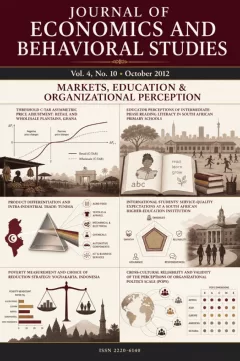 Vol. 4 No. 10 (2012)
Markets, Education & Organizational Perception
View issue contents
Published
Submissions
Have research to publish? Journal of Economics and Behavioral Studies welcomes submissions.
Make a Submission