Abstract
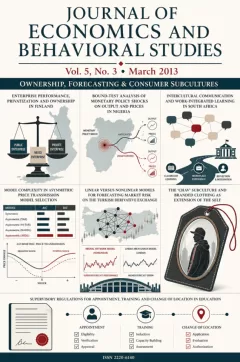
The study examined the effects of monetary policy shocks on output and prices in Nigeria. This is done through an empirical analysis of the effects of anticipated and unanticipated monetary policies on output and prices. Quarterly data from 2000:1 to 2010:4 were used. The long-run ARDL estimates indicate positive and significant effects of anticipated monetary policy on output and prices while unanticipated monetary policy was insignificant. Thus, the findings provide a significant departure from the existing diversity of evidences of empirical literature on the monetary policy actions and macroeconomic variables nexus. The study therefore suggested the use of a one fit for all policy instrument in stimulating output growth and prices in the economy rather than using one specific measure which could lead to the failure of monetary policy in Nigeria.
Keywords
- Monetary Policy Shocks Search this journal for Monetary Policy Shocks (opens in a new tab)
- Output Search this journal for Output (opens in a new tab)
- Prices Search this journal for Prices (opens in a new tab)
- Anticipated Search this journal for Anticipated (opens in a new tab)
- Unanticipated Search this journal for Unanticipated (opens in a new tab)
References
- Alogoskoufis, G. S. (1982). Unanticipated Money, Output and Prices in Greece. European Economic Review , 19(1-2), 289-303.
- Ball, L. (2000). Policy Rules and External Shocks, NBER Working Paper 7910.
- Bannerjee, A., Dolado, J. & Mestre, R. (1998). Error-correction mechanism tests for cointegration in single equation framework. J. Time Series Analysis , 19, 267-83.
- Barro, R. J. (1977). Unanticipated Money Growth and Unemployment in the United States. American Economic Review , 67(2), 101-115.
- Barro, R. J. & Rush, M. (1983). Unanticipated Money and Economic Activity, in Rational Expectations and Economic Policy, Ed. By S. Fischer, Chicago: University of Chicago Press.
- Bernanke, B. S. & Woodford, M. (1997). Inflation Forecasts and Monetary Policy. Journal of Money, Credit and Banking, Blackwell Publishing , 29(4), 653-84.
- Chimobi, O. P. & Uche, U. C. (2010). Money, Price and Output. A Causality Test for Nigeria. American Journal of Scientific Research , 8, 78-87.
- Dickey, D. A. & Fuller, W. A. (1979). Distribution of the Estimators for Autoregressive Time Series with a Unit Root. Journal of the American Statistical Association , 74, 427–431.
- Folawewo A. O. & Osinubu, T. S. (2006). Monetary Policy and Economic Instability in Nigeria. A Rational Expectation Approach. Journal of Social Sciences , 12(2), 93-100.
- Gerlach, S. & Tillmann, P. (2011). Inflation Targeting and Inflation Persistence in Asia-Pacific. Hong Kong Institute for Monetary Research Working Paper No.25/2011.
- Gujarati, D. N. & Porter, D. C. (2009). Basic Econometrics International Edition, 2009, ISBN: 978-007-1276252
- Johansen, S. & Juselius, K. (1990). Maximum likelihood estimation and inference on cointegration – with application to the demand for money . Oxford Bulletin of Economics and Statistics , 52, 169-210.
- Kuttner, K. N. & Posen, A. S. (1999). Does talk matter after all? Inflation targeting and central bank behavior. Federal Reserve Bank of New York Staff Report , 88(1).
- Lee, Y. G. & Zilberfarb, B. Z. (1993). Unanticipated Money, Output, Employment and Price in A Developing economy: The Korean case. International Economic Journal , 7(2).
- Lucas, R. E. (1972). Expectation and the Neutrality of Money. Journal of Economic Theory , 4, 103-124.
- Mishkin, F. (2000). Financial stability and the Macroeconomy, Economics working paper 09, Department of Economics, Central bank of Iceland.
- Mishkin, F. (2002). The Role of Output Stabilization in the Conduct of Monetary Policy. International Finance, Blackwell Publishing , 5(2), 213-27.
- Mishra, P. K., Mishra, U. S. & Mishra, S. K. (2010). Money, Price and Output: A Causality Test for India. International Research Journal of Finance and Economics , 53(2).
- Muhd Zulkhibri, A. M. (2007). Causality link between Money, Output and Prices in Malaysia; an Empirical Reexamination. Applied Econometrics and International Development , 7(1).
- Nelson, C. & Plosser, C. (1982). Trends and Random Walks in Macroeconomics Time Series: Some Evidence and Implications. Journal of Monetary Economics , 10, 139-162.
- Ncube, M. & Mthokozisi, T. M. (2010). Monetary Policy Conduct Based on Nonlinear Taylor Rule: Evidence from South Africa. Working Papers Series N° 113, African Development Bank, Tunis, Tunisia.
- Neumann, M. J. M. & von-Hagen, J. (2002). Does inflation targeting matter? Federal Reserve Bank of St. Louis Review , 85, 127-148.
- Odedokun, M. O. (1998). An Econometric Investigation of Monetary Neutrality In Nigeria. Nigeria Journal of Social Studies , 3, 313-334.
- Ogungbenro, I. O., Adebayo, A. A. & Amekodo, O. T. (1995). Unemployment and Monetary Policy in Nigeria: An Econometric Analysis 1960-1993. First Bank Review , 3, 12-21.
- Owoye, O. & Onafowora, O. A. ( 2007). M2 Targeting, Money Demand, and Real GDP Growth In Nigeria: Do Rules Apply? Journal of Business and Public Affairs , 1(2).
- Saibu, F. & Oladeji, L. (2004). Monetary Policy and Inflation Control: The Relevance of Rational Expectation Hypothesis in Contemporary Nigeria. The India Journal of Economics , LXXXIV(335), 555-568.
- Saibu, M. O. & Oladeji, S. I. (2008b). Openness and the Effects of Fiscal and Monetary Policy Shocks on Real Output in Nigeria (1960–2003). African Development Review, 20(3), 529–548.
- Sargent, J. T. & Wallace, I. (1975). Rational Expectation, the Optimal Monetary instrument And Money Supply Rule. Journal of political Economy , 83, 341-355.
- Taylor, J. B. (1993). Discretion versus Policy Rules in Practice. Carnegie-Rochester Conference Series on Public Policy , 39, 195-214.
- Taylor, J. B. (1999). Monetary Policy Rules. Chicago: University of Chicago.
- Yamak, R. & Küçükkale, Y. (1998). Anticipated versus Unanticipated money in turkey. Yapi Kredi Economic Review , 9(1), 15-25.
Downloads
No downloads have been recorded for this article yet. Figures appear here once readers begin downloading the full text.
How to Cite
Share this article
License
Copyright (c) 2013 Apanisile Olumuyiwa Tolulope, Taiwo Ajilore (Author)

This work is licensed under a Creative Commons Attribution 4.0 International License.
Author (s) should affirm that the material has not been published previously. It has not been submitted and it is not under consideration by any other journal. At the same time author (s) need to execute a publication permission agreement to assume the responsibility of the submitted content and any omissions and errors therein. After submission of revised paper in the light of suggestions of the reviewers, the editorial team edits and formats manuscripts to bring uniformity and standardization in published material.
This work will be licensed under Creative Commons Attribution 4.0 International (CC BY 4.0) and under condition of the license, users are free to read, copy, remix, transform, redistribute, download, print, search or link to the full texts of articles and even build upon their work as long as they credit the author for the original work. Moreover, as per journal policy author (s) hold and retain copyrights without any restrictions.
Keywords
- Monetary Policy Shocks Search this journal for Monetary Policy Shocks (opens in a new tab)
- Output Search this journal for Output (opens in a new tab)
- Prices Search this journal for Prices (opens in a new tab)
- Anticipated Search this journal for Anticipated (opens in a new tab)
- Unanticipated Search this journal for Unanticipated (opens in a new tab)
Section
Published
Submissions
Have research to publish? Journal of Economics and Behavioral Studies welcomes submissions.
Make a Submission