Abstract
There is abundance of baby formula brand in Indonesia’s market. To capture reasonable share in these lucrative businesses, it is imperative that producers have to remain competitive. Advertisements in a variety of media is being recognized as a method to communicate products to a wider target audience but empirical research also shown that consumers are sceptical of such claims. The purpose of the paper is to identify customer perceptions and attitude towards baby formula and their willingness to pay. The preliminary qualitative study was conducted by focus group discussion and sentence completion technique. The quantitative study is expected to validate the findings. Questionnaires are distributed to total 105 mothers who have baby at 0 – 5 years old, where hypothesis were tested with multivariate analysis. The result shows that growth benefit made by baby formula significantly influence the willingness to purchase baby formula. The mothers stated that baby formula is considered as substitute for breast milk only, giving nutrition for baby but does not build baby’s intelligence as claimed in many advertisements. The implication of this research is valuable for marketer to understand consumer preferences and perspective on baby formula purchase.
Keywords
- Baby Formula Search this journal for Baby Formula (opens in a new tab)
- Consumer Perception Search this journal for Consumer Perception (opens in a new tab)
- Brand Position Search this journal for Brand Position (opens in a new tab)
- Willingness to Purchase Search this journal for Willingness to Purchase (opens in a new tab)
- Health Claims Search this journal for Health Claims (opens in a new tab)
References
- Angulo, A. M., Gil, J. M. & Taniburo, L. (2005), Food safety and consumers’ willingness to pay for labelled beef in Spain. Journal of Food Products Marketing , 11(3), 89-105.
- Anne, F. J. (2011). An Investigation Of Baby Formula Marketing Practises In the Health Care Setting. Thesis by undergraduate student faculty of The University of North Carolina at Chapel Hill, United States.
- Ball, T. M. & Wright, A. L. (1999). Health care costs of formula feeding in the first year of life. Pediatrics, 103(4 /2), 870-876.
- Becker, F. & Tilman, I. (2000). Consumer perception of fresh meat quality: a framework for analysis. British Food Journal , 102(3), 158 – 176
- Burton, S., Biswas, A. & Netemeyer, R. G. (1994). Effects of Alternative Nutrition Label Formats and Nutrition Reference Information on Consumer Perceptions, Comprehension, and Product Evaluations. Journal of Public Policy & Marketing , 13, 36–47.
- Calfee, J. E. & Pappalardo, J. K. (1991). Public Policy Issues in Health Claims for Foods. Journal of Public Policy & Marketing , 10, 33–53.
- Caswell, J. A., Ning, Y., Liu, F. & Mojduszka, E. M. (2003). The Impact of New Labeling Regulations on the Use of Voluntary Nutrient-Content and Health Claims by Food Manufacturers. Journal of Public Policy & Marketing , 22, 147–58.
- De Almeida, M. D. V., Graca, P., Lappapainen, R., Kafatos, A., Remaut-de-Winter, A. M. & Kearney, J. M. (1997). Sources used and trusted by nationally representative adults in the European Union for information on healthy eating. European Journal of Clinical Nutrition , 51(2), S16–22
- Eagly, A. H. & Chaiken, S. (1993). The Psychology of Attitudes . Fort Worth, TX: Harcourt Brace Jovanovich.
- Fishbein, M. & Ajzen, I. (1975). Belief, Attitude, Intention and Behaviour, Addison-Wesley, Reading, MA.
- Fournier, S. (1998). Consumers and their brands: developing relationship theory in consumer research. Journal of Consumer Research , 24(4), 343-73.
- Gartner, L. M., Morton, J., Lawrence, R. A., Naylor, A. J., O'Hare, D., Schanler, R. J. & Eidelman, A. I. (2005). Breastfeeding and the use of human milk. Pediatrics , 115(2), 496-506.
- Govindasamy, R., DeCongelio, M. & Bhuyan, S. (2005). An evaluation of consumer willingness to pay for organic produce in the Northeastern US. Journal of Food Products Marketing , 11(4), 3-20.
- Hair, J. F. Jr., Anderson, R. E., Tatham, R. L. & Black, W. C. (2010). Multivariate Data Analysis, New Jersey: Prentice Hall International Hans Martin Norberg, Natalia Maehle and Tor Korneliussen (2011). From commodity to brand: antecedents and outcomes of consumers’ label perception. Journal of Product & Brand Management , 2(5), 368–378.
- Juran, J. M. (1979). Quality Control Handbook , McGraw-Hill, New York, NY.
- Laroche, M. & Howard, J. A. (1980). Nonlinear relations in a complex model of buyer behavior. Journal of Consumer Research , 6(4), 377-88.
- Levy, A. S. (1995). PHS Food Label Health Claims Focus Group Report: Executive Summary, Food and Drug Administration, Center for Food Safety and Applied Nutrition, Division of Market Studies.
- Lichtenstein, D., Blonch, D. & Black, W. (1988). Correlates of price acceptability. Journal of Consumer Research , 15(2), 243-52.
- Okazaki, S., Katsukura, A. & Nishiyama, M. (2007). How mobile advertising works: the role of trust in improving attitudes and recall. Journal of Advertising Research , 47(2), 165-78.
- Picciano, M. F. (2001). Nutrient composition of human milk. Pediatric Clinics of North America , 48, 53-67.
- Posri, W., Shankar, B. & Chadbunchachai, S. (2007). Consumer attitudes towards and willingness to pay for pesticide residue limit compliant ‘safe’ vegetables in Northeast Thailand. Journal of International Food and Agribusiness Marketing , 19(1), 81-101.
- Mazis, M. B. & Raymond, M. A. (2007). Consumer perceptions of health claims in advertisments and on food labels. The Journal of Consumer Affairs , 31(1), 10-26.
- Misra, S., Huang, C. & Ott, S. (1991), Georgia consumers’ preference for organically grown fresh produce. Journal of Agribusiness , 9(2), 53-65.
- Moorman, C. (1996). A Quasi Experiment to Assess the Consumer and Informational Determinants of Nutrition Information Processing Activities: The Case of the Nutrition Labeling and Education Act. Journal of Public Policy & Marketing , 15, 28–44.
- Schultz, D. E., Tannebaum, S. I. & Lauterborn, R. F. (1993). Integrated Marketing Communications , Chicago: NTC Publishing.
- Roe, R. & Sheldon, I. (2007). Credence good labelling: the efficiency and distributional implications of several policy approaches. American Journal of Agricultural Economics , 89(4), 1020-33.
- Tsakiridou, E., Zotos, Y. & Mattas, K. (2006). Employing a dichotomous choice model to assess willingness to pay (WTP) for organically produced products. Journal of Food Products Marketing , 12(3), 5969.
- Underhill, S. & Figueroa, E. (1996). Consumer preferences for non-conventional grown produce. Journal of Food Distribution Research , 27(2), 56-66.
- Van Ravenswaay, E. O. & Hoehn, J. P. (1991). The impact of health risk information on food demand: a case study of ALAR and apples in Caswell, J.A. (Ed.), Economics of Food Safety, Elsevier Science Publishing, New York, NY, 155-74. www.datastatistik-indonesia.com
Downloads
No downloads have been recorded for this article yet. Figures appear here once readers begin downloading the full text.
How to Cite
Share this article
License
Copyright (c) 2013 Febrina Fitriyanti Tambunan, Mustika Sufiati Purwanegara, Mia Tantri Diah Indriani (Author)

This work is licensed under a Creative Commons Attribution 4.0 International License.
Author (s) should affirm that the material has not been published previously. It has not been submitted and it is not under consideration by any other journal. At the same time author (s) need to execute a publication permission agreement to assume the responsibility of the submitted content and any omissions and errors therein. After submission of revised paper in the light of suggestions of the reviewers, the editorial team edits and formats manuscripts to bring uniformity and standardization in published material.
This work will be licensed under Creative Commons Attribution 4.0 International (CC BY 4.0) and under condition of the license, users are free to read, copy, remix, transform, redistribute, download, print, search or link to the full texts of articles and even build upon their work as long as they credit the author for the original work. Moreover, as per journal policy author (s) hold and retain copyrights without any restrictions.
Keywords
- Baby Formula Search this journal for Baby Formula (opens in a new tab)
- Consumer Perception Search this journal for Consumer Perception (opens in a new tab)
- Brand Position Search this journal for Brand Position (opens in a new tab)
- Willingness to Purchase Search this journal for Willingness to Purchase (opens in a new tab)
- Health Claims Search this journal for Health Claims (opens in a new tab)
Section
Published in
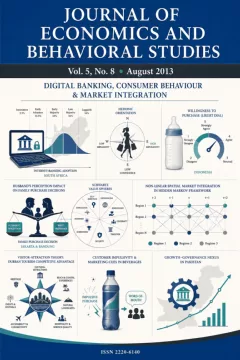 Vol. 5 No. 8 (2013)
Digital Banking, Consumer Behaviour & Market Integration
View issue contents
Published
Submissions
Have research to publish? Journal of Economics and Behavioral Studies welcomes submissions.
Make a Submission