Abstract
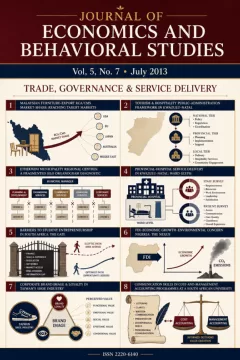
As rising unemployment levels continually erode job opportunities in South Africa, it is sensible to assume that entrepreneurship would be considered as the next-best career option; however, university graduates show very little interest in becoming entrepreneurs. Having observed this disinterest, South African economic policies have put in place initiatives encouraging youth entrepreneurship; however, these have failed to significantly affect the willingness to engage in entrepreneurial activities. It is against this background that this paper investigates barriers to entrepreneurship as experienced by students. A survey of 235 university students was conducted. Their views regarding entrepreneurship were collected by means of self-completion questionnaires and studied using cluster analysis. It was concluded that a taxonomy of two distinct categories of student exist – sceptics and optimists – based on respondents’ predispositions to entrepreneurship barriers. The author identifies the themes that underlie the formation of the taxonomy, namely, family and social influence, exposure to entrepreneurial activity, entrepreneurial support, and education. The paper concludes with a discussion of practical solutions and strategies to mitigate the problem of a lack of student entrepreneurship.
Keywords
- Education Search this journal for Education (opens in a new tab)
- Entrepreneurship Search this journal for Entrepreneurship (opens in a new tab)
- Entrepreneurship Education Search this journal for Entrepreneurship Education (opens in a new tab)
- Universities Search this journal for Universities (opens in a new tab)
- South Africa Search this journal for South Africa (opens in a new tab)
References
- Aldrich, H. E., Renzulli, L. A. & Langton, N. (1998). Passing on Privilege: resources provided by selfemployed parents to their self-employed children. Research in Social Stratification and Mobility. K. Leicht. Greenwich, CT, JAI.
- Apps, P. (2011). Analysis - London riots point to wider risks of youth unrest. Retrieved 5 June 2013, from http://uk.reuters.com/article/2011/08/09/uk-britain-unrest-youth-idUKTRE7783G720110809.
- Blumberg, B., Cooper, D. R. & Schindler, P. S. (2011). Business Research Methods, 3rd European Edition. London, McGraw Hill.
- Carr, J. C. & Sequeira, J. M. (2007). Prior family business exposure as intergenerational influence and entrepreneurial intent: A Theory of Planned Behaviour Approach. Journal of Business Research , 60, 1090-1098.
- Chauke, A. (2011). ANC Youth League 'economic freedom' mass action: LIVE 27 October. from http://www.timeslive.co.za/politics/2011/10/27/anc-youth-league-economic-freedom-massaction-live-27-october.
- Du, P. (2009). The place and role of Universities of Technology in South Africa. Bloemfontein, Durban University of Technology (on behalf of South African Technology Network).
- Dulewics, V., Higgs, M. & Slaski, M. (2003). Measuring emotional intelligence: content, construct and criterion related validity. Journal of Managerial Psychology , 18(5), 405-420.
- Ebewo, P. E. & Shambare, R. (2012). The reason business plans of start-up ventures are rejected by South African financiers: evidence from SIFE-TUT Harmony Fashion Design Business Challenge. Emerging Markets Conference of the International Management Research Academy (IMRA). London, 17-18 May 2012, IMRA.
- Facebook.com. (2012). Histrory of Facebook. Retrieved 6 June 2012, from http://www.facebook.com/pages/History-of-Facebook/105185536206799.
- Field, A. (2009). Discovering Statistics Using SPSS, 3rd Edition. Thousand Oaks, CA, Sage.
- Gaidzanwa. (2003). Gender and Canon Formation: Women and Men and Literary Art in Africa. Mans . Accra, Ghana.
- Gartner, W. B. (1988). Who is an entrepreneur is the wrong question. American Journal of Small Business, 13, 11-32.
- Global Entrepreneurship Monitor. (2005). Global Entrepreneurship Monitor South African Report 2005, GEM. 2005.
- Global Entrepreneurship Monitor. (2011). Global Entrepreneurial Monitor: South Africa 2011, GEM.
- Greve, A. (1995). Networks and entrepreneurship - an analysis of social relations, occupational background, and use of contacts during the establishment process. Scandanavian Journal of Management , 11(1), 1-24.
- Jones, C. & English, J. (2005). A contemporary approach to entrepreneurship education. Journal of Education Training , 46(8/9), 416-423.
- Kane, C. (2013). Spain Prime Minister sees hope for unemployment on day of protests. Retrieved 5 June 2013, from http://uk.reuters.com/article/2013/06/02/uk-spain-joblessidUKBRE95007L20130602?feedType=RSS&feedName=businessNews.
- Kesler, C. & Hout, M. (2010). Entrepreneurship and immigrant wages in US labour markets: a multi-level approach. Social Science Research , 39, 187-201.
- Lekoko, M. (2011). Students' perceptions regarding entrepreneurship education: a case of two universities in Botswana. Master of Technology in Entrepreneurship, Tshwane University of Technology.
- Lennox, N. (2013). SA must up its entrepreneurial game. Retrieved 5 June 2013, from http://m.news24.com/fin24/Entrepreneurs/News/SA-must-up-its-entrepreneurial-game20130315.
- Makgosa, R. & Ongori, H. (2012). Perceptions of Entrepreneurial Behaviour in Botswana. International Journal of Learning & Development , 2(3), 247-259.
- Massad, V. J. & Tucker, J. M. (2009). Using student managed businesses to integrate the business curriculum. Journal of Instructional Pedagogies , 1, 17-29.
- Pallant, J. (2010). SPSS Survival Manual: A step by step guide to data analysis using SPSS, 4th Edition. Berkshire, UK, McGraw Hill.
- Rasmussen, E. A. & Sorheim, R. (2006). Action-based entrepreneurship education. Technovation , 26, 185194.
- Republic of South Africa. (2012). The National Development Plan. D.o. Communication. Pretoria, Department of Communication.
- Robertson, J. (2013). Eurozone unemploymengt reaches new record high in April." from http://www.bbc.co.uk/news/business-22727373.
- Shambare, R. (2011). Using projects in teaching Introductory Business Statistics: the case of TUT Business School. African Journal of Business Management , 5(11), 4176-4184.
- Shane, S. (2008). Why encouraging more people to become entrepreneurs is bad public policy. World Entrepreneurship Forum, 1-18.
- Solymossy, E. & Hisrich, J. (1998). Entrepreneurial dimensions: the relationship of individual, venture, and environmental factors to success. PhD, Case Western Reserve University.
- Sowetan. (2012). Universities produce wrong kind of graduates: analyst. Sowetan. Johannesburg.
- Statistics South Africa. (2013). Quarterly Labour Force Survey. Pretoria, StatsSA. Quarter 1 (January to March 2013).
- Strydom, R. & Adams, M. (2009). Evaluating the learning experience of undergraduate entrepreneurship students exposed to unconventional teaching approach: a South African case study. Southern African Journal of Entrepreneurship and Small Business Management, 2(1), 50-67.
- UNDP. (2007). The legal empowerment of the Poor: Informal business. Cape Town, United Nations Development Programme.
- van der Walt, R. & van der Walt, S. J. (2008). Entrepreneurial training for Human Resources Practitioners and potential services rendered to small enterprises. Southern African Journal of Entrepreneurship and Small Business Management , 1(21-34).
- Yaghoubi, J. (2010). Study barriers to entrepreneurship promtion in agriculture higher education. Procedia Social and Behavioral Sciences , 2, 1901-1905.
Downloads
No downloads have been recorded for this article yet. Figures appear here once readers begin downloading the full text.
How to Cite
Share this article
License
Copyright (c) 2013 Richard Shambare (Author)

This work is licensed under a Creative Commons Attribution 4.0 International License.
Author (s) should affirm that the material has not been published previously. It has not been submitted and it is not under consideration by any other journal. At the same time author (s) need to execute a publication permission agreement to assume the responsibility of the submitted content and any omissions and errors therein. After submission of revised paper in the light of suggestions of the reviewers, the editorial team edits and formats manuscripts to bring uniformity and standardization in published material.
This work will be licensed under Creative Commons Attribution 4.0 International (CC BY 4.0) and under condition of the license, users are free to read, copy, remix, transform, redistribute, download, print, search or link to the full texts of articles and even build upon their work as long as they credit the author for the original work. Moreover, as per journal policy author (s) hold and retain copyrights without any restrictions.
Keywords
- Education Search this journal for Education (opens in a new tab)
- Entrepreneurship Search this journal for Entrepreneurship (opens in a new tab)
- Entrepreneurship Education Search this journal for Entrepreneurship Education (opens in a new tab)
- Universities Search this journal for Universities (opens in a new tab)
- South Africa Search this journal for South Africa (opens in a new tab)
Section
Published
Submissions
Have research to publish? Journal of Economics and Behavioral Studies welcomes submissions.
Make a Submission