Abstract
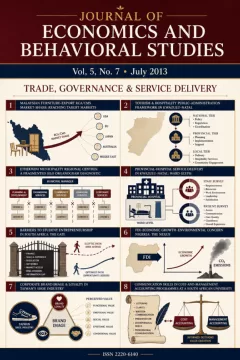
One of the reasons pointed out, as the major cause of low investment in Nigeria is low saving. To bridge the saving-investment gap, there have been calls for inflow of foreign direct investment into the country. However, there are arguments about the impacts of FDI on the host country. Principal among the various arguments is its effect on environmental degradation .This paper sets out to examine the validity of this perception using Granger causality test. It examines the direction of causality between FDI and economic growth, Economic growth and Pollution, FDI and Pollution. The results revealed that there is no causality between the growth rate of GDP and FDI, growth rate of GDP and Co2. The only causality found is a unidirectional causality between the growths of FDI grows and the growth rate of pollution. The direction is from growth rate of FDI to the growth rate of pollution. This paper concludes that government should make policy that will ensure that multinational companies use equipment that is environmentally friendly.
Keywords
- Foreign Direct Investment Search this journal for Foreign Direct Investment (opens in a new tab)
- Economic Growth Search this journal for Economic Growth (opens in a new tab)
- Pollution Search this journal for Pollution (opens in a new tab)
- CO2 Search this journal for CO2 (opens in a new tab)
- Co-integration Search this journal for Co-integration (opens in a new tab)
- Granger Causality Search this journal for Granger Causality (opens in a new tab)
- Multinational Corporation Search this journal for Multinational Corporation (opens in a new tab)
References
- Adegbite E.O. & Ayadi, F. S. (2010). The Role of FDI in Economic Development: A Study of Nigeria. World Journal of Entrepreneurship, Management and Sustainable Development , 6(½).
- Aitken, B. J. & Harrison, A. (1999). Do Domestic Firms Benefit from Direct Foreign Investment? Evidence from Venezuela. American Economic Review , 89, 605-618.
- Akinlo, A. E. (2004). Foreign direct investment and growth in Nigeria: An empirical investigation. Journal of Policy Modeling , 26, 627–39
- Aliyu, M. A. (2005).Foreign Direct Investment and the Environment: Haven Hypothesis Revisited. a Paper prepared for the Eight Annual Conference on Global Economic Analysis, Lübeck, Germany, June 9 - 11, 2005.
- Ayadi, F. S. (2009). Foreign Direct Investment and Economic Growth in Nigeria. Proceedings of the 10th Annual Conference of IAABD.
- Birdsall, N. & Wheeler, D. (1993). Trade Policy and Industrial Pollution in Latin America: Where are the Pollution Havens? Journal of Environment and Development , 2(1), 137-149.
- Blomström, M. & Edward, N. W. (1994). Multinational Corporations and Productive Convergence in Mexico". In Baumol, William J., Richard R. Nelsonand Edward N. Wolff (eds.): Convergence of Productivity: Cross National Studies and Historical Evidence. Oxford: Oxford University Press, 263-283.
- Castellani, D. & Antonello, Z. (2002a). Multinational Companies and Productivity Spillovers: Is there a Specification Error? mimeo, University of Urbino (Italy).
- Castellani, D. & Antonello, Z. (2002b). Technology gaps, absorptive capacity and the impact of inward investments on productivity of European firms, mimeo, University of Urbino (Italy).
- Coondoo, D. & Dinda, S. (2002). Causality between Income and Emission: a Country Group-Specific Econometric Analysis. Ecological Economics, 40, 351-367.
- Copeland B. R. & Taylor, M. S. (1994). North-South Trade and the Environment. Quarterly Journal of Economics , 109, 755-787.
- Copeland, B. R. & Taylor, M. S. (2003). Trade and the Environment: Theory and Evidence. Princeton: Princeton U. Press
- Damijan, J. P., Boris, M., Mark, K. & Matija, R. (2001). The Role ofFDI, Absorptive Capacity and Trade in Transferring Technology to Transition Countries: Evidence from Firm Panel Data for Eight Transition Countries, mimeo, UN Economic Commission for Europe, Geneva.
- Dees, S. (1998). Foreign direct investment in China: Determinants and effects. Economics of Planning, 31, 175– 94.
- De Mello, L. R. (1997). Foreign Direct Investment in developing countries and growth: A selective survey. Journal of Development Studies , 34(1), 1-34.
- Djankov, S. & Bernard, H. (2000). Foreign Investment and Productivity Growth in Czech Enterprises. World Bank Economic Review , 14(1), 49-64.
- Eskeland, G. S. & Harrison, A. E. (1997). Moving to Greener Pastures? Multinationals and the Pollution-haven Hypothesis. World Bank Working Paper Series N0.1744.
- Ederington, J. & Minier, J. (2003). Is environmental policy a secondary trade barrier? An empirical analysis. Canadian Journal of Economics , 36(1), 137-154
- Friedman, J. D. Gerlowski, K. & Silberman, J. (1992). What Attracts Foreign Multinational Corporations? Evidence from Branch Plant Location in the United States. Journal of Regional Science , 32, 403-418.
- Gallagher, K. (2002). Industrial Pollution in Mexico: Did NAFTA Matter?” in Carolyn L. Deere and Daniel C. Esty, eds., Greening the Americas: NAFTA’s Lessons for Hemispheric Trade, Cambridge: MIT Press.
- Granger, C. W. J. (1969). Investigating causal relation by econometric and cross-sectional method. Econometrica , 37, 424–438.
- Grossman, G. & Krueger, A. (1993). Environmental Impact of North American Free Trade Agreement. In P. Garber: The Mexico US Free Trade Agreement, MIT Press, Cambridge Massachussetts.
- Jenkins, C. & Thomas, L. (2002). Foreign direct investment in Southern Africa: determinants, characteristics and implications for economic growth and poverty alleviation, University of Oxford [internet.] Available from http://www.csae.ox.ac.uk/reports/pdfs/rep2002- 02.pdf
- Johansen, S. & Juselius, K. (1990). Maximum Likelihood Estimation and Inference on Cointegration – with Applications to the Demand for Money. Oxford Bulletin of Economics and Statistics , 52, 169-210
- Keller, W. & Levinson, A. (2002). Pollution abatement costs and foreign direct investment ináows to U.S. States. Review of Economics and Statistics , 84(4), 691ñ703.
- Konings, J. (2001). The Effects of Foreign Direct Investment on Domestic Firms: Evidence from Firm Level Panel Data in Emerging Economies. Economics of Transition , 9, 619-633.
- Levinson, A. (2003). Environmental regulatory competition: a status report and some new evidence. National Tax Journal , 56, 91–106.
- Levy, D. L. (1995). The Environmental Practices and Performance of Transnational Corporations. Transnational Corporations , 4(1).
- Lofdalh, C. L. (2002). Environmental Impacts of Globalisation and Trade: A systems study, The MIT Press, Cambridge, Massachusetts.
- MacKinnon, J. G. (1996). Numerical distribution functions for unit root and cointegration tests. Journal of Applied Econometrics , 11, 601–618.
- Noorzoy, M. S. (1979). Flows of Direct Investment and their Effects on Investment in Canada. Economic Letters , 2(3), 357-61.
- Ogundipe, M. S. & Aworinfe, O. B. (2011). An analysis of causality between Economic and Foreign Direct Investment in pre- and post-deregulated Nigerian economy (1970-2007). European Journal of Scientific Research , 53(3), 317-325
- Otepola, A. (2002). Foreign Direct Investment as a factor of Economic Growth in Nigeria. Institute for Economic Development and Planning (IDEP), Dakar, Senegal.
- Oyejide T. A. (2005). Capital Flows and Economic Transformation. A Conceptual Framework on Proceedings of Central Bank of Nigeria 5th Annual Monetary Policy Conference with the theme “Capital Flows and Economic Transformation in Nigeria. Held at the CBN Conference Hall, Abuja. November 10th to 11th.
- Pearson, C. S. (1987). Multinational Corporations, Environment, and the Third World. Durham, NC: Duke University Press, 3-31.
- Schatan, C. (2002). Mexico’s Manufacturing Exports and the Environment Under NAFTA. The Environmental effects of Free Trade. Montreal, North American Commission for Environmental Cooperation.
- Smarzynska, B. & Wei, S. (2001). Pollution Havens and the Location of Foreign Direct investment: Dirty Secret or Popular Myth? June 10, 2001. Washington, D.C.: International Trade Team – Development Economics Research Group, The World Bank. Mimeo
- Smarzynska, B. & Wei, S. (2001). Pollution Havens and the Location of Foreign Direct investment: Dirty Secret
- Smarzynska, B. & Wei, S. J. (2004). Pollution havens and foreign direct investment: Dirty secret or popular myth? Contributions to Economic Analysis and Policy , 3 (2), 1ñ32
- Warhurst, A. & Isnor, R. (1996). Environmental Issues for Developing Countries Arising from Liberalised Trade in the Mining Industries. Natural Resources Forum , 20(1), 27-35.
- Xing, Y. & Kolstad, C. D. (1996). Do Lax Environmental Regulations Attract Foreign Investment? Paper presented to National Bureau of Economic Research Workshop on Public Policy and the Environment, Cambridge, MA.
Downloads
No downloads have been recorded for this article yet. Figures appear here once readers begin downloading the full text.
How to Cite
Share this article
License
Copyright (c) 2013 Jonathan D. Danladi, Kehinde John Akomolafe (Author)

This work is licensed under a Creative Commons Attribution 4.0 International License.
Author (s) should affirm that the material has not been published previously. It has not been submitted and it is not under consideration by any other journal. At the same time author (s) need to execute a publication permission agreement to assume the responsibility of the submitted content and any omissions and errors therein. After submission of revised paper in the light of suggestions of the reviewers, the editorial team edits and formats manuscripts to bring uniformity and standardization in published material.
This work will be licensed under Creative Commons Attribution 4.0 International (CC BY 4.0) and under condition of the license, users are free to read, copy, remix, transform, redistribute, download, print, search or link to the full texts of articles and even build upon their work as long as they credit the author for the original work. Moreover, as per journal policy author (s) hold and retain copyrights without any restrictions.
Keywords
- Foreign Direct Investment Search this journal for Foreign Direct Investment (opens in a new tab)
- Economic Growth Search this journal for Economic Growth (opens in a new tab)
- Pollution Search this journal for Pollution (opens in a new tab)
- CO2 Search this journal for CO2 (opens in a new tab)
- Co-integration Search this journal for Co-integration (opens in a new tab)
- Granger Causality Search this journal for Granger Causality (opens in a new tab)
- Multinational Corporation Search this journal for Multinational Corporation (opens in a new tab)
Section
Published
Submissions
Have research to publish? Journal of Economics and Behavioral Studies welcomes submissions.
Make a Submission