Abstract
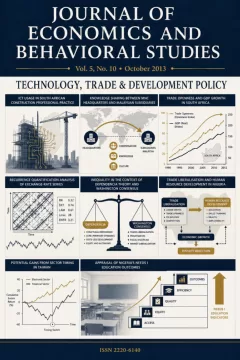
The study examined the causal links among trade liberalisation, economic growth and human resource development in Nigeria with a view to identifying the nexus connecting these three variables. Inferences of causality were drawn within the framework of Vector Auto-regression model employing techniques of analysis involving unit root test, cointegration and Granger causality tests. The findings that emerged from the analysis show that economic growth granger-caused both poverty level and trade liberalization in Nigeria. Besides, trade liberalization equally predicted poverty level. The study therefore concluded that it is desirable for government to initiate strategies that would further boost economic growth in Nigeria in order to alleviate poverty and to derive maximum benefits from trade liberalization. In addition, government should further diversify the productive base of the economy, and ensure proper integration of the key sectors of the economy to enhance output growth. In order to reduce poverty level, trade liberalization needs to be further embraced using multi-dimensional approaches such as more tariff reduction, and systematic reduction or removal of other forms of quantitative and qualitative restrictions on goods and services.
Keywords
References
- Agrawal P. (2008). Economic and Poverty Reduction: Evidence from Kazakhstan. Asian Development Review , 24(2), 90-115.
- Balasubramanyan, V. N., Salisu M. A. & Saps-ford, D. (1996). Foreign Direct Investment and Growth in E.P and IS countries. Economic Journal , 106, 92-105.
- Bhagwati, J. (2000). Poverty of Reforms Friends or Foes. In the winds of the hundred days: How Washington mismanaged Globalisation. Cambridge and London MIT Press.
- Blanchard, E. & Willmann, G. (2008). Trade, Education and the Shrinking MiddleClass.JEL Classifications: F11, F12, F15, F16.
- Borensztein, E. J., De Gregoria, K. & Lee, J. (1998). How does Foreign Investment affect Economic Growth? Journal of International Economics , 45(1), 115-35.
- Bourguignon, F. (2003). The Growth Elasticity of Poverty Reduction. In T. EICHER T. and Turnovsky S. Inequality and Growth. MIT Press, Cambridge. Working Paper. May.
- Bussolo, M., Lay, J., Medveden, D. & Van der Mensbrugghe, D. (2008). Trade Options for Latin America: A poverty Assessment Using a Top down Macro-Micro Modelling Framework in Bourgguignon F, Bussolo M, and Calvo, S. Leiderman C. and Reinhart Cpp123 – 39.
- Chuang, Y. C. (2000). Human Capital, Exports, and Economic Growth: A Causality Analysis for Taiwan, 1952-1995. Rev. Int. Econ ., 8(4), 712-720.
- Datt, G. & Ravallion, I. (2002). Is India’s Economic Growth Living the Poor Behind?’World Bank Washington D.C. Mimeo.
- Deaton, A. & Dreze, I. (2002). Poverty and Inequality in India: A Re-examination. Economic and Political Weekly. September, 3729-48.
- Dollar, D. & Kraay, A. (2000). Growth Is Good for the Poor Mimeo, World Bank, Washington, D.C.
- Dollar, D. & Kraay, A. (2002). Growth is good for the Poor. Journal of Economic Growth, 7, 195-225.
- Domeland, D. (2007). Trade and Human Capital Accumulation: Evidence from U.S. immigrants. No 4144, Policy Research Working Paper Series from the World Bank.
- Dunning, J. H. & Narula, R. (1996). Foreign Direct Investment and Government, Routledge.
- Gallup, J. L., Radelet, S. & Warner, A. (1999). Economic Growth and the Income of the Poor CAER II Discussion Paper No. 36, HIID, Harvard.
- Government of India (GOI). (2000). Education for All: The Year 2000 Assessment Final Country Report of India, New Delhi: Government of India.
- Gould, D. M. & Ruffin, R. J. (1995). Human Capital, Trade and Economic Growth. Weltwirtschaftliches Archive, 13(1), 425-445.
- Goulder, L. H. & Eichengreen, B. (1992). Trade Liberalisation in General Equilibrium: Intertemporal and Interindustry Effects. The Canadian Journal of Economics , 25(2), 253-280.
- Hanson, G. H. & Hanson, A. (1995). Trade, Technology, and Wage Inequality. NBER Working Papers. 5110. National Bureau of Economic Research; Inc.
- Jones, R. W. & Scheinkman, J. (1977). The Relevance of the Two-Sector Production Model in Trade Theory. Journal of Political Economy , 85, 909-935.
- Karmei, P. H. & Polasek, N. (1980). Applied Statistics for Economists. Pitman Publishing, Australia.
- Klasen, S. (2003). In Search of the Holy Grail: How to Achieve Pro-poor Growth. In B. Tungodden, Stern N. and Kolstad (Eds). Towards Pro-poor Policies: Aid, Institutions and Globalisation. Proceedings from the Annual World Bank Conference on Development Economics, Europe Conference 2003, Washington D.C
- Long, N. V., Riezman, R. & Soubeyran, A. (2003). Trade, Wage Gaps, and Specific Human Capital Accumulation. CESIFO Working Paper No 911 Category 7: Trade Policy April.
- Metzler, L. A. (1949). International Demand and Domestic Prices. Journal of Political Economy, 57, 345351.
- Miyamoto, K. (2003). Human Capital Formation and Foreign Director Investment in Developing Countries Development Centre Working Paper No. 211 (Formerly Technical paper No. 211) July 2003. DEV/DOC 09
- Naranpanawa, R. M. A. K. B. (2005). Trade Liberalization and Poverty in a Computable General Equilibrium (CGE) Model: The Sri-Lankan Case. Unpublished PhD Thesis of the Department of Accounting, Finance and Economics, Griffith Business School, Griffith, University, Australia.
- Neary, I. J. (2004). The Stolper-Samuelson Theorem. Prepared for Encyclopaedia of World Trade Since 1450, (online). Available at: http://www.ucd.ie/economic/ staff/pneary/pdf/stolpers.pdf
- Nwaobi, G. C. (1999). Money and output, Interaction in Nigeria: an Econometric investigation using Multivariate Cointegration Technique. CBN Economic and Financial Review , 37(3), 44–76.
- Ogun, T. P. (2010). Infrastructure and Poverty Reduction: Implications for Urban Development in Nigeria. Urban Forum , Springer Science Media B.V. , 21, 249-266.
- Okojie, C. E. E. (2002). Gender and Education as Determinants of Household Poverty in Nigeria. UNIWIDER Discussion Paper. No 2002/37. Helsinki
- Oyejide, A. T. (2002). Monetary Policy and its Effects on the Nigerian Economy: Proceedings of Nigeria Economic Society one-day’s Seminar Held in Lagos.
- Karmel, P. H. & Polasek, M. (1980). Applied Statistics for Economics. Victoria Pitman Publishing Pty Ltd
- Ranis, G. & Stewart, F. (2001). Growth and Human Development: Comparative Latin American Experience, Yale University Economic Growth Centre Discussion Paper 826.
- Rao, N., Cheng, K. & Narain, K. (2003). Primary Schooling in China and India: Understanding How SocioContextual Factors Moderate the Roles of the State. International Review of Education , 49, (1/2), 153-176.
- Ravallion, M. & Datt, G. (1996). How Important to India’s Poor is the Sectoral Composition of Economic Growth? World Bank Economic Review , 10(1), 1-25.
- Roemer, M. & Gugerty, M. (1997). Does Economic Growth Reduce Poverty? CARE II Discussion Paper No. 4, HIID, Harvard.
- Sanusi, J. O. (2002). Central Bank and the Macroeconomic Environment in Nigeria. A Lecture delivered at Senior Executive Course N0 24 Institute of Policy and Strategy Studies.
- Stolper, W. F. & Samuelson, P. A. (1941). Protection and real wages. The Review of Economic Studies, 9(1), 58-73.
- Stokey, N. L. (1991). Human Capital Product Quality and Growth. Quarterly Journal, 106(2), 587-616.
- Tendulkar, S. D. & Jain, L. R. (1995). Economic Growth, Relative Inequality, and Equity: The Case of India. Asian Development Review, 13(2), 138-68.
- Teweldemedhin, M. Y. (2009). Implications of Trade Liberalisation and Economic Growth for South African Agricultural Industries. Dept. of Agricultural Economics, Faculty of Agriculture and Natural Sciences. University of Free State, Bloemfontein, South Africa
- Tanna, S. & Topaiboul, K. (2006). Human Capital, Trade, FDI and Growth in Thailand: What causes What? DEGIT Conference Papers from DEGIT, Economic Growth, and International Trade. New economics Papers; this item is included in nep-dev, nep-edu, nep -sea. Date: 2005-2006.
- Tikly, L. (2001). Globalisation and Education in the Post Colonial World: Towards a Conceptual Framework. Journal of Comparative Education, 37(2), 151-171.
- Timmer, P. (1997). How Well Do the Poor Connect to the Growth Process? CAER II Discussion Paper No. 17, HIID, Harvard.
- Tsen, W. (2006). Granger Causality Tests Among Openness to International Trade, Human Capital Accumulation and Economic Growth in China1952-1999. International Economic Journal , 20(3), 285-302
- Winters, A. L. (2000). ‘Trade Liberalisation and Poverty’. Prus Working paper No 7 April. Poverty Research Unit as Sussex, University of Sussex Falmer, Brighton. BN198
- World Bank. (1999). Coping with the Cost in Education and Health. Thailand Social Monitor Washington, D. C. June.
- World Bank. (2000). Global Economic Passports and the Developing Countries Washington, DC
- World Bank. (2000). World Bank Development Report. Oxford University Press., New York.
Downloads
No downloads have been recorded for this article yet. Figures appear here once readers begin downloading the full text.
How to Cite
Share this article
License
Copyright (c) 2013 Aremo Adeleke Gabriel (Author)

This work is licensed under a Creative Commons Attribution 4.0 International License.
Author (s) should affirm that the material has not been published previously. It has not been submitted and it is not under consideration by any other journal. At the same time author (s) need to execute a publication permission agreement to assume the responsibility of the submitted content and any omissions and errors therein. After submission of revised paper in the light of suggestions of the reviewers, the editorial team edits and formats manuscripts to bring uniformity and standardization in published material.
This work will be licensed under Creative Commons Attribution 4.0 International (CC BY 4.0) and under condition of the license, users are free to read, copy, remix, transform, redistribute, download, print, search or link to the full texts of articles and even build upon their work as long as they credit the author for the original work. Moreover, as per journal policy author (s) hold and retain copyrights without any restrictions.
Keywords
Section
Published
Submissions
Have research to publish? Journal of Economics and Behavioral Studies welcomes submissions.
Make a Submission