Abstract
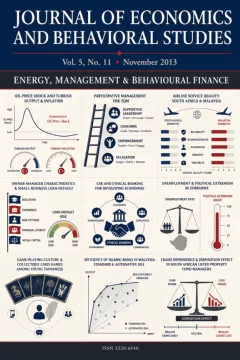
The potential of small businesses is inhibited by a cocktail of problems of which inaccessibility to finance is pre-eminent. This problem is linked to the lenders’ risk estimation, often based on financial indicators which small businesses are not adept at using to signal their performance ability. This situation, especially in South Africa, with a history of a people who were previously disadvantaged does not aid the development of small businesses that may well be the antidote for overcoming the strain of poverty and unemployment in the country. This study stems from the human capital theory and investigated possible relationships between owner-manager characteristics and loan default propensity. The aim being to unveil non-financial variables, associated with the owner-manager which could be relied upon by lenders’ to estimate the loan default propensity of the small business borrower. Primary data collected in South Africa were empirically analysed for possible associations between owner-manager characteristics and loan default propensity. Results revealed business size-dependent differences in the association between certain ownermanager characteristics and business loan default propensity. The implication of this for all stakeholders is that considerations for small business lending should be sensitive to business size.
Keywords
- Small Search this journal for Small (opens in a new tab)
- Micro and Medium Enterprises (SMMEs) Search this journal for Micro and Medium Enterprises (SMMEs) (opens in a new tab)
- Entrepreneurship Search this journal for Entrepreneurship (opens in a new tab)
- Small Business Finance Search this journal for Small Business Finance (opens in a new tab)
- OwnerManager Search this journal for OwnerManager (opens in a new tab)
- Loan Default Propensity Search this journal for Loan Default Propensity (opens in a new tab)
References
- Allen-Ile, C & Eresia-Eke, C. (2007). The role of management style on the propensity for loan default by small businesses. Journal of business and management dynamics 1, 14-27.
- Altman, E. (1983). Corporate financial distress – A complete guide to predicting, avoiding and dealing with bankruptcy . New York: John Wiley & Sons.
- Alvarez S. & Meyer, G. (1998). Why do women become entrepreneurs? Frontiers of Entrepreneurship Research.
- Bates, C. (1991). Commercial bank finance in white and black owned small business start-ups. Quarterly Review of Economics and Business, 31 (3), pp. 64-80.
- Baumback, C. (1983). Small Business Management Practice , Englewood Cliffs: Prentice Hall.
- Berg, N. (1997). Gender, Place and Entrepreneurship. Entrepreneurship and regional development 9 , 259-268.
- Belcourt, M. Burke, R. & Lee-Gosselin, H. (1991). The glass box: Women business owners in Canada. Background paper, Canadian advisory council on the state of women. Ottawa, Ontario
- Bhatt, N. and Tang, S. (1998). The Problem of Transaction Costs in Group-based Micro-lending: An Institutional Perspective. World Development, (26)4, 623-637.
- Blackburn R., Hart M. & Wainwright T. (2013). Small business performance: business, strategy and ownermanager characteristics. Journal of small business and enterprise development 20(1), 9-27
- Boden R. & Nucci A. (1999). On the survival prospects of men’s and women’s new business ventures. Journal of Business Venturing, 15; 347-362
- Breen, J., Calvert, C. & Oliver, J. (1995). Female entrepreneurs in Australia: An investigation of financial and family issues. Journal of Enterprising Culture 3(4), 445-461
- Brockhaus, R. (1980). Risk-taking propensity of entrepreneurs. Academy of Management Journal 23(3), 509520
- Brush, C. & Hisrich, R. (2000). Women-owned businesses: An exploratory study comparing factors affecting performance. Working paper of the research institute for small and emerging businesses inc. www.riseb.org
- Caner, S. & Karan, M (2012). Screening creditworthiness of SMEs: The case of small business assistance in Turkey. Multinational finance journal, 16 (1), 1-20
- Carlsson, G. & Karlsson, K. (1970). Age, Cohorts and the generation of generations. American sociological review 35, 710-718
- Carter, S. & Rose, P. (1998). The financing of male- and female-owned businesses. Entrepreneurship and regional development, 10(3), 225-241.
- Child, J. (1974). Managerial and organisational factors associated with company performance. Journal of Management studies 11, 13-27
- Clayton, K. (1998). Women’s work: Success in small business. Australian CPA; Melbourne Nov: 36-39
- Coleman, S. (2000). Access to Capital and Terms of Credit: A Comparison of Men-and Women-Owned Small Businesses. Journal of Small Business Management, 3(38), 37-52.
- Cooper A., Gimeno-Gascon F. & Woo C. (1994). Initial human and financial capital as predictors of new venture performance. Journal of Business Venturing 9, 371-395.
- Cuba, R., DeCenzo, D., and Anish, A. (1983). Management practices of successful female business owners. American Journal of small business 8(2), 40-45.
- Curran, J. and Blackburn, R. (2001). Researching the small enterprise. London: Sage publications.
- D’Ambroise, G. & Muldowney, M. (1988). Management theory for small business: attempts and requirements. Academy of management review 13, 226-240.
- Delmar F. (1997). Measuring Growth: Methodological considerations and empirical results in Donckels R. and Miettinen A. (Eds), Entrepreneurship and SME Research on its way to the next millennium, Aldershot, Ashgate.
- Department of Trade and Industry (1998). Financial Access for SMMEs: Towards a comprehensive strategy. Paper prepared by the Centre for Small Business Promotion, Department of Trade and Industry (DTI) for the South African Parliament (April).
- Dunkelberg W. and Cooper A. (1982). Patterns of Small Business Growth. Academy of Management Proceedings, 409-413
- Eyiah, A. (2001). An Integrated Approach to Financing Small Contractors in Developing Countries: A Conceptual Model. Journal of Construction Management and Economics, 19, 511-518.
- European Commission (1997). Women as agents of regional development. Official publications service of the European community, Luxemburg.
- Fatoki, O. (2012). The impact of entrepreneurial orientation on access to debt finance and performance of small and medium business in South Africa. Journal of social sciences 32(2), 121-131.
- Fjose, S., Grunfeld, L. & Green, C. (2010). SMEs and growth in Sub-Saharan Africa. MENON Business Economics
- Freel M., Carter S., Tagg S. & Mason, C. (2012). The latent demand for bank debt: characterizing discouraged borrowers. Small business economics 38, 399-418
- Hambrick, D. and Mason, P. (1984). Upper Echelons: The organisation as a reflection of its top managers. Academy of Management Review , 9(2), 193-206.
- Hansen B. & Hamilton R. (2011). Factors distinguishing small firm growers and non-growers. International small business journal 29(3), 278-291.
- Hart, P. & Mellons, J. (1970). Management youth and company growth: A correlation? Management Decision 4(2), 50-53
- Haynes G. & Haynes D. (1999). The debt structure of small businesses owned by women in 1987 and 1993. Journal of Small business Management 37(2), 1-20.
- Hempell, G. and Sinonson, D. (1990). Bank Management . New York: John Wiley & Sons Inc.
- Herron, L. and Robinson, R. (1993). A structural model of the effects of entrepreneurial characteristics on venture performance. Journal of Business Venturing, 8, 281-294.
- Gartner, W. & Frid, C. (2012). Financing the emerging firm. Small business economics, 39, 745-761.
- Johnson S. & Storey D. (1993). Male and Female Entrepreneurs and their business: A comparative study in Allen s. and Truman C. (Eds), Women in Business: Perspectives on Women Entrepreneurs. London, Routledge Press, 70-83
- Kabacoff, R. (1998). Gender differences in organisational leadership: A large sample study. Paper presented at the meeting of the American psychological association. San Francisco, CA
- Kalleberg, A. and Leicht, K. (1991). Gender and Organizational Performance: Determinants of Small Business Survival and Success. Academy of Management Journal, 34(1), 136-161.
- Kasseeah, H., & Thoplan, R. (2012). Access to financing in a small island economy: Evidence from Mauritius. Journal of African business, 13(3), 221-231.
- Keasey, K. and Watson, R. (1991). The state of the art of small firm failure prediction: Achievements and Prognosis. International Small Business Journal, 9(4), 11-29.
- Kolari, J., Berney, R. and Ou, C. (1997). Study Finds Small Banks Profit from Small Business Lending, Despite Risks. Journal of Retail Banking, 3(19), 17-24.
- Kotey, B. (1999). Debt Financing and Factors Internal to the Business. International Small Business Journal, 17(3), 11-29.
- Ladzani, W. and Van Vuuren, J. (2002). Entrepreneurship Training for Emerging SMEs in South Africa. Journal of Small Business Management, 40(2), 154-161.
- Lerner M. & Almor T. (2002). Relationships among strategic capabilities and the performance of womenowned small ventures. Journal of Small Business management, 40(2), 109-125.
- Liedholm, C. (2002). Small firm dynamics: Evidence from Africa and Latin America. Journal of Small Business Economics, 18, 227-242.
- Lucey, B. (2010). Determinants of capital structure of Irish SMEs. Small business economics, 35(3), 1-25.
- Lussier, R. (1995). A non-financial business success versus failure prediction model for young firms. Journal of Small Business Management, 33(1), 8-20.
- Lussier, R. and Pfeifer, S. (2001). A cross-national prediction model for business success. Journal of Small Business Management , 39(3), 228-239.
- Marlow, S. & Patton, D. (2005). All credit to men? Entrepreneurship, finance and gender . Entrepreneurship Theory and Practice, (29), 717-736.
- McConnel, J. and Pettit, R. (1984). Application of the modern theory of finance to small business firms. Small Business Finance, 42, 97-126.
- Mead, D. and Liedholm, C. (1998). The Dynamics of Micro and Small Enterprises in Developing Countries. World Development, 26(1), 61-74.
- Neider, B. (1987). A preliminary investigation of female entrepreneurs in Florida. Journal of small business management 25(3), 22-29.
- Nguyen, N. & Luu, N (2013). Determinants of financing pattern and access to formal/informal credit: The case of small and medium-sized enterprises in Vietnam. Journal of management research, 5(2), 240-259.
- Okafor, R. & Onebunne, I. (2012). Review of financial challenges of Nigerian entrepreneurs in an attempt to reduce financial institutions’ risk perception index of small firms: Evidence from survey data. Developing country studies, 2(11), 197-204.
- Orser, B., Riding A., & Manley, K. (2006). Women entrepreneurs and financial capital. Entrepreneurship Theory and Practice (30), 643-665.
- Ovadje, F. (2003). Access to Credit: A study of the Perception of Nigerian Women Entrepreneurs. Lagos Business School Management Review, 8(1), 21-27.
- Owualah, S. (1999). Entrepreneurship in Small Business Firms . Lagos: G-Mag Educational Publishers.
- Riding, A. & Swift, C. (1990). Women business owners and terms of credit: some empirical findings of the Canadian experience. Journal of business venturing, 5(5), 327-340.
- Rogers, B. (2002). Funding of SMEs: Sourcing for funds and problems limiting access. The official journal of the Institute of chartered accountants of Nigeria, 35(1), 15-18.
- Rogerson, C. (1995). SMME Infrastructure and policy in South Africa. International Small Business Journal, 13(3).
- Rogerson, C. (2008). Tracking SMME development in South Africa: Issues of finance, training and regulatory environment. Urban forum, 19(1), 61-81.
- Roper, S. (1999). Modelling small business growth and profitability. Small Business Economics, 13, 235-252.
- Rosa, P., Carter, S. & Hamilton, D. (1996). Gender as a determinant of small business performance: Insights of a British study. Small Business Economics 8, 463-478.
- Sandberg W. (1986). New venture performance: the role of strategy and industry structure, Lexington, D.C. Heath & Co.
- Sorenson, P., Hawkins, K. & Sorenson, R. (1995). Gender, psychological type and conflict style preference. Management communication quarterly 9(1), 115-126.
- Srivanson, R., Woo, C. & Cooper, A. (1994). Performance determinants for male and female entrepreneurs. In Frontiers of entrepreneurship research (Ed) Bygrave, W., Birley, S., Churchill, N., Gatewood, E., Hoy, F., Keely, R., Wetzel, W. Wellesley, Mass: Babson college, 43-55.
- Statistics South Africa (2009). Quarterly Labour Force Survey, Quarter 3 . p.17 http://www.statssa.gov.za/publications/P0211/P02113rdQuarter2009.pdf. Accessed 01 Dec 2009.
- Van Praag M. & de Wit G. (2001). The value of investments in human and social capital for small business founders. Frontiers of Entrepreneurship research, 213-223.
- Verheul, I. & Thurik, R. (2001). Start-up capital: Does gender matter? Small business economics, 16(4), 329345.
- Westhead P. (1995). Survival and employment growth: Contrasts between types of owner-managed high technology firms. Entrepreneurship and Practice, Fall, 5-27.
Downloads
No downloads have been recorded for this article yet. Figures appear here once readers begin downloading the full text.
How to Cite
Share this article
License
Copyright (c) 2013 Eresia-Eke, CE (Author)

This work is licensed under a Creative Commons Attribution 4.0 International License.
Author (s) should affirm that the material has not been published previously. It has not been submitted and it is not under consideration by any other journal. At the same time author (s) need to execute a publication permission agreement to assume the responsibility of the submitted content and any omissions and errors therein. After submission of revised paper in the light of suggestions of the reviewers, the editorial team edits and formats manuscripts to bring uniformity and standardization in published material.
This work will be licensed under Creative Commons Attribution 4.0 International (CC BY 4.0) and under condition of the license, users are free to read, copy, remix, transform, redistribute, download, print, search or link to the full texts of articles and even build upon their work as long as they credit the author for the original work. Moreover, as per journal policy author (s) hold and retain copyrights without any restrictions.
Keywords
- Small Search this journal for Small (opens in a new tab)
- Micro and Medium Enterprises (SMMEs) Search this journal for Micro and Medium Enterprises (SMMEs) (opens in a new tab)
- Entrepreneurship Search this journal for Entrepreneurship (opens in a new tab)
- Small Business Finance Search this journal for Small Business Finance (opens in a new tab)
- OwnerManager Search this journal for OwnerManager (opens in a new tab)
- Loan Default Propensity Search this journal for Loan Default Propensity (opens in a new tab)
Section
Published
Submissions
Have research to publish? Journal of Economics and Behavioral Studies welcomes submissions.
Make a Submission