Abstract
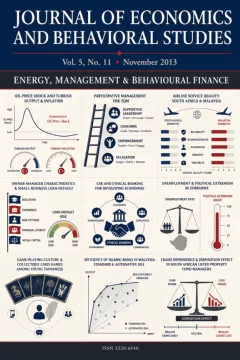
Unemployment prevalence among the youth is largely tribute to political extremism in politically disoriented countries. The paper examined the effects of political extremism in Zimbabwe on the high unemployment statistics in the period between 2000- 2010. The study applies the Zimbabwean quarterly data to explore the relationship among variables by using interrelated Tobit econometric procedure. The study findings indicated that 82.97 percent of the Zimbabwean population is unemployed, if the country is unstable and there is political violence. The partial coefficients showed that when political extremism persists, and is not controlled, unemployment is likely to increase by almost 4.29 percent increase in each period.
Keywords
References
- Appelbaum, E. (2008). Extremism as a strategic tool in conflicts in conflicts. Journal of Economic behavior and organization, 68, 352- 364.
- Bay, A. & Blekensaune, H. (2002). Youth, unemployment and Political marginalization. International Journal of Social Welfare , 11, 132- 139
- Berrebi, C. & Klor, E. R. (2006). On terrorism and electoral outcomes; Theory and evidence from the IsraeliPalestinian Conflict. Journal of Conflict Resolution , 50, 899- 925.
- Chirisa, I. & Muchini, T. (2011). Youth, Unemployment and Peri- Urbanity in Zimbabwe: a snapshot of lessons from Hatcliffe. International Journal of Politics and Good Governance, 2, 1- 15.
- CIA Factbook. The world Fact BookZimbabwe. (2013). Available [Online] https://www.cia.gov/library/publications/the-world-factbook/geos/zi.html Accessed 15/08/2013.
- Cochrane, R. & Billig, M. (1983). Youth and Politics. Youth and Policy , 2, 31- 34
- CSO. Labour Force Survey. (2004). [Online] Available: http://www.zimstat.co.zw Accessed 13/08/2013.
- Glazer, A. & Konrad, K. A. (1996). A signalling Explanation for Charity. The America Economic Review , 86, 1019- 1028
- Hansen, B. E. (2009). Econometrics. 2nd edition. University of Wisconsin press.
- Winsconsin Heckman, J. J. (1979). Sample selection bias as a specification error. Econometrica, 47, 153- 161 Lapan, H. E. & Sandler, T. (1993). Terrorism and signalling. European Journal of Political Economy, 9, 383- 397.
- Luebker, M. (2008). Employment, Unemployment and Informality in Zimbabwe: Concepts and Data for Coherent Policy- making. ILO integration working paper, 90.
- Pepe, R. A. (2003). The strategic logic of suicide terrorism. The American Political Social Review, 97, 343- 361.
- Roemer, J. E. (2001). Political Competition: Theory and Applications. Harvard University Press.
- Boston Roneck, D. W. (1992). Learning more from the Tobit Coefficients: Extending a comparative Analysis of Political Protest. American Sociological Review, 57, 503- 507.
- Shurghart, W. F. (2006). An Analytical history of terrorism. Public Choice , 128, 7- 39.
- Tobin, J. (1958). Estimation of Relationship for limited dependent variable. Econometrica , 26, 24-36 UNOCHA, Unemployment in Zimbabwe. (2010). Available [Online] www.mydec.gov.zw Accessed 12/08/2013 Walton, J. & Ragin, C. (1990). Global and National Sources of Political Protest: Third World Protest to Debt Crisis. American Sociological Review, 55, 876- 890.
- Wooldridge, J. M. (2000). Introductory Econometrics: A modern Approach. Southern Western College Publishing. Mason.
Downloads
No downloads have been recorded for this article yet. Figures appear here once readers begin downloading the full text.
How to Cite
Share this article
License
Copyright (c) 2013 Innocent Sitima, Clifford Kendrick Hlatywayo (Author)

This work is licensed under a Creative Commons Attribution 4.0 International License.
Author (s) should affirm that the material has not been published previously. It has not been submitted and it is not under consideration by any other journal. At the same time author (s) need to execute a publication permission agreement to assume the responsibility of the submitted content and any omissions and errors therein. After submission of revised paper in the light of suggestions of the reviewers, the editorial team edits and formats manuscripts to bring uniformity and standardization in published material.
This work will be licensed under Creative Commons Attribution 4.0 International (CC BY 4.0) and under condition of the license, users are free to read, copy, remix, transform, redistribute, download, print, search or link to the full texts of articles and even build upon their work as long as they credit the author for the original work. Moreover, as per journal policy author (s) hold and retain copyrights without any restrictions.
Keywords
Section
Published
Submissions
Have research to publish? Journal of Economics and Behavioral Studies welcomes submissions.
Make a Submission