Abstract
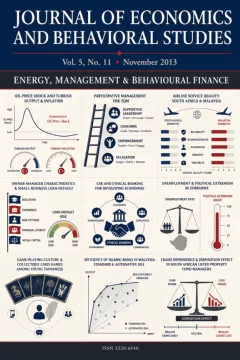
The purpose of this paper is to analyse the efficiency of Islamic banks in Malaysia using both the standard approach and the alternative approach to Data Envelopment Analysis (DEA). The standard approach relies on linear averages of outputs and inputs to measure efficiency whereas the alternative approach uses nonlinear averages. Both approaches are tested on 14 Islamic banks in Malaysia for the three-year period, 2008 to 2010. Our overall results for the three years suggest that, the inefficiency level among these banks using the standard approach (SDEA) is much higher than using the alternative approach (ADEA). Implications and future research are also discussed.
Keywords
- Efficiency Search this journal for Efficiency (opens in a new tab)
- Data Envelopment Analysis (DEA) Search this journal for Data Envelopment Analysis (DEA) (opens in a new tab)
- Standard Approach Search this journal for Standard Approach (opens in a new tab)
- Alternative Approach Search this journal for Alternative Approach (opens in a new tab)
- Islamic Banks Search this journal for Islamic Banks (opens in a new tab)
- Malaysia Search this journal for Malaysia (opens in a new tab)
References
- Aik, N. C. & Tan, K. E. (2012). Cost and profit efficiency of the full-fledged Islamic banks and Islamic window in Malaysia. Segi Review , 5(1), 41-46.
- Bashir, A. H. M. (2001). Assessing the Performance of Islamic Banks: Some Evidence from the Middle East, in American Economic Association Annual Meeting, New Orleans, Louisiana.
- Berger, A. N. & Humphrey, D. B. (1997). Efficiency of Financial Institutions: International Survey and Directions for Future Research. European Journal of Operations Research , 98, 175-212
- Haron, S. W. N. & Azmi, W. (2004). Profitability Determinants of Islamic Banks: A Co-integration Approach”, Proceedings of the Islamic Banking Conference, Union Arab Bank, Beirut, Lebanon, 5- 7December 2004.
- Kamaruddin, B. H., Safa, M. S. & Mohd, R. (2008). Assessing Production Efficiency of Islamic Banks and Conventional Banks Islamic windows in Malaysia, MPRA Paper no 10670, available online at http//mpra.ub.unimuenchen.de/10670
- Samad, A. & Hassan, M. K. (1999). The Performance of Malaysian Islamic Banks during 1984-1997: An Exploratory Study. Journal of Islamic Financial Services , 1(2).
- Samad, A. (2004). Performance of Interest-Free Islamic Banks Vis-a-Vis Interest-based Conventional Banks in Bahrain. IIUM Journal of Economics and Management , 12(2).
- Shirvani, H., Taj, S. & Mirshab, B. (2011). A New Approach to Data Envelopment Analysis with an Application to Bank Efficiency in Turkey. Banks and Bank Systems , 6(1), 5-10.
- Sufian, F. (2007). The efficiency of Islamic banking industry in Malaysia: Foreign vs domestic banks. Humanomics , 23(3), 174-192.
- Seiford, L. M. & Thrall, R. M. (1990). Recent Developments in DEA: the Mathematical Programming Approach to Frontier Analysis. J Econometrics , 4, 7-38.
- Tahir, I. M., Bakar, N. B. & Haron, S. (2011). Evaluating Efficiency of Islamic Banks Using Data Envelopment Analysis: International Evidence . Journal of Islamic Economics, Banking and Finance , 7(1), 11-24.
Downloads
No downloads have been recorded for this article yet. Figures appear here once readers begin downloading the full text.
How to Cite
Share this article
License
Copyright (c) 2013 Izah Mohd Tahir, Ahmad Rizal Razali, Sudin Haron (Author)

This work is licensed under a Creative Commons Attribution 4.0 International License.
Author (s) should affirm that the material has not been published previously. It has not been submitted and it is not under consideration by any other journal. At the same time author (s) need to execute a publication permission agreement to assume the responsibility of the submitted content and any omissions and errors therein. After submission of revised paper in the light of suggestions of the reviewers, the editorial team edits and formats manuscripts to bring uniformity and standardization in published material.
This work will be licensed under Creative Commons Attribution 4.0 International (CC BY 4.0) and under condition of the license, users are free to read, copy, remix, transform, redistribute, download, print, search or link to the full texts of articles and even build upon their work as long as they credit the author for the original work. Moreover, as per journal policy author (s) hold and retain copyrights without any restrictions.
Keywords
- Efficiency Search this journal for Efficiency (opens in a new tab)
- Data Envelopment Analysis (DEA) Search this journal for Data Envelopment Analysis (DEA) (opens in a new tab)
- Standard Approach Search this journal for Standard Approach (opens in a new tab)
- Alternative Approach Search this journal for Alternative Approach (opens in a new tab)
- Islamic Banks Search this journal for Islamic Banks (opens in a new tab)
- Malaysia Search this journal for Malaysia (opens in a new tab)
Section
Published
Submissions
Have research to publish? Journal of Economics and Behavioral Studies welcomes submissions.
Make a Submission