Abstract
The purpose of this study was to investigate the effect of contractor selection andrequirements on Health and Safety compliance in Botswana. Literature was reviewed, a questionnairesurvey was conducted and the statistical analysis undertaken. According to Murie (2007), one of the weaknesses of adopting traditional procurement approach is that the successful tender will frequently be the one that, among others, does not provide H&S protective equipment or have insurance coverage for accidents, and has the largest proportion of informal workers, who are not covered in practice by any legal or social protection. The study has provided usefulinformation involving key stakeholders involvement in H&S performance in constructionindustry. The traditional method could thus impede on Health and Safety management from project preplanningthrough to construction on site.
Keywords
References
- Hislop, R. (1999). Construction Site Safety: A Guide for Managing Contractors. Lewis Publishers, USA. Kartam, N. A., Flood, I. & Koushki, P. (2000). Construction safety in Kuwait: issues, procedures, problems, and recommendations. Safety Science , 36, 164-184.
- Kumaraswamy, M. & Dulaimi M. (2001). Empowering innovative improvements through creative construction procurement . Engineering Construction and Architectural Management, 8(5-6), 325– 334.
- McDonald, N. & Hrymak, V. (2002). Safety Behaviour in the Construction Industry. Report to the Health and Safety Authority, Dublin and the Health and Safety Executive, Northern Ireland
- Murie, F. (2007). Building Safety - An International Perspective. Building and Woodworkers International (BWI), a federation of 350 trade unions. International Journal of Occupational and Environmental Health in Construction, 1(3).
- Public Procurement and Asset Disposal Board (PPADB). (2008). Public Procurement and Asset Disposal Board, registration of contractors, Botswana. [on line] Available from http//www.ppadb.co.bw [Accessed on the 28th November 2008]
- Rwelamila, P. D., Talukhaba, A. A. & Ngowi, A. B. (2000). Project procurement systems in the attainment of sustainable construction. Sustainable Development, 8(1) , 39-50.
- Smallwood, J. (1996). The Influence of Designers on Occupational Safety and Health. In First International Conference of CIB Working Commission W99, Implementation of Safety and Health on Construction Sites, 203-213. Rotterdam: Technical University of Lisbon.
- Smallwood, J. J. (2004). The influence of engineering designers on H&S during construction. Journal of the South African Institution of civil Engineering, 46(1), 2 - 8.
- Van Rijn, J. (2005). Procurement In the Construction Industry, in development countries, Edition 2005
- Winch, G. M. (2000). Institutional reform in British construction: Partnering and private finance. Building Research & Information, 28(1), 141-155.
Downloads
No downloads have been recorded for this article yet. Figures appear here once readers begin downloading the full text.
How to Cite
Share this article
License
Copyright (c) 2014 Erastus Mwanaumo, Wellington Didibhuku Thwala, Jan-Harm Pretorius (Author)

This work is licensed under a Creative Commons Attribution 4.0 International License.
Author (s) should affirm that the material has not been published previously. It has not been submitted and it is not under consideration by any other journal. At the same time author (s) need to execute a publication permission agreement to assume the responsibility of the submitted content and any omissions and errors therein. After submission of revised paper in the light of suggestions of the reviewers, the editorial team edits and formats manuscripts to bring uniformity and standardization in published material.
This work will be licensed under Creative Commons Attribution 4.0 International (CC BY 4.0) and under condition of the license, users are free to read, copy, remix, transform, redistribute, download, print, search or link to the full texts of articles and even build upon their work as long as they credit the author for the original work. Moreover, as per journal policy author (s) hold and retain copyrights without any restrictions.
Keywords
Section
Published in
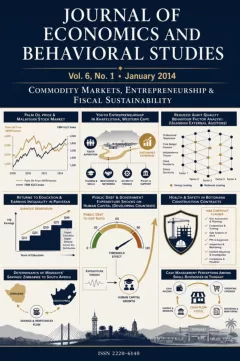 Vol. 6 No. 1 (2014)
Commodity Markets, Entrepreneurship & Fiscal Sustainability
View issue contents
Published
Submissions
Have research to publish? Journal of Economics and Behavioral Studies welcomes submissions.
Make a Submission