Abstract
This paper examines the implications of shocks to public debt and government expenditure on the development of human capital and growth within a model that explicitly recognizes the role of fiscal constraints through introducing the government budget constraint for a set of selected developing countries1 from 1980-2013. This is mainly to capture fiscal challenges facing developing countries in developing human capital which is fundamental for sustainable growth. The dynamics of our model results reveal that high stocks of public debt, beyond the 30-40% debt/GDP threshold, depress the effect of human capital on output growth through limiting government expenditure resources available for developing human capital. Although we find that government expenditure has a positive role to play in developing human capital, sustainability becomes questionable particularly for countries where there are fiscal constraints. We conclude that developing countries which face fiscal challenges such as high public debt and poor revenue prospects to back government expenditure sustainably, cannot solely develop human capital based on the strength of their domestic resources, underscoring the need for specific supportive global fund for human capital development. The key policy implication calls for public debt management strategies and efficient government expenditure management frameworks supported by sustainable revenue prospects to provide fiscal sustenance impetus to enhance the growth process in developing countries.
Keywords
- Human Capital Search this journal for Human Capital (opens in a new tab)
- Growth Search this journal for Growth (opens in a new tab)
- Government Budget Constraint Search this journal for Government Budget Constraint (opens in a new tab)
- Developing Countries Search this journal for Developing Countries (opens in a new tab)
References
- Aizenman, J., Kletzer, K. & Pinto, B. (2007). Economic Growth with Constraints on Tax Revenues and Public Debt: Implications for Fiscal Policy and Cross-Country Differences National Bureau of Economic Research Working Paper 12750 1050 Massachusetts Avenue Cambridge, MA 02138
- Barro, R. J. (1990). Government Spending in a Simple Model of Endogenous Growth. Journal of Political Economy , 98(5), S103-S125.
- Barro, R. J. (1991). Economic Growth in a Cross Section of Countries. Quarterly Journal of Economics , CVI, 407444.
- Barro, R. J. & Lee, J. W. (1993). International Comparisons of Educational Attainment. Journal of Monetary Economics , 32(3), 363–94.
- Barro, R. J. & Sala-i-Martin, X. (1990). Public Finance in Models of Economic Growth, NBER Working Papers 3362, National Bureau of Economic Research, Inc.
- Barro, R. J. & Sala-i-Martin, X. (1995). Economic Growth”, McGraw-Hill, Boston, Massachusetts.
- Bigsten, A., Jörgen Levin, J. & Persson, H. (2001). Debt Relief and Growth: A Study of Zambia and Tanzania. Prepared for the WIDER Development Conference on Debt Relief, Helsinki, 17-18 August 2001.
- Bose, N., Haque, E. M. & Osborn, D. R. (2003). Public Expenditure and Economic Growth: A Disaggregated Analysis for Developing Countries Centre for Growth and Business Cycle Research, School of Economic Studies, University of Manchester, Manchester, M13 9PL, UK.
- Bils, M. & Peter, K. J. (1998). Does Schooling Cause Growth or the Other Way Around? National Bureau of Economic Research Working Paper No. 6393, Cambridge, MA.
- Benhabib, J. & Spiegel, M. (1997). Growth and Investment Across Countries: Are Primitives All that Matter? Working Papers in Applied Economic Theory 97-03, Federal Reserve Bank of San Francisco
- Bloom, D. E., Canning, D. & Sevilla, J. (2004). The Effect of Health on Economic Growth: A Production Function Approach. World Development , 32(1), 1–13.
- Blinder, A. S. & Solow, R. M. (1973). Does fiscal policy matter? Journal of Public Economics , 2, 319-338.
- Caselli, F., Esquivel, G. & Lefort, F. (1996). Reopening the convergence debate: a new look at cross country growth empirics. Journal of Economic Growth , 1, 363–389.
- Cashin, P. (1995). Government Spending, Taxes, and Economic Growth. IMF Staff Papers , 42(2), 237 - 269.
- Christ, C. F. (1967). A short-run aggregate-demand model of the interdependence and effects of monetary and fiscal policies with Keynesian and classical interest elasticities. American Economic Review , 57, 434-443.
- Christ, C. F. (1968). A simple macroeconomic model with a government budget restraint. Journal of Political Economy , 76, 63-67.
- Christ, C. (1979). On Fiscal and Monetary Policies and the Government Budget Constraint. American Economic Review , 69, 526-38.
- Christopher, A. S. (1995). Econometric Implications of the Government Budget Constraint. Journal of Econometrics , 83(1), 9-19(11).
- Chowdhury, A. R. (2001). External Debt and Growth in Developing Countries: A Sensitivity and Causal Analysis. WIDER Discussion Paper No. 2001/95, United Nations University.
- Clements, B., Bhattacharya, R. & Nguyen, T. Q. (2003). External Debt, Public Investment, and Growth in LowIncome Countries. IMF Working Paper WP/03/249, Washington, DC.
- Easterly, W. & Rebelo, S. (1993). Fiscal Policy and Economic Growth: An Empirical Investigation. Journal of Monetary Economics , 32, 417-458.
- Easterly, W. R. & Levine, R. (1997). Africa’s Growth Tragedy: Policies and Ethnic Divisions. Quarterly Journal of Economics , 112, 1203–1250.
- Elbadawi, I. A., Ndulu, B. J. & Ndung’u, N. (1997). Debt Overhang and Economic Growth in Sub-Saharan Africa, Chapter 5 in External Finance for Low-Income Countries, ed. by Zubair Iqbal and Ravi Kanbur (Washington: International Monetary Fund).
- Greiner, A., Semmler, W. & Gong, G. (2004). Economic Growth: A Time Series Perspective. International Monetary Fund and World Bank. Washington DC.
- Greiner, A. (2008). Human capital formation, public debt and economic growt h . Journal of Macroeconomics , 30(1), 415-427.
- King, R. & Rebelo, S. (1990). Public Policy and Economic Growth: Developing Neoclassical Implications. Journal of Political Economy , 98, 126-150.
- Kneller, R., Bleany, M. F. & Gemmell, N. (1999). Fiscal Policy and Growth: Evidence from OECD Countries. Journal of Public Economics , 74, 171 – 190.
- Limam, Y. R. & Miller, S. M. (2004). Explaining Economic Growth: Factor Accumulation, Total Factor Productivity Growth, and Production Efficiency Improvement. Economics Working Papers . Paper 200420.
- Levine, R. & Renelt, D. (1992). A Sensivity Analysis of Cross-Country Growth Regressions. American Economic Review , 82(4), 942-963.
- Mankiw, N. G., Romer, D. & Weil, D. N. (1992). A Contribution to the Empirics of Economic Growth. Quarterly Journal of Economics , 107(2), 407-437.
- Pattillo, C., Helene, P. & Ricci, L. (2004). What Are the Channels Through Which External Debt Affects Growth? IMF Working Paper WP/04/15, Washington, DC.
- Pattillo, C., Hélène, P. & Ricci, L. (2002). External Debt and Growth, IMF Working Paper 02/69. Washington DC.
- Romer, P. M. (1990). Human Capital and Growth: Theory and Evidence. Carnegie-Rochester Conference Series on Public Policy , 32, 251-286.
- Strauss, J. & Thomas, D. (1998). Health, nutrition, and economic development. Journal of Economic Literature, 36, 766–817.
- Sachs, J. D. (1986). The Debt Overhang of Developing Countries, in Calvo, Guillermo et al., Debt, Stabilization, and Development: Essays in Memory of Carlos Diaz-Alejandro, 80-102.
- Sachs, J. D. (1989). Developing Country Debt and the World Economy. Chicago: NBER University of Chicago Press.
- Solow, R. (1956). A contribution to the theory of economic growth. Quarterly Journal of Eco omics , 70, 65-94.
- Turnovsky, S. J. (1975). The Dynamics of Fiscal Policy in an open economy. Journal of International Economics , 6, 115-142
- World Bank (2011). World Development Report, World Bank, Oxford University Press, 2011.
Downloads
No downloads have been recorded for this article yet. Figures appear here once readers begin downloading the full text.
How to Cite
Share this article
License
Copyright (c) 2014 Grace G. Kgakge-Tabengwa (Author)

This work is licensed under a Creative Commons Attribution 4.0 International License.
Author (s) should affirm that the material has not been published previously. It has not been submitted and it is not under consideration by any other journal. At the same time author (s) need to execute a publication permission agreement to assume the responsibility of the submitted content and any omissions and errors therein. After submission of revised paper in the light of suggestions of the reviewers, the editorial team edits and formats manuscripts to bring uniformity and standardization in published material.
This work will be licensed under Creative Commons Attribution 4.0 International (CC BY 4.0) and under condition of the license, users are free to read, copy, remix, transform, redistribute, download, print, search or link to the full texts of articles and even build upon their work as long as they credit the author for the original work. Moreover, as per journal policy author (s) hold and retain copyrights without any restrictions.
Keywords
- Human Capital Search this journal for Human Capital (opens in a new tab)
- Growth Search this journal for Growth (opens in a new tab)
- Government Budget Constraint Search this journal for Government Budget Constraint (opens in a new tab)
- Developing Countries Search this journal for Developing Countries (opens in a new tab)
Section
Published in
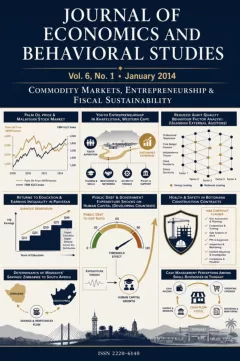 Vol. 6 No. 1 (2014)
Commodity Markets, Entrepreneurship & Fiscal Sustainability
View issue contents
Published
Submissions
Have research to publish? Journal of Economics and Behavioral Studies welcomes submissions.
Make a Submission