Abstract
The quality of life of society as a whole is to a considerable extent determined by the role of government. South African society is characterised by the presence of a wide gap between the rich and the poor. This is exacerbated by the presence of poverty, HIV/AIDS, crime, corruption and exploitation. Governments attempt to address these contradictions are encapsulated in various policies that detail in accurate form, the needs of the majority of South Africans. Whilst policies depict the needs of the majority of South Africans, these needs remain undelivered. The void between the formulation of policy and service delivery has been most severely felt by the poor. Policy implementation is the responsibility of central, provincial and local government. The policy on tourism has been identified as one of the major players in resolving the impasse that is experienced by government. According to South Africa’s National Tourism Sector strategy (2011 & 2016) the country’s tourism’s economic contribution is set to increase from R318, 16 billion by 2015 to R499 billion by 2020. The challenge however, remains in harnessing Tourism policy in a way that addresses the past and current contradictions. Legislative provisions, policies and plans have set the tone in terms of the direction that tourism should be heading. Public sector institutions at national, provincial and local levels have equipped themselves to develop and enhance the tourism industry in such a way that it resonates with the South African tourism imperatives. This places within context the role of public organisations and its capacity to deliver in terms of government’s national imperative. The tourism industry is complex with a range of different stakeholders. There is an inextricable link between the tourism and hospitality industries. This paper attempts to improve on the South African tourism competitiveness with the expressed intention of enhancing growth and sustainability.
Keywords
References
- Brent, J. R. & Ritchie, J. R. (2003). The Competitive Destination: A sustainable tourism perspective. CAB International.
- Bell, E. & Bryman, A. (2007). Business Research Methods. Oxford University Press.
- Delacy, T., Lipman, G. & Whitelaw, P. (2013). Competiveness, Jobs, and Green Growth: A Global Model. Geneva: WEF Printer
- Geneva. (2013). The World Economic Forum Travel and Tourism Competitiveness Report. WEF Printer.
- Martins, J. H., Loubser, M. & Wyk, H. D. J. V. (1996). Marketing Research a South African Approach. Unisa Press. Pretoria.
- Pietsch, T. & Ringbeck, J. (2013). How to Succeed as a Tourism Destination in a Volatile World. Geneva: WEF Printer.
- Poon, A. (1993). Tourism Technology and Competitive Strategies. CAB International.
- Republic of South Africa. The National Department of Tourism, 2011-2016. Medium-Term Strategic Plan. Pretoria: Government Printer.
- Republic of South Africa. The National Department of Tourism, 2011. National Tourism Sector Strategy. Pretoria: Government Printer.
- Republic of South Africa. South African Tourism, 2011-2013. The Marketing Tourism Growth Strategy for South Africa. Pretoria: Government Printer.
- World Travel and Tourism Council. (2013). Travel and Tourism Economic Impact 2013 – South Africa. London. WTTC Printer.
Downloads
No downloads have been recorded for this article yet. Figures appear here once readers begin downloading the full text.
How to Cite
Share this article
License
Copyright (c) 2014 S. Maharaj, R. Balkaran (Author)

This work is licensed under a Creative Commons Attribution 4.0 International License.
Author (s) should affirm that the material has not been published previously. It has not been submitted and it is not under consideration by any other journal. At the same time author (s) need to execute a publication permission agreement to assume the responsibility of the submitted content and any omissions and errors therein. After submission of revised paper in the light of suggestions of the reviewers, the editorial team edits and formats manuscripts to bring uniformity and standardization in published material.
This work will be licensed under Creative Commons Attribution 4.0 International (CC BY 4.0) and under condition of the license, users are free to read, copy, remix, transform, redistribute, download, print, search or link to the full texts of articles and even build upon their work as long as they credit the author for the original work. Moreover, as per journal policy author (s) hold and retain copyrights without any restrictions.
Keywords
Section
Published in
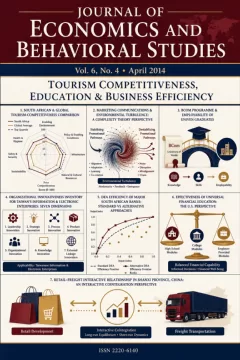 Vol. 6 No. 4 (2014)
Tourism Competitiveness, Education & Business Efficiency
View issue contents
Published
Submissions
Have research to publish? Journal of Economics and Behavioral Studies welcomes submissions.
Make a Submission