Abstract
The primary purpose of this study is to develop Taiwan localization and suitable inventory for the measuring organizational innovation in information and electronic enterprises. In review of relevant literatures, and with reference to opinions from scholars and practical experience from enterprises, the framework of the inventory would be initially established. Concerning the inventory reliability, Cronbach's coefficient, item-total correlation and test-retest reliability coefficient have been employed to test the extent of internal consistency and the stability of the inventory. In the construction of validity, Linear Structural Relation was adopted to carry out confirmatory factor analysis. The suitability and fitness of the seven dimensions and 58 questions have been thus verified. As a result, this inventory with adequate validity and reliability can serve as effective instrument for the measurement of organizational innovation in domestic information and electronic enterprises. The developed questionnaire of this study is a method to quantify the organizational innovation. These instrument targets two areas OI and TI evaluation model–to assess innovativeness in an organization.
Keywords
- Innovation Search this journal for Innovation (opens in a new tab)
- Organizational Innovation Search this journal for Organizational Innovation (opens in a new tab)
- Organizational Innovativeness Inventory Search this journal for Organizational Innovativeness Inventory (opens in a new tab)
- Linear Structural Relation (LISREL) Search this journal for Linear Structural Relation (LISREL) (opens in a new tab)
- Questionnaire Search this journal for Questionnaire (opens in a new tab)
References
- Adisu, K. (2014). Chinese Economic Development and Leadership Strategy: The Challenges of Creating Competitive Advantage. Journal of Economics and Behavioral Studies , 6(2), 163–168.
- Amabile, T. M. (1988). A Model of Creativity and Innovation in Organization. Edited by Behavior , 10, 123-167.
- Anderson, J. C. & Gerbing, C. W. (1988). Structural Equation Modeling in Practice: A Review and Recommended Two-Step Approach. Psychological Bulletin , 103(3), 411-423.
- Becker, S. W. & Whisler, T. L. (1967). The innovative organization: A selective view of current theory and research. Journal of Business , 4, 462-469.
- Brubaker, T. A. (2012). Measuring Political Perceptions in Organizations: Assessing Reliability and Validity of POPS across Cultures. Journal of Economics & Behavioral Studies , 4(10), 603–611.
- Daft, R. L. (1978). A Dual-core Model of Organization Innovation. Academy of Management Journal , 21, 193-210.
- Damanpour, F. (1987). The Adoption of Technological, Administrative, and Ancillary Innovations: Impact of Organizational Factors. Journal of Management , 13, 675-688.
- Damanpour, F. (1991). Organizational Innovation: A Meta Analysis of Effects of Determinants and Moderators. Academy of Management Journal , 34(3), 555-590.
- Damanpour, F. (1996). Organizational Complexity and Innovation: Developing and Testing Multiple Contingency Models. Management Science , 42, 693-716.
- Ettlie, J. E., Bridges, W. P. & O’Keefe, R. D. (1984). Organization Strategy and Structural Differences for Radical versus Incremental Innovation. Management Journal , 30, 682-695.
- Evan, W. M. & Black, G. (1967). Innovation in Business Organization: Some Factors Associated with Success or Failure. Journal of Business , 40, 519-530.
- Higgins, J. M. (1995). Innovation: the core competence. Planning Review , 23, 32-36.
- Hurley, R. F., Hult, G. & Tomas M.(1998). Innovation, Market Orientation, and Organizational Learning : An Integration and Empirical Examination. Journal of Marketing , 62(3), 42-54.
- Knight, K. E. (1967). A Descriptive Model of the Intra-firm Innovation Process. Journal of Business , 40, 478-496.
- Nonaka, I. (1991). The Knowledge-creating Company. Harvard Business Review, 96-104.
- Nunnally, J. C. (1978). Psychometric Theory, 2nd edition, New York: McGraw-Hill.
- Quinn, J. B. (1992). The intelligent enterprise a new paradigm. Academy of Management Executive , 6(4), 48-63.
- Robbins, S. P. (1996). Organizational behavior: Concepts, controversies and Applications. Englewood Cliffs, N. J. Prentice-Hall.
- Rubera, K. & Kirca, L. (2012). Firm Innovativeness and Its Performance Outcomes: A Meta-Analytic Review and Theoretical Integration. Journal of Marketing , 76, 130-147.
- Russell, R. D. (1995). An investigation of some organizational correlates of corporate entrepreneurship: Toward a systems model of organizational innovation. Entrepreneurship, Innovation, and Change , 4(4), 295-314.
- Shepard, H. A. (1967). Innovation-resistion and Innovation-producing Organizations. Journal of Business , 4 , 470-477.
- Slappendel, C. (1996). Perspectives on innovation in organizations. Organization Studies , 17(1), 107-129.
- Sorescu, A. & Spanjol, J. (2008). Innovation’s Effect on Firm Value and Risk: Insights from Consumer Packaged Goods. Journal of Marketing , 72(5), 114–32.
- Srinivasan, S. & Hanssens, D. M. (2009). Marketing and Firm Value: Metrics, Methods, Findings, and Future Directions. Journal of Marketing Research , 46(6), 293-312.
- Tellis, J., Prabhu, C. & Chandy, R. K. (2009). Radical Innovation Across Nations: The Preeminence of corporate Culture. Journal of Marketing , 73(1), 3-23.
- Wolfe, R. A. (1994). Organizational Innovation: Review, Critique and Suggested Research Directions. Journal of Management Studies , 31(3), 405-430.
- Yamin, S., Gunasekaran, A. & Mavondo, F. T. (1999). Innovation index and its implications on organizational performance: A study of Australian manufacturing companies. International Journal of Technology Management, Geneva , 17(5), 495-503.
Downloads
No downloads have been recorded for this article yet. Figures appear here once readers begin downloading the full text.
How to Cite
Share this article
License
Copyright (c) 2014 Li-Min Chuang, Chun-Chu Liu, Wen-Chia Tsai (Author)

This work is licensed under a Creative Commons Attribution 4.0 International License.
Author (s) should affirm that the material has not been published previously. It has not been submitted and it is not under consideration by any other journal. At the same time author (s) need to execute a publication permission agreement to assume the responsibility of the submitted content and any omissions and errors therein. After submission of revised paper in the light of suggestions of the reviewers, the editorial team edits and formats manuscripts to bring uniformity and standardization in published material.
This work will be licensed under Creative Commons Attribution 4.0 International (CC BY 4.0) and under condition of the license, users are free to read, copy, remix, transform, redistribute, download, print, search or link to the full texts of articles and even build upon their work as long as they credit the author for the original work. Moreover, as per journal policy author (s) hold and retain copyrights without any restrictions.
Keywords
- Innovation Search this journal for Innovation (opens in a new tab)
- Organizational Innovation Search this journal for Organizational Innovation (opens in a new tab)
- Organizational Innovativeness Inventory Search this journal for Organizational Innovativeness Inventory (opens in a new tab)
- Linear Structural Relation (LISREL) Search this journal for Linear Structural Relation (LISREL) (opens in a new tab)
- Questionnaire Search this journal for Questionnaire (opens in a new tab)
Section
Published in
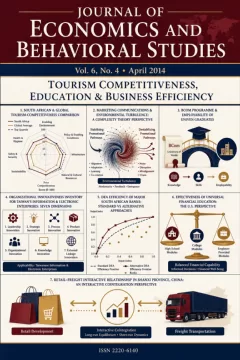 Vol. 6 No. 4 (2014)
Tourism Competitiveness, Education & Business Efficiency
View issue contents
Published
Submissions
Have research to publish? Journal of Economics and Behavioral Studies welcomes submissions.
Make a Submission