Abstract
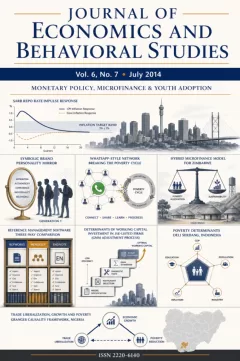
The repurchase rate (repo rate) is the most common monetary policy instrument that the South African Reserve Bank (SARB) uses to control inflation and endeavours to keep it within the inflation target band of 3% to 6%. This study examines the effect of the repo rate on inflation rate along with other variables using the Impulse-Response Function (IRF) of a Vector Autoregressive (VAR) technique. This study uses quarterly data spanning over the period 1980Q2 to 2013Q3. The response of a shock in repo rate on inflation rate and vice versa is generally positive. The results show that given one standard deviation shock in the repo rate, inflation rate will initially increase up until the second quarter after which it starts to decline, and increases again in the fifth quarter. The results obtained from the VAR granger causality test show that repo rate leads the gross domestic product (GDP) growth and inflation rate. There is bidirectional causality between inflation and repo rate; and the result is the same, even after structural break was accounted for. The VAR shows no evidence of instability and autocorrelation, hence the results are reliable. The study suggests some policy recommendations.
Keywords
- Economic Growth Search this journal for Economic Growth (opens in a new tab)
- Inflation Rate Search this journal for Inflation Rate (opens in a new tab)
- IRF Search this journal for IRF (opens in a new tab)
- Repo Rate Search this journal for Repo Rate (opens in a new tab)
- VAR Search this journal for VAR (opens in a new tab)
References
- Bernake, B. S., Boivin, J. & Eliasz, P. (2003). Measuring the Effects of Monetary Policy: A Factor-Augmented Vector Autoregressive (FAVAR) Approach. 2003 National Bureau of Economic Research, NBER Summer Institute.
- Bonga-Bonga, L. & Kabundi, A. (2009). Monetary Policy Instrument and Inflation in South Africa: Structural Vector Error Correction Model Approach. Paper presented at the 13th Annual Conference of Econometric Modelling for Africa.
- Christiano, L. & Eichenbaum, M. (1992). Identification and the liquidity effect of a monetary policy shock.In: Cukierman, A., Hercowitz, Z., Leiderman, L. (Eds.), Political Economy, Growth, and Business Cycles. MIT Press, Cambridge, MA, 335–370.
- Christiano, L., Eichenbaum, M. & Evans, C. (1996). The effects of monetary policy shocks: evidence from the flow of funds. Review of Economics and Statistics , 78, 16–34.
- Dickinson, D. & Riu, J. (2007). The real effects of monetary policy in China: An empirical analysis. China Economic Review , 18, 87 – 111.
- Edelberg, W. & Marshall, D. (1996).Monetary policy shocks and long-term interest rates. Federal Reserve Bank of Chicago. Economic Perspectives , 20, 2–17.
- Gupta, R. & Komen, K. (2008).Time Aggregation and the Contradictions with Causal Relationships: Can Economic Theory Come to the Rescue? University of Pretoria. Department of Economics Working Paper Series.
- Gupta, R., Miller, S. M. & Van-Wyk, D. (2010). Financial Market Liberalization, Monetary Policy and Housing Price Dynamics. University of Connecticut, Department of Economics Working Paper Series.2010-06.
- Kabundi, A. & Ngwenya, N. (2011). Assessing Monetary Policy in South Africa in A Data-Rich Environment. South African Journal of Economics , 79(1), 91 – 107.
- Khan, M., Kandel, S. & Sarig, K. O. (2002). Real and nominal effects of central bank monetary policy. Journal of Monetary Economics , 49, 1493–1519.
- Sims, C. (1992). Interpreting the macro-economic time-series facts: the effects of monetary policy. European Economic Review , 36, 975 – 1000.
- Sims, C. (1980). Macroeconomics and Reality. Econometrica , 48, 1 – 49.
- South African Reserve Bank (2014). Inflation Targeting Framework. www.resbank.co.za Accessed February 2nd 2014.
Downloads
No downloads have been recorded for this article yet. Figures appear here once readers begin downloading the full text.
How to Cite
Share this article
License
Copyright (c) 2014 Temitope L.A. Leshoro (Author)

This work is licensed under a Creative Commons Attribution 4.0 International License.
Author (s) should affirm that the material has not been published previously. It has not been submitted and it is not under consideration by any other journal. At the same time author (s) need to execute a publication permission agreement to assume the responsibility of the submitted content and any omissions and errors therein. After submission of revised paper in the light of suggestions of the reviewers, the editorial team edits and formats manuscripts to bring uniformity and standardization in published material.
This work will be licensed under Creative Commons Attribution 4.0 International (CC BY 4.0) and under condition of the license, users are free to read, copy, remix, transform, redistribute, download, print, search or link to the full texts of articles and even build upon their work as long as they credit the author for the original work. Moreover, as per journal policy author (s) hold and retain copyrights without any restrictions.
Keywords
- Economic Growth Search this journal for Economic Growth (opens in a new tab)
- Inflation Rate Search this journal for Inflation Rate (opens in a new tab)
- IRF Search this journal for IRF (opens in a new tab)
- Repo Rate Search this journal for Repo Rate (opens in a new tab)
- VAR Search this journal for VAR (opens in a new tab)
Section
Published
Submissions
Have research to publish? Journal of Economics and Behavioral Studies welcomes submissions.
Make a Submission