Abstract
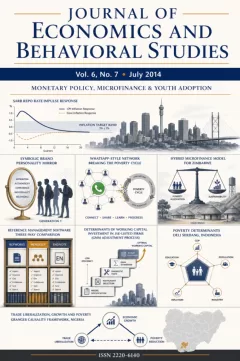
The main aim of this paper is to propose the development of a new microfinance model that can approximate sustainability in Zimbabwe. The secondary purpose is to find out whether the same model can be replicated in other developing countries. The paper adopted a mixed methodology. A crosssectional data collection method was preferred because data was collected during the time of high volatility in the country. Questionnaires, interview schedules were combined to collect data from villagers involved in microfinance programmes. Data were collected from 250 households in the Masvingo rural district area of Zimbabwe. The findings show that the two polar models are biased, hence the need for the ‘middle of the road approach’/‘hybrid model’ for the provision of microfinance services to the poor in order to achieve the twin objectives of poverty alleviation and sustainability. The paper is limited to a Masvingo district of Zimbabwe, thus replication could become a challenge. This article attempts to develop a ‘middle of the road’ model for microfinance in Zimbabwe. According to our knowledge, there is no study that has attempted to do the same.
Keywords
- Microfinance Search this journal for Microfinance (opens in a new tab)
- Poverty Alleviation Search this journal for Poverty Alleviation (opens in a new tab)
- Sustainable Development Search this journal for Sustainable Development (opens in a new tab)
- Microfinance Model Search this journal for Microfinance Model (opens in a new tab)
- Zimbabwe Search this journal for Zimbabwe (opens in a new tab)
References
- Adams, D. W., Douglas, H. G. & Von-Pischke, J. D. (1984). Undermining Rural Development with Cheap Credit. Boulder, CO: Westview Press.
- Ahmed, S. (2010). Microfinance institutions in Bangladesh: achievements and challenges. Managerial Finance , 35(12), 999 - 1010
- Birdsall, N. & Londono, J. L. (1997). Assets Inequality Matters: An Assessment of the World Bank’s Approach to Poverty Reduction. The American Economic Review , 87(2), 32-37.
- Cahn, M. (2002). Sustainable Livelihoods Approach .Concept and Practice. Massey University. [Online] Available: www.devnet.org.nz/conf2002/papers. (June 13, 2009).
- CAP Business Plan. (1999). Masvingo Credit against Poverty Business Plan. Masvingo Zimbabwe: CAP.
- Carney, D. (1998). Implementing the sustainable rural approach’. In Carney, D., ed. 1998. Sustainable Rural Livelihoods: What Contribution Can We Make? (pp. 3-23). London: Department for International Development (DFID).
- Chambers, R. (1983). Putting the last first. New York: Longman Inc.
- DFID. (1999). Sustainable Livelihoods Guidance Sheets. [Online] Available: www.nssd.net/pdf/section.pdf (February 1, 2010).
- Ellis, F. & Biggs, S. (2001). Evolving themes in rural Development. Development Policy Review. United Kingdom: Overseas Development Institute (ODI).
- Fouracre, P. (2001). Transport and Sustainable Rural Livelihoods. Rural Travel and Transport Program. TR Limited. [Online] Available: www.transport-links.org . (February 10, 2010).
- Gulli, H. (1998). Microfinance and Poverty: Questioning the Conventional Wisdom. Washington D.C.: Inter-American Development Bank.
- Hishigsuren, G. (2007). Evaluating Mission Drift in Microfinance: Lessons from Programs with Social Mission. Evaluation Review , 31(3), 203.
- Hussein, K. (2002). Livelihoods Approaches Compared: A Multi-Agency Review of Current Practice. London, UK: Department for International Development (DFID) and Overseas Development Institute (ODI).
- Hussein, K. & Nelson, J. (2004). Sustainable Livelihoods and Livelihood Diversification. IDS working paper 69. London, UK: Institute of Development Studies.
- Krantz, L. (2001). The Sustainable Livelihoods Approach to Poverty Reduction: An Introduction. Sweden: SIDA.
- Lont, H. & Hospes, O. (2004) . Livelihood and Microfinance: Anthropological and Sociological Perspectives on Savings and Debt. Amsterdam: Eburon Academic Publishers.
- Moser, C. & Dani, A. A. (2008). Assets, Livelihoods, and Social Policy. New Frontiers of Social Policy. Washington, DC: The World Bank.
- Rakodi, C. (2002). A Livelihoods Approach: Conceptual Issues and Definitions. In Rakodi, C. and T. LloydJones, eds. 2002. Urban Livelihoods: A People Centered Approach to Reducing Poverty. London, Sterling: Earthscan.
- Robinson, S. M. (2001). The Microfinance Revolution: Sustainable Finance for the Poor. Washington, D.C: The World Bank and Open Society Institute.
- Robinson, S. M. (2002). The Microfinance Revolution: Lessons from Indonesia, 2. Washington, D.C: The World Bank and Open Society Institute.
- Sa-Dhan, G. (2003). Sustainable Livelihoods and Microfinance. New Dehli, India: Sa-Dhan. Funded by Ford Foundation: www.sa-dhan.org. (Accessed 06 February 2010).
- Sherraden, M. (1991). Assets and the Poor: A New American Welfare Policy. New York: M.E. Shape. Inc.
- Solesbury, W. (2003). Sustainable Livelihoods: A Case Study of the Evolution of DFID Policy. Working Paper 217. London, UK: ODI.
- Soussana, J., Blaike, P., Springate-Biginski, O. & Chadwick, M. (2000). Understanding Livelihood Processes and Dynamics. Livelihood-Policy Relationships in South Asia, Working Paper 7. Leeds, UK: School of Geography.
- Turton, C. (2000). The Sustainable Livelihoods Approach and Program Development in Cambodia. Working Paper 130. London, UK: Overseas Development Institute (ODI).
- UNDP. (2008). Comprehensive Economic Recovery in Zimbabwe: A Discussion Document. Zimbabwe: UNDP.
- Zhang, N. & Wong, P. (2014). Sustainable Microfinance in Asia: Landscapes, Challenges and Strategies. Milken Institute.
- Zoeteleif, J. (2004). Microfinance from Below: Exploring Rural Livelihoods in Tanzania. In Lont, H. and O. Hospes, eds. 2004 . Livelihood and Microfinance: Anthropological and Sociological Perspectives on Savings and Debt. Amsterdam: Eburon Academic Publishers.
Downloads
No downloads have been recorded for this article yet. Figures appear here once readers begin downloading the full text.
How to Cite
Share this article
License
Copyright (c) 2014 Stephen Mago (Author)

This work is licensed under a Creative Commons Attribution 4.0 International License.
Author (s) should affirm that the material has not been published previously. It has not been submitted and it is not under consideration by any other journal. At the same time author (s) need to execute a publication permission agreement to assume the responsibility of the submitted content and any omissions and errors therein. After submission of revised paper in the light of suggestions of the reviewers, the editorial team edits and formats manuscripts to bring uniformity and standardization in published material.
This work will be licensed under Creative Commons Attribution 4.0 International (CC BY 4.0) and under condition of the license, users are free to read, copy, remix, transform, redistribute, download, print, search or link to the full texts of articles and even build upon their work as long as they credit the author for the original work. Moreover, as per journal policy author (s) hold and retain copyrights without any restrictions.
Keywords
- Microfinance Search this journal for Microfinance (opens in a new tab)
- Poverty Alleviation Search this journal for Poverty Alleviation (opens in a new tab)
- Sustainable Development Search this journal for Sustainable Development (opens in a new tab)
- Microfinance Model Search this journal for Microfinance Model (opens in a new tab)
- Zimbabwe Search this journal for Zimbabwe (opens in a new tab)
Section
Published
Submissions
Have research to publish? Journal of Economics and Behavioral Studies welcomes submissions.
Make a Submission