Abstract
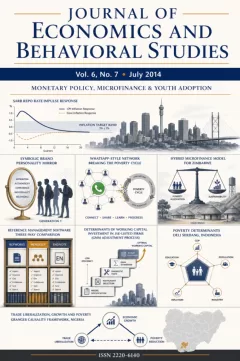
The paper examines the nexus among trade liberalization, economic growth and poverty level in Nigeria between 1980 and 2009 within the context of multivariate Vector Auto regression (VAR) with a view to establishing the links that exist among the three variables. The data series were also subjected to unit root and co integration tests to examine the properties of the data. The findings that emerged from the analyses showed that the interactions among trade liberalization, economic growth and poverty level suggest that economic growth had a positive impact on trade liberalization in Nigeria within the study period. Also, the interactions among trade liberalization, economic growth and poverty level were weak making the effect of trade liberalization on poverty to be low. This probability portrays the presence of some structural rigidity in the economy capable of preventing the impact of trade liberalization from being fully felt on poverty, particularly through economic growth channel. This suggests the presence of some institutional factors that create inherent problems in the economy that could largely frustrate any valid and sincere trade policies formulated by the government. It is therefore recommended that policy makers should be mindful of the fact that the Nigerian economy is structurally vulnerable; such that for any policy to succeed, the peculiar characteristics of the economy must be factored into the plan and rigorously evaluated for good policy effects.
Keywords
- Trade Liberalization Search this journal for Trade Liberalization (opens in a new tab)
- Economic Growth Search this journal for Economic Growth (opens in a new tab)
- Poverty Level Search this journal for Poverty Level (opens in a new tab)
- Vector Auto Regression Search this journal for Vector Auto Regression (opens in a new tab)
References
- Akinlo, A. E. (2003). Foreign direct investment and economics growth in sub-Saharan Africa. International Review of Economics and Business (RISEC), 50(4), 569–580.
- Akinyosoye, V. O., Akande, S. O., Akpokodje, G. & Mbanefoh, N. M. (1996). Trade and Exchange Rate liberalisation and Competitive Nigeria’s Tradeable Commodities. NISER, Ibadan, NG 1996-04-01.
- Asogu, J. O. (1998). The Relative Potency of Monetary and Fiscal Policies in Nigeria. Central Bank of Nigeria Economic and Financial Review , 36(2).
- Bhagwati, J. (2001). Growth, Poverty and Reforms. Economic and Political Weekly , 11, 843-46.
- Case, A. (2000). Income Distribution and Expenditure Pattern in South Africa, Paper Prepared for the Conference on Poverty and the International Economy, organized by World Bank and Swedish Parliamentary Commission of Global Development, Stockholm, October 20-21.
- Dercon, S. (2001). Economic Reform, Growth and the Poor: Evidence from Rural Ethiopia. CSAE Working Paper Series. 2001-08, Centre for the Study of African Economies, University of Oxford.
- Dollar, D. & Kraay, A. (2000). Growth Is Good for the Poor. Mimeo, World Bank, Washington, D.C.
- Dollar, D. & Kraay, A. (2001). Trade, Growth and Poverty. Finance & development, 38(3), 16-19.
- Dollar, D. & Kraay, A. (2002). Growth is Good for the Poor. Journal of Economic Growth , 7, 195-225
- Dollar, D. & Kraay, A. (2004). Trade, Growth and Poverty. Economic Journal , 114(22).
- Dreze, J. & Sen, A. (1990). Hunger and Public Action. Oxford Clarendon Press
- Federal Republic of Nigeria (FRN). (1996). Socio-economic Profile of Nigeria: Abuja, Federal office of Statistics.
- Gandolfo, G. (1981). Qualitative Analysis and Econometric Estimation of Continuous Time Dynamic Models. North Holland, Amsterdam 1, 2.
- Gunduz, L. (2000). Monetary Transmission and Bank Lending in Turkey. Paper presented at the International Conference on Banking, financial market and the Economics of the Middle East and North Africa”. LUA Byblos/Lebanon, May 23-25.
- Hacker, T. & Hatemi, J. (2008). Optimal lag-length choice in stable and unstable VAR models under situations of homosexuality and ARCH. Journal of Applied Statistics , 35(6), 601-615.
- Harsch, E. (2006). Combating Inequality in Africa; Lessen Inequalities to Reduce Poverty and Reach MDGs; says UN Africa. Afrca Renewal, pp 16.
- Johansen, S. (1988). Statistical Analysis of Cointegrated Vectors. Journal of Economic Dynamics and Control , 12, 231 -254.
- Johansen, S. & Juselius, K. (1990). Maximum Likelihood Estimation and Inferences on Cointegration-with Application to the Demand for Money. Oxford Bulletin of Economics and Statistics , 52, 169-210.
- Khor, M. (2000). Rethinking Liberalisation and Reforming The WTO. Paper Presented at the World Economic Forum at Davos, Switzerland, in January.
- Knight, J. (2002). The Impact of Trade Liberalisation on Higher Education: Policy Implication. Globalisation: What Issues are at Stake For Universities? Universte Laval, Quebec, Canada.
- Kuji, L. T. D. (2002). Comprehensive Review of The Nigerian Customs and Excise Tariffs 19952001: Implications for Nigeria of The ECOWAS Common External Tariffs and Nigeria’s Obligations/Commitments under WTO, ECOWAS, AGOA and ACP-EU
- Lanchovichina, E., Nicita, A. & Soloaga, I. (2001). Trade Reform and Household Welfares: The case of Mexico. Policy Research Working Paper 2667, World Bank Development Research Gtoupon Trade.
- Mbabazi, J., Morrissey, O. & Milner, C. (2001). Are Inequality and Trade Liberalization influences on growth and poverty? WIDER Discussion Paper, DP2001/132.
- Miyamoto, K. (2003). Human Capital Formation and Foreign Director Investment in Developing Countries Development Centre Working Paper No. 211 (Formerly Technical paper No. 211) July 2003. DEV/DOC09
- Nayaar, B. R. (1997). The Political Economy of India’s Economic Performance since 1947, in C. Steven La (ed.), The India Handbook, Chicago and London: Fitzroy Dearborn Publishers. Pp. 37-61.
- Nanna, K. (2002). Inflation Pressures and Continuous Fall in Foreign in Nigeria . Central Bank of Nigeria Publication , 4, 34-49, CBN Press Ltd., Nigeria.
- Sanusi, S. L. (2001). Monetary Policy Expansion. Central Bank of Nigeria Publication , 171, 64-79, CBN Press Ltd., Nigeria.
- Nwafor, M., Kanayo, O. & Adenikinju, L. (2005). The Impact of Trade Liberalisation on Poverty in Nigeria: Dynamic Simulations in a CGE Model. Interim Report to the Poverty and Economic Policy (PEP) Research Network. First Draft April, 2005.
- Nwaobi, G. C. (1999). Money and Output, Interaction in Nigeria: an Econometric Investigation using Multivariate Cointegration Technique. CBN Economic and Financial Review , 37(3), 44 – 76.
- Ogun, T. P. (2010). Infrastructure and Poverty Reduction: Implications for Urban Development in Nigeria. Urban Forum. published online :29 May 2010 Springer Science Media B.V. vol. 21:249-266.
- Okojie, C. E. E. (2002). Gender and Education as Determinants of Household Poverty in Nigeria. UNI-WIDER Discussion Paper: No 2002/37, Helsinki.
- Olofin, A. (2001). A Computable General Equilibrium Model of Nigeria.” Trade Competitivenesss. CEAR Research Paper No 2001/01 ,CEEAR, Ibadan.
- Oyejide, A. T. (2002). Monetary Policy and its Effects on the Nigerian Economy: Proceedings of Nigeria Economic Society one-day’s seminar held in Lagos.
- Rajan, S. R. (2002). Trade Liberalisation and Poverty: Revisiting the Age-Old Debate. Economic and Political Weekly , 37(49), 4941-4946.
- Ravallion, M. & Datt, G. (1996). How Important to India’s Poor is the Sectoral Composition of Economic Growth?’ World Bank Economic Review , 10(1), 1-25.
- Rodrik, D. (2000). Comments on Trade, Growth and Poverty. By D. Dollar and A. Kraay. Paper Presented at the American Economic Association Meeting. Boston MA 7-9 January.
- Sachs, J. D. & Warner, A. M. (1995). Economic Reforms and the Process of Global Integration. Brookings Papers on Economic Activity , 2, 1-118.
- Saibu, O. M. (2004).Openness and Economic Growth in Nigeria: Further Evidence on Causality Issue. South African Journal of Economics and Management Sciences (SJEMS). Vol.7 no. pp. 115-131, Pretoria, South Africa.
- Soludo, C. C. (2008). Financial Globalization and Domestic Monetary Policy: Whither The Economics for the 21st Century? Inaugural Lecture, published by the University of Nigeria Senate Ceremonials Committee.
- Tendulkar, S. D. (1998).Indian Economic Policy Reforms and Poverty: An Assessment. In I.J.Ahluwalia and I.M.D. Little (eds). India’s Economic Reforms and Development Essays for Manmohan Singh Delhi: Oxford and New York: Oxford University Press.
- Todaro, M. P. (1997). Economic Development. Reading Mass, Addison-Wesley.
- UNCTAD. (1997).Trade and Development Report. United Nations New York and Geneva
- UNCTAD. (1999).Trade and Development Report. United Nations New York and Geneva
- United Nations. (1997). Human Development Report. New York Oxford University PressUwatt Bill (2003), Globalisation and Economic Growth: The African Experience. Globaisation and Africa’s Economic Development. Selected papers for the 2003.annualconferene of the Nigeria Economic society.
Downloads
No downloads have been recorded for this article yet. Figures appear here once readers begin downloading the full text.
How to Cite
Share this article
License
Copyright (c) 2014 Aremo, Adeleke Gabriel (Author)

This work is licensed under a Creative Commons Attribution 4.0 International License.
Author (s) should affirm that the material has not been published previously. It has not been submitted and it is not under consideration by any other journal. At the same time author (s) need to execute a publication permission agreement to assume the responsibility of the submitted content and any omissions and errors therein. After submission of revised paper in the light of suggestions of the reviewers, the editorial team edits and formats manuscripts to bring uniformity and standardization in published material.
This work will be licensed under Creative Commons Attribution 4.0 International (CC BY 4.0) and under condition of the license, users are free to read, copy, remix, transform, redistribute, download, print, search or link to the full texts of articles and even build upon their work as long as they credit the author for the original work. Moreover, as per journal policy author (s) hold and retain copyrights without any restrictions.
Keywords
- Trade Liberalization Search this journal for Trade Liberalization (opens in a new tab)
- Economic Growth Search this journal for Economic Growth (opens in a new tab)
- Poverty Level Search this journal for Poverty Level (opens in a new tab)
- Vector Auto Regression Search this journal for Vector Auto Regression (opens in a new tab)
Section
Published
Submissions
Have research to publish? Journal of Economics and Behavioral Studies welcomes submissions.
Make a Submission