Abstract
The focus of this paper is to present an exploratory study on the level of awareness regarding green marketing and its managerial implications, among selected, South African Manufacturing Small, Medium and Micro Enterprises (SMMEs), in the province of KwaZulu–Natal (KZN). The concept of green marketing and thought provoking managerial implications are still an issue of concern in the South African manufacturing sector. The study aimed to explore the awareness levels about green marketing by selected South African manufacturing SMMEs in KZN, and the resulting managerial implications. Primary data was collected from 84 manufacturing SMMEs. This research was quantitative in nature and a questionnaire was used to collect data from SMMEs owners/managers in KZN. Findings of the research indicate that SMMEs in the study are aware of green marketing and its managerial implications. It further reveals that SMMEs’ owners/managers indicate that the South African Environmental Act and Consumer Protection Act are additional factors that influence their businesses operations. The paper will benefit SMMEs owners/managers, SMMEs marketing managers, and affiliated stakeholders, by introducing a new understanding of green marketing and how to cope with the demand of new green marketing strategies. Most work on the Green Zone has concentrated on green products, with little emphasis on green marketing and its implications. The findings are limited by the study’s exploratory, quantitative nature and small sample. Generalisation should be done with care and further research, with a large sample and consideration of other provinces, is therefore recommended.
Keywords
- Green Marketing Search this journal for Green Marketing (opens in a new tab)
- Awareness Search this journal for Awareness (opens in a new tab)
- Managerial Implication Search this journal for Managerial Implication (opens in a new tab)
- Manufacturing SMMEs Search this journal for Manufacturing SMMEs (opens in a new tab)
- South Africa Search this journal for South Africa (opens in a new tab)
References
- Azad, N., Nobahari, S., Bagheri, H., Esmaeeli, M. & Rikhtegar, M. (2013). An exploration study on factors influencing green marketing. Management Science Letters, 3(5), 1367.
- Bukhari, S. S. (2011). Green Marketing and its impact on consumer behaviour. European Journal of Business and Management, 3(4), 1.
- Carroll, A. B. & Buchholtz, A. K. (2000). Business & Society, Ethics and Stakeholder Management, SouthWestern Publishing, Cinn., Ohio.
- Chen, T. B. & Chai, L. T. (2010). Attitude towards the environmental and green products: Consumer perspective. Management science and engineering , 4 (2), 27-39.
- Coddington, W. (1993). Environmental marketing: positive strategies for reaching the Green consumer, New York: McGraw-Hill.
- Czinkota, M. & Ronkainen, I. (1992). Global marketing: A marketing survival guide. Marketing management , 1(1), 36-45.
- Da-Silva, I. S. (2010). Is green marketing the future of business? [Online]. Available at: http://www.bizcommunity.com/Article/196/423/43446.html. (Accessed 23/02/2014).
- Engel, D. (2008). Three stages to a greener company. [Online]. Available at: http://www.harmoniousliving.co.za. (Accessed 19/04/2014).
- Finistera do Paco, A., Raposo, M. & Filho, W. (2009). Identifying the green consumer: A segmentation study. Journal of Targeting, Measurement and Analysis for Marketing , 17(4), 17–25.
- Frause, B. & Colehour, J. (1994). The Environmental Marketing Imperative. Chicago: Probus Publishing.
- Gale, F. (2006). Regulating the market in an Era of globalization: Global governance via the forest stewardship council. [Online]. Available at: http://eprints.utas.edu.au/455/1/APSA-06ForestGovernance.pdf?origin=publication_detail (Accessed 26/02/2014).
- Ghoshal, M. (2008). Green Marketing A Changing Concept in Changing Time. [Online]. Available at http://www.scribd.com/doc/12859654/Green-Marketing. (Accessed 18/04/2014).
- Gurmeet, S. H. (2013). A study of evolution and practice of green marketing by various companies in India. International Journal of Management and Social Sciences Research , 2(7), 49-56.
- Hashem, T. & Al-rifai, N. (2011). The influence of applying green marketing mix by chemical industries companies in three Arab States in West Asia on consumer's mental image. International Journal of Business and Social Science , 2(3), 92.
- Horne, R. E. (2009). Limits to be labels: The role of eco –labels in the assessment of product sustainability and routes to sustainable consumption. International of consumer studies , 33(6), 175-182.
- Humphreys, D. (2008). The Politics of ‘Avoided Deforestation’: Historical Context and Contemporary Issues. International Forestry Review , 10(3), 433-442.
- Iravania, M. R., Zadehb, M. S., Foroziac, A., shafaruddind, N. & Mahroeiane, H. (2012). Study of Factors Affecting Young Consumers to Choose Green Products. Journal of Basic and Applied Scientific Research , 2(6), 5534-5544.
- Juwaheer, T. D., Pudarah, S. & Noyaux, M. M. E. (2012). Analysing the impact of green marketing strategies on consumer purchasing patterns in Mauritius. World Journal of Entrepreneurship, Management and Sustainable Development, 8(1), 36-59.
- Kassinis, G. & Vafeas, N. (2006). Stakeholder pressures and environmental performance. Academy of Management Journal, 49(5), 145–159.
- Kinoti, M. M. (2011). Green marketing Intervention Strategies and Sustainable Development: A Conceptual Paper. International Journal of Business and Social Science , 2(23), 263.
- Kleiner. A. (1991). What does it mean to be Green? Havard Business Review, 3, 4-11.
- Kleindorfer, P. R., Singhal, K. & Wassenhove, L. N. V. (2005). Sustainable operations management. Production and Operations Management , 14(4), 482–492.
- Kontic, I. (2010). Greening the marketing mix: A case study of the Rockwool Group. [Online]. Available at: http://www.diva-portal.org/smash/get/diva2:329044/FULLTEXT01.pdf. (Accessed 18/03/2014).
- Kotler, P. (2000). Marketing management analysis, Planning, implementation and control , 9th edition, prentice hall. INC.
- KZN Manufacturing sector. (2014). Manufacturing Sector. [Online]. Available at: http://kzntopbusiness.co.za/site/manufacturing (Accessed 25/03/2014).
- Lee, H. & Park, S. (2013). Environmental orientation in going green: A qualitative approach to consumer psychology and sociocultural factors on green consumption. Journal of global scholars of marketing science: Bridging Asia and the world , 23(3), 245 – 262.
- Mishra, P. & Sharma, P. (2010). Green marketing in India: emerging opportunities and challenges. Journal of Engineering, Science and Management Education , 3, 9-14.
- Mohanasundaram, V. (2012). Green marketing – challenges and opportunities, International Journal of Multidisciplinary Research, 2(4), 66-73.
- Murray, K. B. & Montanari, J. R. (1986). Strategic Management of the Socially Responsible Firm: Integrating Management and Marketing Theory. Academy of Management Review , 11, 815-827.
- OECD working party on SMEs and entrepreneurship (WPSMEE). (2010). SMEs and Green Growth: Promoting sustainable manufacturing and eco-innovation in small firms. [Online]. Available at: http://www.oecd.org/cfe/smes/46404383.pdf. (Accessed 26/04/2014).
- Ottman, J. A., Stafford, E. R. & Hartman, C. L. (2006). Avoiding Green Marketing Myopia: Ways to Improve Consumer Appeal for Environmentally Preferable Products, Environment. Science and Policy for Sustainable Development, 48 (5), 22-36.
- Peattie, K. (1995). Environmental Marketing Management: Meeting the Green Challenge (Paperback), London: Financial Times Prentice Hall.
- Peattie, K. & Crane, A. (2005). Green marketing: legend, myth, farces or prophesies? Qualitative Market Research. An International Journal , 8(4), 357 – 370.
- Polonsky, M. J. (1994). An introduction to green marketing. Electronic green Journal , 1(2), 1.
- Prakash, A. (2002). Green marketing, public policy and managerial strategies. Business Strategy and the Environment, 11, 285-297.
- Saad, L. (2009). Did Hollywood’s Glare heat up public concern about Global warming? Gallup news service. [Online]. Available at: http://www.gallup.com/poll/26932/did-hollywoods-glare-heatpublic-concern-about-global-warming.aspx. (Accessed 19/04/2014).
- Saxena, R. & Khandelwal, P. K. (2010), 'Sustainable development through green marketing: The industry perspective. The International Journal of Environmental, Cultural, Economic and Social Sustainability, 6(5), 59-79.
- Shrikanth, R. & Raju, D. (2012). Contemporary green marketing - brief reference to Indian scenario. International Journal of Social Sciences & Interdisciplinary Research, 1(1), 26 – 39.
- Smith, K., Lawrence, G. & Richards, C. (2010). Supermarkets’ governance of the agri - food supply chain: is the ‘corporate-environmental’ food regime evident in Australia. International Journal of society of agriculture and food, 17(2), 37.
- Sorensen, E. & Jacob, T. (2007). Theories of Democratic Network Governance. Palgrave Macmillan.
- Thakur, K. S. & Gupta, S. (2012). Exploration of Green Shift: Shift from trendy marketing to environmental friendly green marketing. International Journal of Arts and Commerce , 1(7), 1.
- Van Wyk, A. & Deegan, W. (2009). Executive Guide to King III, [Online]. Available at: http://www.pwc.co.za/en/king3/ (Accessed 23/01/2014).
- Williamson, A. (2013). Green Marketing for Eco-Friendly Businesses. [Online]. Available at: http://www.environment.co.za/sustainable-green-business-news/green-marketing-for-ecofriendly-businesses.html. (Accessed 23/02/2014).
- Walker, R. H. & Hanson, D. J. (1998). Green Marketing and Green Places: Taxonomy for the Destination Marketer . Journal of Marketing Management , 14 (6), 623-639.
- Yurman, D. (1994). Green Technology Markets; Opportunities, Barriers & New Paradigms, [Online]. Available at: http://courses.cs.vt.edu/cs3604/lib/GreenMachines/Yurman.html. (Accessed 20/01/2014).
Downloads
No downloads have been recorded for this article yet. Figures appear here once readers begin downloading the full text.
How to Cite
Share this article
License
Copyright (c) 2014 Lawrence Mpele LEKHANYA (Author)

This work is licensed under a Creative Commons Attribution 4.0 International License.
Author (s) should affirm that the material has not been published previously. It has not been submitted and it is not under consideration by any other journal. At the same time author (s) need to execute a publication permission agreement to assume the responsibility of the submitted content and any omissions and errors therein. After submission of revised paper in the light of suggestions of the reviewers, the editorial team edits and formats manuscripts to bring uniformity and standardization in published material.
This work will be licensed under Creative Commons Attribution 4.0 International (CC BY 4.0) and under condition of the license, users are free to read, copy, remix, transform, redistribute, download, print, search or link to the full texts of articles and even build upon their work as long as they credit the author for the original work. Moreover, as per journal policy author (s) hold and retain copyrights without any restrictions.
Keywords
- Green Marketing Search this journal for Green Marketing (opens in a new tab)
- Awareness Search this journal for Awareness (opens in a new tab)
- Managerial Implication Search this journal for Managerial Implication (opens in a new tab)
- Manufacturing SMMEs Search this journal for Manufacturing SMMEs (opens in a new tab)
- South Africa Search this journal for South Africa (opens in a new tab)
Section
Published in
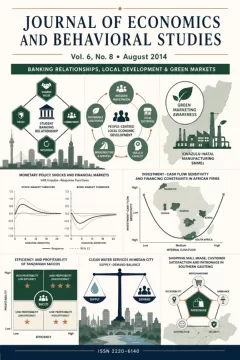 Vol. 6 No. 8 (2014)
Banking Relationships, Local Development & Green Markets
View issue contents
Published
Submissions
Have research to publish? Journal of Economics and Behavioral Studies welcomes submissions.
Make a Submission