Abstract
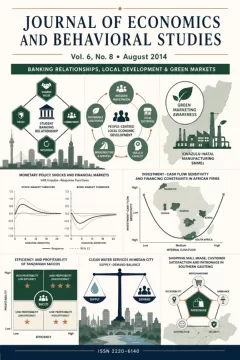
The use of investment cash flow sensitivity as a measure of financing constraints is an unresolved research agenda. This paper endeavors to explain the conflicting evidence by using proxies for both internal financial constraint and external financial constraint measures. Data is taken from selected six African countries, a region where no previous studies are conducted. It is observed that the investment curve is U- shaped when firms are classified on the basis of internal financial constraint measure (i.e. cash flow). Using external financial constraint proxies (age, size and payout) it is found that all category of firms show positive and significant investment cash flow sensitivity. This suggests that the sampled African firms are externally financial constrained. It is concluded that the way firms are a priori classified as internal vs. external financial constrained matters. This raises the issue of whether the term financial constraints itself is a multidimensional construct.
Keywords
- Investment Cash Flow Sensitivity Search this journal for Investment Cash Flow Sensitivity (opens in a new tab)
- Financing Constraints Search this journal for Financing Constraints (opens in a new tab)
- African Countries Search this journal for African Countries (opens in a new tab)
- GMM Search this journal for GMM (opens in a new tab)
References
- Allayannis, G. & Mozumdar, A. (2004). The impact of negative cash flow and influential observations on investment–cash flow sensitivity estimates. Journal of Banking and Finance, 28(5), 901–930.
- Alti, A. (2003). How sensitive is investment to cash flow when financing is frictionless? Journal of Finance , 58(2), 707–722.
- Baum, C., Schäfer, D. & Talavera, O. (2011). The impact of the financial system’s structure on firms’ financial constraints. Journal of International Money and Finance , 30(4), 678–691.
- Bernanke, B., Gertler, M. & Gilchrist, S. (1996). The financial accelerator and the flight to quality. The Review of Economics and Statistics, 78(1), 1–15.
- Bhattacharya, S. (1979). Imperfect information, dividend policy, and the ‘bird in the hand fallacy. Bell Journal of Economics, 10(1), 259–270.
- Blundell, R. & Bond, S. (1998). GMM estimation with persistent data: An application to production functions. Econometric Reviews , 19(3), 321–40.
- Carreira, C. & Silva, F. (2013). Does Size, Age and Dividend Policy Provide Useful Measures of Financing Constraints? New Evidence from a Panel of Portuguese Firms, Estudos Do GEMF, 26
- Carreira, C. & Silva, F. (2010). No Deep Pockets: Some stylized results on firms' financial constraints. Journal of Economic Surveys , 24(4), 731–53.
- Cleary, S. (2006). International corporate investment and the relationship between financial constraint measures. Journal of Banking and Finance , 30(5), 1559–1580.
- Cleary, S. (1999). The relationship between firm investment and financial status. Journal of Finance, 54(2), 673–692.
- Cleary, S., Povel, P. E. & Raith, M. (2007).The U-shaped investment curve: Theory and evidence. Journal of Financial and Quantitative Analysis , 42(1), 1–39.
- Cowling, M. & Mitchell, P. (2003). Is the small firm’s loan guarantee scheme hazardous for banks or helpful to small business? Small Business Economics, 21(1), 63–71.
- Fazzari, S., Hubbard, R. & Petersen, B. (2000). Investment–cash flow sensitivities are useful: a comment on Kaplan and Zingales. Quarterly Journal of Economics, 115(2), 695–705.
- Fazzari, S., Hubbard, R. & Petersen, B. (1988). Financing constraints and corporate investment. Brookings Papers on Economic Activity , 1, 141–206.
- George, R., Kabir, R. & Qian, J. (2011). Investment cash flow sensitivity and financing constraints: Evidence from Indian Business Groups. Journal of Multinational Financial Management , 21(2), 69-88
- Guariglia, A. (2008). Internal financial constraints, external financial constraints and investment choice: Evidence from a Panel of UK firms. Journal of Banking & Finance , 32(9), 1795-1809.
- Hubbard, R. (1998). Capital-market imperfections and investment. Journal of Economic Literature, 36(1), 193– 225.
- Kadapakkam, P., Kumar, P. & Riddick, L. (1998). The Impact of cash flows and firm size on investment: The international evidence. Journal of Banking and Finance , 23(3), 293-320.
- Kaplan, S. & Zingales, L. (2000). Investment–cash flow sensitivities are not valid measures of financing constraints. Quarterly Journal of Economics, 115(2), 707–712.
- Kaplan, S. & Zingales, L. (1997). Do investment–cash flow sensitivities provide useful measures of financing constraints? Quarterly Journal of Economics, 112(1), 169–216
- Khurana, I., Martin, X. & Pereira, R. (2006). Financial development and the cash flow sensitivity of cash. Journal of Financial and Quantitative Analysis , 41(4), 787–807.
- Love, I. (2003). Financial development and financing constraints: international evidence from the structural investment model. Review of Financial Studies, 16(3) , 765–791.
- Musso, P. & Schiavo, S. (2008). The impact of financial constraints on firm survival and growth. Journal of Evolutionary Economics, 18(2), 135–149.
- Silva, F. & Carreira, C. (2012). Measuring firms’ financial constraints: A rough guide. Notas Económicas , 36, 23–46.
- Starkey, R. (2010). Financial system development and economic growth in Selected African countries: Evidence from a panel cointegration analysis, Master’s Thesis, Rhodes University, Grahamstown.
Downloads
No downloads have been recorded for this article yet. Figures appear here once readers begin downloading the full text.
How to Cite
Share this article
License
Copyright (c) 2014 Letenah Ejigu Wale (Author)

This work is licensed under a Creative Commons Attribution 4.0 International License.
Author (s) should affirm that the material has not been published previously. It has not been submitted and it is not under consideration by any other journal. At the same time author (s) need to execute a publication permission agreement to assume the responsibility of the submitted content and any omissions and errors therein. After submission of revised paper in the light of suggestions of the reviewers, the editorial team edits and formats manuscripts to bring uniformity and standardization in published material.
This work will be licensed under Creative Commons Attribution 4.0 International (CC BY 4.0) and under condition of the license, users are free to read, copy, remix, transform, redistribute, download, print, search or link to the full texts of articles and even build upon their work as long as they credit the author for the original work. Moreover, as per journal policy author (s) hold and retain copyrights without any restrictions.
Keywords
- Investment Cash Flow Sensitivity Search this journal for Investment Cash Flow Sensitivity (opens in a new tab)
- Financing Constraints Search this journal for Financing Constraints (opens in a new tab)
- African Countries Search this journal for African Countries (opens in a new tab)
- GMM Search this journal for GMM (opens in a new tab)
Section
Published in
 Vol. 6 No. 8 (2014)
Banking Relationships, Local Development & Green Markets
View issue contents
Published
Submissions
Have research to publish? Journal of Economics and Behavioral Studies welcomes submissions.
Make a Submission