Abstract
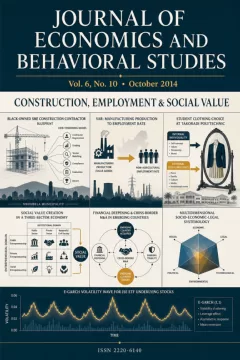
Clothing is an important factor in the interpretation of body image which affects the response behaviour of the beholder. A person’s appearance profoundly affects the way he or she is treated by others at home, social gathering, market, job area, office or school. Selecting clothing requires careful considerations. The purpose of the study was to find out external influences on students’ choice of clothing in Takoradi Polytechnic. The research design was descriptive. Questionnaires and focus group discussion guide were used. Departments of Fashion and Accounting participated with respondents chosen through stratified random sampling. Sample consisted of 207 with a total population of 699 students, 77 males and 130 females. Study revealed students dress casually for lectures instead of formally because casual wear could take any form. Male students’ were normally driven internally indicating individuality while female students were mostly externally directed. Both sexes would least choose clothing for warm relationship. The more individuals they were aware of their inner feelings, the more differentiation they exhibited in their choice of clothing. This is contrary to the general perception that students or the youth choice of clothing is socially driven. However, some external factors were also quite significant in students’ choices and should be given close attention if youth clothing are undesirable. This calls for continues education to streamline vital issues that are of significance to academic institutions and the African society as a whole.
Keywords
References
- Dibley, A. (2004). Uncovering the links between brand choice and personal values among young consumers in Spain and the UK. Doctoral thesis, Canfield University. Retrieved March 3, 2010, from www.marketing-trends-congrees.com.
- Dixon, D. L. (2007). The influence of values and other social and psychological factors on the clothing and appearance of African American college students. Doctoral dissertation, Southern University and A & M College. Retrieved March 4, 2010 from www.citeseerx.ist.psu.edu.
- Fayokun, K. O., Adedeji, S. O. & Oyebade, S. A. (2009). Moral crisis in higher institutions and the dress code phenomenon. Paper presented at Faculty of Law, Obafemi Awolowo University, Ile-Ife 00234, Nigeria.
- Hansen, K. B. (2004). Dressing dangerously: Miniskirts, gender relations and sexuality in Zambia. In J. Allman (Ed), Fashioning Africa: Power and the Politics of Dress. Pp.166-185. Bloomington: Indiana University Press.
- Kahle, L. R. (1996). Social values and consumer behaviour. In Seligman, C., Olson, J. M., & Zanna, M. P. (Eds.), The Psychology of Values: The Ontario Symposium, Volume 8 (pp.135-151). Mahwah, NJ: Erlbaum.
- Kaiser, S. B. (1997). The social psychology of clothing: Symbolic appearance in context (2nd ed.). New York: Capital Cities Media.
- Langner L. (1959). The Importance of Wearing Clothes. Hastings House, 1959. University of Michigan.
- Lynn, H. G. (2004). Fashioning modernity: Changing meanings of clothing in colonial Korea. Journal of International and Area Studies , 11, 75-93.
- Marshal, S. C., Jacjson, O. H., Stanley, M. S. & Kefgaf, M. (2000). touchine-Spectit, P. Individuality in Clothing Section and Person Appearance New Jersey Prentice Hall.
- Moschis, G. P. & Moore, R. L. (1979). Decision-making among the young: A socialization perspective. Journal of Consumer Research , 6, 45-50.
- Munson, G. M. (1984). Personal values: considerations on their measurement and application to five areas of research inquiry. In E. Robert, Pitts Jr. & G. Arch (Eds.), Personal Values and Consumer Psychology. (pp. 123-127) .Woodside: Lexington Books.
- Okwu, O. J. (2006). A Critique of Students’ Vices and the Effect on Quality of Graduates of Nigerian Tertiary Institutions. Paper presented at the Department of Agricultural Extension and Communication. University of Agriculture, Makurdi, Nigeria.
- Odeleye, A. D. (2000). Psychological correlates of contemporary clothing behaviour of Nigerian undergraduate students. Unpublished doctoral thesis, Obafemi Awolowo University, Ile-Ife, Nigeria.
- Osei-Poku, P. & Adu-Agyemang, J. (2008). Achieving a goal of distinction in your dress. Journal of Science and Technology , 28(2), 135-150.
- Pauly, D. (2008). Clothing code. Retrieved May 8, 2010 from http://www.answers.com/Clothing%20code.
- Simmel, G. (1973). Fashion. In G. Wills & D. Midgley (Eds.), Fashion Marketing: an Anthology of Viewpoints and Perspectives. London: Allen and Unwin.
- Sybers, R. & Roach, M. E. (1962). Clothing and human behaviour. Journal of Home Economics , 54(3), 184187.
- Wallace. (1985). Advocating for Normal Birth with Normal Clothes Retrieved from: www.ncbi.nlm.nih.gov/pmc/articles/PMC1804322/
- Watkins, S. M. (1977). the design of protective equipment for ice hockey. Home economics Research Journal , 5(5), 154-166.
- Weber, R. P. (1990). Basic content analysis, Newbury Park, CA: SAGE Publications.
Downloads
No downloads have been recorded for this article yet. Figures appear here once readers begin downloading the full text.
How to Cite
Share this article
License
Copyright (c) 2014 Azuah, S., Aigbvboa, C.O. (Author)

This work is licensed under a Creative Commons Attribution 4.0 International License.
Author (s) should affirm that the material has not been published previously. It has not been submitted and it is not under consideration by any other journal. At the same time author (s) need to execute a publication permission agreement to assume the responsibility of the submitted content and any omissions and errors therein. After submission of revised paper in the light of suggestions of the reviewers, the editorial team edits and formats manuscripts to bring uniformity and standardization in published material.
This work will be licensed under Creative Commons Attribution 4.0 International (CC BY 4.0) and under condition of the license, users are free to read, copy, remix, transform, redistribute, download, print, search or link to the full texts of articles and even build upon their work as long as they credit the author for the original work. Moreover, as per journal policy author (s) hold and retain copyrights without any restrictions.
Keywords
Section
Published
Submissions
Have research to publish? Journal of Economics and Behavioral Studies welcomes submissions.
Make a Submission