Abstract
The last two decades have experienced rapid expansion of information and communication technology. This wide application of internet stated its influence on attitude and adoption of internet among various generations. The generation Y which is “the millennial generation”, are the major one who has connected with the technology, especially with internet usage, and is widely in every aspect of life. They adopt technology application in shopping product and services, moving away from traditional purchasing behavior of consumer. Though various studies have come out in the area of generation Y and technology adoption, very less studies are observed connecting gender, and contextualizing the topic to the Malaysian context, considering the consumer internet usage attitude and e-commerce activities. Hence this particular study, then observed and analyzed generation Y attitude towards internet usage and e-commerce activities with its moderating effect of gender variation.
Keywords
References
- American Express. (2012). American Express Business Insight. New York: American Express.
- Atlas, C. (2000). Increase seen in internet shopping. Cyber Atlas.
- Bartlett, J. E., Kotrlik, J. W. & Higgins, C. C. (2001). Organizational Research: Determining Appropriate sample Size in Survey Research. Information Technology, Learning, and Performance Journal , 19(1), 43-50.
- Bimber, B. (2000). Measuring the Gender Gap on the Internet. Social Science Quarterly, 81(3), 868.
- Blakewell, C. & Mitchell, V. (2003). Gen Y female consumer decision-making styles. International Journal of Retail and Distribution Management, 31(2), 95-106.
- Brafton Editorial. (2012). Gen Y spending more than others in ecommerce. Retrieved March 18, 2014, from Brafton: http://www.brafton.com/news/gen-y-spending-more-than-others-in-ecommerce
- Castells, M. (2000). The rise of network society. Oxford: Wiley Blackwell.
- Chiu, Y. B. (2005). Gender differs: assessing a model of online purchase intentions in e-tail service. International Journal of Service Industry Management, 16(5), 416-435.
- Crisp, B., Jarvenpaa, S. & Todd, P. (1997). Individual differences and Internet shopping attitudes and intentions. Working paper, University of Texas at Austin. Retrieved October 17, 2011, from http://informationr.net/ir/12-2/Crisp.html
- Djamasbi, S., Siegel, M. & Tullis, T. (2010). Gen Y, web design and eye tracking. International Journal of Human-Computer Studies. International Journal of Human-Computer Studies, 68(5), 307-323.
- Ford, N. & Miller, D. (1996). Gender differences in Internet perceptions and use. ASLIB Proceeding. London.
- Hair, J., Money, A., Samouel, P. & Page, M. (2007). Research Method for Business. John Willey & Sons, Ltd.
- Hawkins, J. (1985). Computers and girls: Rethinking the issues. Journal of sex roles, 13(3-4), 165-180.
- Hernandez, B., Jimenez, J. & Martı´n, J. (2009). Age, gender and income: do they really moderate online shopping behavior. Online Information Review, 35(1), 113-133.
- Holbrook, M. B. (1986). Aims, concepts andmethods for the representation of individual differences. Journal of Consumer Research, 13(3), 337-347.
- Joines, J. L., Scherer, C. W. & Scheufele, D. A. (2003). Exploring motivations for consumer Web use and their implications for e-commerce. Journal Consumer Marketing, 20(2), 90-108.
- Jusoh, Z. M. & Ling, G. H. (2012). Factor Influencing Consumers' Attitude Towards E-commerce. International Journal of Humanities and Social, 2(4), 223-230.
- Keating, L. (2000). The in crowd: retail rushes to keep pace with generation y. Shopping Center World
- Korgaonkar, P. K. & Wolin, L. D. (1999). A multivariate analysis of Web usage. Journal of Advertising Research , 39(2), 53-68.
- Kottler, A. &. (2004). Principles of Marketing. New Jersey: Prentice Hall.
- Li, N. & Kirkup, G. (2007). Gender and cultural differences in Internet use: A study of China and the UK. Computers and Education, 48 (2), 301-307.
- Lockeheed, M. (1985). Women, Girls and Computers: A First Look at the Evidence. Sex Roles, 13 (3/4).
- Lockheed, M. E. (1985). Women, Girls, and Computers: A First Look at the Evidence'. Sex Roles: A Journal of Research , 13, 115—122
- Lohse, G., Bellman, S. & Johnson, E. (2000). Consumer Buying Behavior on the Internet. Journal of Interactive Marketing, 14(1), 15-29.
- Luan, W. S., Fung, N. S. & Atan, H. (2008). Gender Differences in the Usage and Attitudes toward the Internet among Student. American Journal of Applied Sciences, 10(2).
- Madell, D. & Muncer, S.(2004). Back from the beach but hanging on the telephone? Englsih adolescents’ attitudes and experience of mobile phones and the internet. CyberPsychology & Behaviour, 7, 359367.
- Malaysian Communication and Media Commission. (2010). Annual Report of MCMC.URL: http://www.skmm.gov.my/skmmgovmy/media/General/pdf/ MCMC_AR_ 2010(English).pdf .Retrieved on 24/7/2014
- Mick, D. G. & Fournier, S. (1998). Paradoxes of technology: Consumer Cognizance, Emotions and Coping Strategies. Journal of Consumer Research, 25(2), 123-143
- Morahan-Martin, L. & Janet, L. (1998). The gender gap in Internet use: Why men use the Internet more than women—A literature review. Cyber Psychology & Behavior, 1(1), 3-10.
- Muncer, D. M. (2004). Gender differences in the use of the Internet by English. Social Psychology of Education, 7(2), 229-251.
- Nachmias, R., Mioduser, D. & Shemla, A. (2001). Information and Communication Technologies usage by school students in an Israeli school: Equity, gender, and inside/outside school learning issues. Education and Information Technologies, 6(1). URL: http://muse.tau.ac.il/publications/ICT.pdf
- Nahmias, E. (2002). When consciousness matters: A critical review of Daniel Wegner’sThe illusion of conscious will. Philosophical Psychology, 15(4) , 527–541.
- Ono, H. (2003). Gender and the Internet. Social Science Quarterly, 84(1), 111-121.
- Papastergiou, M. (2005). Students' mental models of the internet and their didactical exploitation in informatics education. Education and Information Technologies, 10 ( 4), 341-360.
- Papastergiou, M., & Solomonidou, C. (2005). Gender issues in Internet access and favourite Internet activities among Greek high school pupils inside and outside school. Computers & Education, 44(4), 377-393.
- Paris, P. G. (2004). E-Learning: A study on Secondary Students’ Attitudes towards Online Web-Assisted Learning. International Education Journal, 5(1).
- Rakow, L. F. (1988). Gendered technology, gendered practice. Critical Studies in Mass Communication, 5(1), 57-70.
- Roscoe, J. (1975). Fundamaental Research Statistics for The Behavioral Science. New York: Rinehart and Winston.
- Schiffman, L. G., Kanuk, L. L. & Hansen, H. (2008). Consumer Behavior. Upper Saddle River, N.J.: Prentice Hall.
- Sekaran, U. (2003). Research Methods for Business: A Skill Building Approach. John Wiley & Sons, Incorporated.
- Sherman, R. C., End, C., Kraan, E., Cole, A., Campbell, J., Birchmeier Z. & Klausner. (2000). The Internet gender gap among college students: forgotten but not gone? Cyber Psychology and Behavior , 3(5), 885-894.
- Sun, H. & Zhang, P. (2006). The role of moderating factors in user technology acceptance. International Journal of Human-Computer Studies, 64(2), 53-78.
- Suri, G. & Sharma, S. (2013). The Impact of Gender on Attitude Towards Computer Technology and ELearning. International Journal of Engineering Research, 2(2), 132-136.
- Swinyard, W. R., & Smith, S. M. (2003). Why people (don't) shop online: A lifestyle study of the internet consumer. Psychology & Marketing, 20(7), 567-597.
- The Broadband Comission Working Group on Broadband & Gender. (2013). Doubling Digital Opportunities: Enhancing The Inclusion of Women & Girls In The Information Society. New York: UNDP.
- Tsai, C. C. & Lin, S. (2007). Developing an Internet Attitude Scale for High School Student. Computers Education, 37(1), 41-51.
- Venkatesh, V. & Davis, F. (2000). A theoretical extension of the technology acceptance model: Four longitudinal filed. Management Science, 46(2), 186-204.
- Venkatesh, V. & Morris, M. G. (2000). A Longitudinal Field Investigation of Gender Differences in Individual Technology Adoption Decision-Making Processes. Organizational Behavior & Human Decision Process, 83(1), 33-60.
Downloads
No downloads have been recorded for this article yet. Figures appear here once readers begin downloading the full text.
How to Cite
Share this article
License
Copyright (c) 2014 Dileep Kumar M., Normala S, Govindarajo, Harvi, S. (Author)

This work is licensed under a Creative Commons Attribution 4.0 International License.
Author (s) should affirm that the material has not been published previously. It has not been submitted and it is not under consideration by any other journal. At the same time author (s) need to execute a publication permission agreement to assume the responsibility of the submitted content and any omissions and errors therein. After submission of revised paper in the light of suggestions of the reviewers, the editorial team edits and formats manuscripts to bring uniformity and standardization in published material.
This work will be licensed under Creative Commons Attribution 4.0 International (CC BY 4.0) and under condition of the license, users are free to read, copy, remix, transform, redistribute, download, print, search or link to the full texts of articles and even build upon their work as long as they credit the author for the original work. Moreover, as per journal policy author (s) hold and retain copyrights without any restrictions.
Keywords
Section
Published in
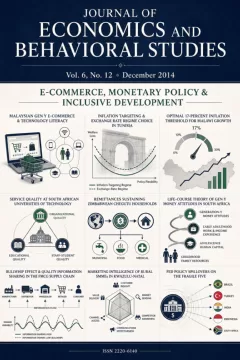 Vol. 6 No. 12 (2014)
E-Commerce, Monetary Policy & Inclusive Development
View issue contents
Published
Submissions
Have research to publish? Journal of Economics and Behavioral Studies welcomes submissions.
Make a Submission