Abstract
The inflation targeting is considered as an attractive monetary policy strategy in order to handle the inflation rate and improves the credibility of the central bank. The paper provides a stochastic dynamic general equilibrium model with the specificity of employing a small open economy. This model analyzes the impact of different regimes of inflation targeting and exchange rate in Tunisia in terms of the welfare loss and describes some aspects of the Tunisian’s economy. The results displays that the social loss is higher under the managed exchange rate than the flexible exchange rate regime for all the shocks. Then in terms of the inflation targeting index, it demonstrates that the consumer prices index outperforms the domestic inflation except for the productivity shock, in contrast to the result of (Parrado, 2004). Finally the strict is superior to the flexible inflation targeting except with the foreign inflation and the domestic interest rate shock.
Keywords
- Welfare Analysis Search this journal for Welfare Analysis (opens in a new tab)
- Inflation Targeting Search this journal for Inflation Targeting (opens in a new tab)
- Open Economy Search this journal for Open Economy (opens in a new tab)
- Exchange Rates Search this journal for Exchange Rates (opens in a new tab)
References
- Palma, A, A. & Portugal, M. S. (2014). Preferences of the Central Bank of Brazil under the inflation targeting regime: Estimation using a DSGE model for a small open economy. Journal of Policy Modeling , 36, 824-839.
- Ashot, M. E., Norris, D. & Stepanyan, A. (2009). A New Keynesian Model of the Armenian Economy. IMF Working Paper No.WP/09/66.
- Ball, L. (1999). Policy Rules for Open Economies. University of Chicago Press. National Bureau of Economic Research.
- Ball, L. (1997). Efficient rules for monetary stability. Working paper no. 5952. NBER, Cambridge, MA.
- Ben-Hadj-Boubaker, H. (2011). Inflation Forecast-Based Rule for Inflation Targeting: Case of Some Selected MENA Countries. Politics and economic development. The 17th Annual Conference of the ERF. Renaissance Antalya Beach Resort &Spa Turkey.
- Ben-Aissa, M. & Rebei, N. (2012).Price Subsidies and the Conduct of Monetary Policy. Journal of macroeconomics , 34,769-787.
- Chockri, A. & Frihka, I. (2011). La portée de la politique de ciblage d’inflation: Approche analytique et empirique pour le cas Tunisien. Panoeconomicus , 1, 91-111.
- Chow, H. K., Lim, G. C. & McNelis, P. D. (2014). Monetary regime choice in Singapore: Would a Taylor rule outperform exchange-rate management? Journal of Asian Economics , 30, 63–81.
- Gali, J. & Monacelli, T. (2005). Monetary policy and exchange rate volatility in a small open economy . Review of Economic Studies , 72, 707-734.
- Hammond, G. (2012). State of the art of inflation targeting . Centre for Central Banking Studies, Handbook No. 29. Centre for Central Banking Studies. Bank of England .
- Huseynov, S. (2010). An estimated DSGE model for Turkey with a monetary regime change. Central European university. Department of Economics. CEU etD collection.
- Ireland, P. (2004).Money’s role in the monetary business cycle. Journal of Money. Credit, and Banking , 36(6),969-983.
- Jouini, N. & Rebei, N. (2014). The Welfare Implications of Services Liberalization in a Developing Country: Evidence from Tunisia. Journal of Development Economics , 106 , 1-14.
- Justiniano, A. & Preston, B. (2010a). Monetary Policy and Uncertainty in an Empirical Small Open Economy Model. Journal of Applied Econometrics , 25(1).
- Juillard, M., Phillipe, K., Douglas, L. & Paolo, P. (2006).Welfare-based monetary policy rules in an estimated DSGE model of the US economy. Working paper series N° 0613.European Central Bank.
- Leitemo, K. ( 1999). Inflation Targeting Strategies in Small Open Economies. Memorandum, Department of Economics, University of Oslo, No. 1999,21
- Parrado, E. (2004). Inflation Targeting and Exchange Rate Rules in an Open Economy . Central Banking, Analysis, and Economic Policies Book Series. IMF Working Paper No. 04/21 .
- Peiris, J. & Saxegaard, M. (2007). An Estimated DSGE Model for Monetary Policy Analysis in Low-Income Countries. African Department . IMF Working Paper No.07/282.
- Rudebusch, D. & Svensson, L. E. O. (1998). Policy Rules for Inflation Targeting. NBER Working Paper No. 6512
- Svensson, L. E. O. (1997b). Inflation Targeting in an Open Economy: Strict vs. Inflation Targeting.” Public Lecture at Victoria University of Wellington, Reserve Bank of New Zealand Discussion Paper, forthcoming.
- Svensson, L. E. O. (2000).Open-economy inflation targeting. Journal of International Economics, 50, 155– 183.
Downloads
No downloads have been recorded for this article yet. Figures appear here once readers begin downloading the full text.
How to Cite
Share this article
License
Copyright (c) 2014 Abdelli Soulaima, Belhadj Besma (Author)

This work is licensed under a Creative Commons Attribution 4.0 International License.
Author (s) should affirm that the material has not been published previously. It has not been submitted and it is not under consideration by any other journal. At the same time author (s) need to execute a publication permission agreement to assume the responsibility of the submitted content and any omissions and errors therein. After submission of revised paper in the light of suggestions of the reviewers, the editorial team edits and formats manuscripts to bring uniformity and standardization in published material.
This work will be licensed under Creative Commons Attribution 4.0 International (CC BY 4.0) and under condition of the license, users are free to read, copy, remix, transform, redistribute, download, print, search or link to the full texts of articles and even build upon their work as long as they credit the author for the original work. Moreover, as per journal policy author (s) hold and retain copyrights without any restrictions.
Keywords
- Welfare Analysis Search this journal for Welfare Analysis (opens in a new tab)
- Inflation Targeting Search this journal for Inflation Targeting (opens in a new tab)
- Open Economy Search this journal for Open Economy (opens in a new tab)
- Exchange Rates Search this journal for Exchange Rates (opens in a new tab)
Section
Published in
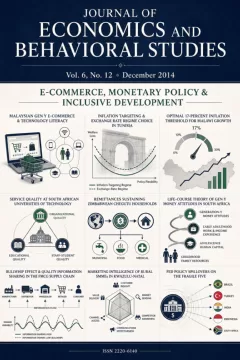 Vol. 6 No. 12 (2014)
E-Commerce, Monetary Policy & Inclusive Development
View issue contents
Published
Submissions
Have research to publish? Journal of Economics and Behavioral Studies welcomes submissions.
Make a Submission