Abstract
There is near consensus in the literature that high levels of inflation (above 40%) affect economic growth negatively. The effects of low and moderate inflation, however, are ambiguous. Nonetheless, several studies have found that low levels of inflation are positively correlated with economic growth, which suggests the existence of a curvilinear relationship between inflation and economic growth. This study sets out to find the threshold level of inflation that is consistent with optimal and sustainable economic growth in Malawi. Using annual time series data for the period 1980 to 2013 and the Conditional Least Squares method, the study finds an optimal inflation threshold level of 17 percent for the country. The study results show that gains in real GDP growth below the optimal threshold level are greater than gains above the threshold level, which is consistent with the theoretical expectations of the threshold estimation model and other empirical studies. Unlike similar optimal inflation threshold studies, this study carries out structural change tests (using the Vogelsang approach) prior to estimating the threshold model. The data are also tested for unit roots using the Zivot and Andrews test for unit roots with a single structural break, and the Lumsdaine and Papell test for unit roots with multiple structural breaks.
Keywords
- Optimal Inflation Search this journal for Optimal Inflation (opens in a new tab)
- Economic Growth Search this journal for Economic Growth (opens in a new tab)
- Threshold Search this journal for Threshold (opens in a new tab)
- Structural Break Search this journal for Structural Break (opens in a new tab)
- Monetary Policy Search this journal for Monetary Policy (opens in a new tab)
References
- Ahortor, C., Adenekan, A. & Ohemeng, W. (2011). An estimate of inflation threshold in the WAMZ: The case of Ghana and Nigeria. West African Journal of Monetary and Economic Integration, 11, 158-201.
- Akerlof, G., Dickens, W. & Perry, G. (2000). Near-rational wage and price setting and the long-run Phillips curve. Brookings Papers on Economic Activity , 1, 1-44.
- Almeida, A., Fry, M. & Goodhart, C. (2004). Central banking in developing countries: Objectives, activities and independence. London: Routledge.
- Andersen, P. S. & Gruen, D. W. (1995). Macroeconomic policies and growth (RBA Research Discussion Papers rdp9507).Economic Research Department, Reserve Bank of Australia.
- Andreou, E. & Ghysels, E. (2009). Structural breaks in financial time series. In T. G. Andersen, R. A. Davis, J.-P. Kreiss & T. Mikosch (Eds.), Handbook of financial time series (pp. 839-870). Berlin: Springer.
- Ball, L. (2013). The case for four percent inflation. Central Bank Review, 13(2), 17-31.
- Barro, R. J. (1995). Inflation and economic growth. (NBER Working Paper No. 5325).National Bureau of Economic Research.
- Brook, A., Karagedikli, Ö. & Scrimgeour, D. (2002). An optimal inflation target for New Zealand: Lessons from the literature. Reserve Bank of New Zealand Bulletin, 65(3), 5-16.
- Bruno, M. & Easterly, W. (1998).Inflation crises and long-run growth. Journal of Monetary Economics, 41(1), 3- 26.
- Burton, D. & Fischer, S. (1998). Ending moderate inflations. In C. Cottarelli & G. Szapáry (Eds.) Moderate inflation: The experience of transition economies, (pp.15-96). Washington, DC: IMF and National Bank of Hungary.
- Busetti, F., Forni, L., Harvey, A. & Venditti, F. (2006).Inflation convergence and divergence within the European Monetary Union. International Journal of Central Banking, 3(2), 95-121.
- Campillo, M. & Miron, J. (1997). Why does inflation differ across countries? In C.D. Romer & D.H. Romer (Eds.).Reducing inflation: Motivation and strategy, (pp. 335-362).University of Chicago Press.
- Chiyembekeza, C. (2013). Malawi inflation soars. The Nation. Retrieved from http://mwnation.com/nationalnews-the-nation/14845-malawi-inflation-soars
- Corbo, V. & Fischer, S. (1994).Lessons from the Chilean Stabilization and Recovery. In B.P. Bosworth, R. Dornbusch, & R. Laban (Eds.).The Chilean economy: Policy lessons and challenges. Washington, DC: The Brookings Institution.
- Cottarelli, C. & Szapary, G. (1998). Moderate inflation: The experience of transition economies. Washington, DC: International Monetary Fund/National Bank of Hungary.
- Decarlo, L. T. (1997). On the meaning and use of kurtosis. Psychological Methods, 2(3), 292-307.
- De Gregorio, J. (1993). Inflation, taxation and long-run growth. Journal of Monetary Economics, 31(3), 271298.
- Dossani, S. (2012). Malawi: A development puzzle? Global Majority E-Journal , 20(2).
- Fischer, S. (1993). The role of macroeconomic factors in growth. Journal of Monetary Economics, 32(3), 485512.
- Fischer, S. (1996). Why are central banks pursuing long-run price stability? Achieving Price Stability , 2, 7-34.
- Ghosh, A. & Phillips, S. (1998). Warning: Inflation may be harmful to your growth. IMF Staff Papers, 45, 672710.
- Ghosh, A., Gulde, A., Ostry, J. D. & Wolf, H. (1996). Does the exchange regime matter for inflation and growth?(IMF Economic Issues No. 2). Washington, DC: International Monetary Fund.
- Gomme, P. (1993). Money and growth revisited: Measuring the costs of inflation in an endogenous growth model. Journal of Monetary Economics, 32(1), 51-77.
- Gujarati, D. (2003). Basic Econometrics, 4th Ed. McGraw-Hill: New York.
- Gylfason, T. & Herbertsson, T. (2001). Does inflation matter for growth? Japan and the World Economy, 13(4), 405-428.
- Hansen, B. (2001). The new econometrics of structural change: Dating breaks in US labour productivity. Journal of Economic Perspectives, 15(4), 117-128.
- Hussain, M. (2005). Inflation and growth: Estimation of threshold point for Pakistan. Economic Policy Department, State Bank of Pakistan, October.
- Ibarra, R. & Trupkin, D. (2011).The relationship between inflation and growth: A panel smooth transition regression approach. (Working paper Series 006-2011.).Research Network and Research Centers Program of Banco Central del Uruguay
- Kannan, R. & Joshi, H. (1998). Growth-inflation trade-off: Empirical estimation of threshold rate of inflation for India. Economic and Political Weekly , 2, 2724-2728.
- Khan, M. & Senhadji, A. (2001).Threshold effects in the relationship between inflation and growth. IMF Staff Papers, 48, 1-21.
- Kremer, S., Bick, A. & Nautz, D. (2011). Inflation and growth: New evidence from a dynamic panel threshold analysis. Empirical Economics , 44(2), 861-878.
- Lee, J. & Strazicich, M. (2003).Minimum Lagrange multiplier unit root test with two structural breaks. Review of Economics and Statistics, 85(4), 1082-1089.
- Leshoro, T. (2012).Estimating the inflation threshold for South Africa. Journal for Studies in Economics and Econometrics, 36(2), 53-65.
- Li, M. (2006). Inflation and economic growth: Threshold effects and transmission mechanisms. Edmonton, Canada: Department of Economics, University of Alberta.
- López-Villavicencio, A. & Mignon, V. (2011). On the impact of inflation on output growth: Does the level of inflation matter ? Journal of Macroeconomics, 33(3), 455-464.
- Lumsdaine, R. & Papell, D. (1997). Multiple trend breaks and the unit-root hypothesis. Review of Economics and Statistics, 79(2), 212-218.
- Lungu, M., Jombo, W. & Chiumia, A. (2012).Determining the Output Gap and its Link with Price Dynamics in Malawi. Journal of Research in Economics and International Finance) , 1(4), 124-135.
- Malawi Government. (1989). Reserve Bank of Malawi. Laws of Malawi , 44(02), 1-19.
- Mandiwa, M. (2009).The effect of exchange rate on output and inflation in Malawi (Unpublished doctoral dissertation). Zomba: University of Malawi.
- Mangani, R. (2011). The effects of monetary policy in Malawi (Working paper).African Economic Research Consortium.
- Marbuah, G. (2011). On the inflation-growth nexus: Testing for optimal inflation for Ghana. West African Journal of Monetary and Economic Integration, 11, 55-82.
- Morar, D. (2011). Inflation threshold and nonlinearity: Implications for inflation targeting in South Africa (Unpublished Thesis). Master of Commerce, Rhodes University.
- Mubarik, Y. (2005). Inflation and growth: An estimate of the threshold level of inflation in Pakistan. State Bank of Pakistan Research Bulletin, 1, 35-44.
- Ndaferankhande, M. & Ndhlovu, T. (2006). Inflationary experiences in Malawi: An investigation of the underlying determinants (1980.1-2002.4). Final Research report presented to the African Economic Research Consortium, Nairobi, Kenya, February, 2005. Retrieved from http://www.csae.ox.ac.uk/conferences/2006-E01-RPI/papers/csae/ndaferankhande.pdf
- Nell, K. (2000). Is low inflation a precondition for faster growth? The case of South Africa. Studies in Economics, 11, 1-33.
- Ngalawa, H. & Viegi, N. (2011).Dynamic effects of monetary policy shocks in Malawi. South African Journal of Economics, 79(3), 224-250.
- Ngwira, N. (2012). Drivers of economic growth in Malawi. Presentation by Deputy Governor (Economics), Reserve Bank Malawi, presented at the ECAMA Annual Conference, November 2012.Retrieved from https://www.rbm.mw/documents/governor_statements/ECAMA_Conference_Presentation.pdf.
- Papademos, L. (2003). The contribution of monetary policy to economic growth. Paper presented at Die Förderung des Wirtschaftswachstums in Europa/ Fostering Economic Growth, the 31st Economics Conference of the OesterrieichischeNationalbank (OeNB), Vienna.
- Sala-i-Martin, X. (1997). I just ran two million regressions. American Economic Review , 4, 178-183.
- Salami, D. & Kelikume, I. (2010).An estimation of inflation threshold for Nigeria 1970-2008. International Review of Business Research Papers, 6(5), 375-385.
- Sarel, M. (1996).Nonlinear Effects of Inflation on Economic Growth. IMF Staff Papers, 43(1), 199-215.
- Sato, L. (2001). Monetary policy frameworks in Africa: The case of Malawi. Paper presented at an International Conference on Monetary Policy Frameworks in Africa at the South African Reserve Bank, Pretoria, South Africa. Retrieved from http://www.reservebank.co.za/internet/Publication.nsf/LADV/9CD00895CF13D9CF42 2570510040CC98/$File/malawi.pdf [Accessed: 12/06/2013].
- Seleteng, M. (2006). Inflation and Economic Growth: An Estimate of an Optimal Level of Inflation in Lesotho (Working paper series no. 03/07). Maseru: Central Bank of Lesotho.
- Seleteng, M. (2013). Inflation and economic growth nexus in the Southern African Development Community: A panel data investigation (Unpublished doctoral dissertation). University of Pretoria.
- Seleteng, M., Bittencourt, M. & van Eyden, R. (2011). Non-linearities in inflation–growth nexus in the SADC region: A panel smooth transition regression approach. Economic Modeling, 30(C), 149-156.
- Simwaka, K., Ligoya, P., Kabango, G. & Chikonda, M. (2012). Money supply and inflation in Malawi: An econometric investigation. Journal of Economics and International Finance, 4(2), 36-48.
- StannerTemple, J. (2000). Inflation and growth: Stories short and tall . Journal of Economic Surveys, 14(4), 395426.
- Tobin, J. (1965). Money and economic growth. Econometrica: Journal of the Econometric Society , 4, 671-684.
- Tobin, J. (1969). Money and income: Post hoc ergo propter hoc? (Cowles Foundation Discussion Paper no. 283).Cowles Foundation for Research in Economics, Yale University.
- Truman, E. (2003). Inflation targeting in the world economy. Washington: Peterson Institute Press, All Books.
- Vaona, A. (2011). Inflation and growth in the long run: A new Keynesian theory and further semi parametric evidence. Macroeconomic Dynamics, 16(1), 94-132.
- World Bank. (2013). World Databank Retrieved from http://databank.worldbank.org/data/home.aspx [Accessed 25/04/2013 2013].
- Zivot, E. & Andrews, D. (2002).further evidence on the great crash, the oil-price shock, and the unit-root hypothesis. Journal of Business & Economic Statistics, 20(1), 25-44.
- Vogelsang, T. (1997). Wald-type tests for detecting breaks in the trend function of a dynamic time series. Econometric Theory, 13(6), 818-849.
Downloads
No downloads have been recorded for this article yet. Figures appear here once readers begin downloading the full text.
How to Cite
Share this article
License
Copyright (c) 2014 Jean-Baptiste Nkume, Harold Ngalawa (Author)

This work is licensed under a Creative Commons Attribution 4.0 International License.
Author (s) should affirm that the material has not been published previously. It has not been submitted and it is not under consideration by any other journal. At the same time author (s) need to execute a publication permission agreement to assume the responsibility of the submitted content and any omissions and errors therein. After submission of revised paper in the light of suggestions of the reviewers, the editorial team edits and formats manuscripts to bring uniformity and standardization in published material.
This work will be licensed under Creative Commons Attribution 4.0 International (CC BY 4.0) and under condition of the license, users are free to read, copy, remix, transform, redistribute, download, print, search or link to the full texts of articles and even build upon their work as long as they credit the author for the original work. Moreover, as per journal policy author (s) hold and retain copyrights without any restrictions.
Keywords
- Optimal Inflation Search this journal for Optimal Inflation (opens in a new tab)
- Economic Growth Search this journal for Economic Growth (opens in a new tab)
- Threshold Search this journal for Threshold (opens in a new tab)
- Structural Break Search this journal for Structural Break (opens in a new tab)
- Monetary Policy Search this journal for Monetary Policy (opens in a new tab)
Section
Published in
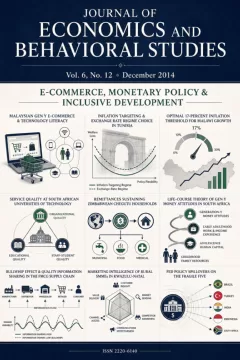 Vol. 6 No. 12 (2014)
E-Commerce, Monetary Policy & Inclusive Development
View issue contents
Published
Submissions
Have research to publish? Journal of Economics and Behavioral Studies welcomes submissions.
Make a Submission