Abstract
Several research studies have been conducted on the evaluation of service quality at conventional universities. However, this study focuses on universities of technology which are fast growing value-based educational institutions in South Africa. The uniqueness of this study highlights the issues that can affect the improvement of service at universities of technology. Three factors namely: Organizational issues, Educational issues and Staff &Student issues were extracted as the main foci in the improvement of service at universities of technology. A mixed method methodology and an action research approach were employed in this study. The results obtained using factor analysis provides a basis for driving an equation system for evaluating the impact of the issues with respect to the factors named above. The results also show that some extraneous factors that are external to service delivery, have a substantial effect on the quality of service at universities of technology.
Keywords
- Service Quality Search this journal for Service Quality (opens in a new tab)
- Customer Service Search this journal for Customer Service (opens in a new tab)
- Factor Analysis Search this journal for Factor Analysis (opens in a new tab)
- Universities of Technology Search this journal for Universities of Technology (opens in a new tab)
- South Africa Search this journal for South Africa (opens in a new tab)
References
- Asubonteng, P., McCleary, K. & Swan, J. (1996). SERVQUAL Revisited: A Critical Review of Service Quality. The Journal of Services Marketing, 10(6), 62–81 .
- Berry, L. L. (1995). Relationship Marketing of Services--Growing Interest, Emerging Perspectives. Journal of the Academy of Marketing Science , 23(4), 236-45.
- Bisschoff, C. A. & Bisschoff, A. (2001). Customer service factors of a Telemetric Learning BBA degree. South African Journal of Education , 21(4), 228–233.
- Boyd, N., Walker, E. & Larreche, P. (1998). Marketing Strategy. New York: Irwin.
- Davis, M. M. & Heineke, J. (1998). How disconfirmation, perception and actual waiting times impact customer satisfaction. International Journal of Service Industry Management, 9, 64– 73.
- de Winter, J. C. F., Dodou, D. & Wieringa, P. A. (2009) Exploratory Factor Analysis With Small Sample Sizes. Multivariate Behavioural Research, 44, 147-181.
- Donaldson, W. G. & McNicholas, C. (2004). Understanding the postgraduate education market for UK based students. Journal of non-profit and Voluntary Sector Marketing , 9(4), 346–360.
- Dotchin, J. A. & Oakland, J. S. (1994). Total Quality Management in Services, Part 1: Understanding and Classifying Services. International Journal of Quality & Reliability Management , 11(3), 9–36.
- Du Pré, R. (2009). The Place and Role of Universities of Technology in South Africa. Bloemfontein, South Africa: South African Technology Network.
- DuToit, A. (2004). How satisfied are our Students? Proceedings of the 1st International Conference on Teaching and Learning in Higher Education. Centre for the Development of Teaching and Learning, National University of Singapore. Singapore.
- Ham, L. & Hayduk, S. (2003). Gaining competitive advantage in higher education: analyzing the gap between expectations and perceptions of service quality. International Journal of Value-Based Management , 16(3), 223-242.
- Ibrahim, E., Wang, L. & Hassan, A. (2013). Expectations and Perceptions of Overseas Students towards Service Quality of Higher Education Institutions in Scotland. International Business Research, 6(6), 20-30.
- ISO. (2007). IWA 2, Quality Management Systems – Guidelines for the application of ISO 9001:2000 in Education, ISO, Geneva.
- Joseph, M., Yakhou, M. & Stone, G. (2005). An educational institution’s quest for service quality: customers’ perspective. Quality Assurance in Education , 13(1), 66-82.
- Kanning, U. P. & Bergmann, N. (2009). Predictors of customer satisfaction: testing the classical paradigms. Managing Service Quality, 9(4), 377–390.
- Kayastha, A. (2011). A Study of Graduate Student Satisfaction towards Service Quality of Universities in Thailand. Masters Degree in Business Administration (MBA).Webster University, Thailand.
- Kim-Soon, N., Rahman, A. & Ahmed, M. (2014). E-Service Quality in Higher Education and Frequency of Use of the Service. International Education Studies, 7(3), 1-10.
- Le Blanc, G. & Nguyen, N. (1997). Searching for excellence in business education: an exploratory study of customer impressions of service quality. International Journal of Educational Management , 11(2), 72-79.
- Lewis, B. R. & Mitchell, V. W. (1990). Defining and Measuring the Quality of Customer Service. Marketing Intelligence & Planning , 8(6), 11–17.
- Oldfield, B. M. & Baron, S. (2000). Student perceptions of service quality in a UK university business and management faculty. Quality Assurance in Education , 8(2), 85-95.
- Parasuraman, A., Zeithmal, V. A. & Berry, L. L. (1985). A Conceptual Model Service Quality and its Implications for Future Research. Journal of Marketing, 49(4), 41-50.
- Parasuraman, A. (2004). Assessing and Improving Service Performance for Maximum Impact: Insights from a Two-Decade-Long Research Journey. Performance Measurements and Metrics , 5(2), 45–52.
- Potluri, R. M. & Zeleke, A. A. (2009). Evaluation of customer handling competencies of Ethiopian employees. African Journal of Business Management , 3(4), 131–135.
- Russell, M. (2005). Marketing education: a review of service quality perceptions among international students. International Journal of Contemporary Hospitality Management , 17(1), 65-77.
- Sakthivel, P. B., Rajendran, G. & Raju, R. (2005) TQM implementation and students satisfaction of academic performance. The TQM Magazine, 17(6), 573-589.
- Shaari, H. (2014). Service Quality in Malaysian Higher Education: Adult Learners’ Perspective. International Journal of Business and Social Science, 5(1), 86-90.
- Soutar, G. & McNeil, M. (1996).Measuring service quality in a tertiary institution. Journal of Educational Administration, 34(1), 72-82.
- Sultan, P. & Wong, H. P. (2013). Antecents and consequences of service quality in a higher education context. Quality Assurance in Education, 21(1), 70-95.
- Sumaedi, S., Bakti, G. M. Y. & Metasri, N. (2012). An empirical study of state university students’ perceived service quality. Quality Assurance in Education, 20(2), 164 -183.
- Woodruff, R. B., Clemons, D. S., Schumann, D. W., Gardial, S. F. & Bruns, M. J. (1991). The standards issue in CS/D research: A historical perspective. Journal of Customer Satisfaction Dissatisfaction and Complaining Behaviour, 4, 103–109.
Downloads
No downloads have been recorded for this article yet. Figures appear here once readers begin downloading the full text.
How to Cite
Share this article
License
Copyright (c) 2014 Paul Green, OluwoleAdekanmbi (Author)

This work is licensed under a Creative Commons Attribution 4.0 International License.
Author (s) should affirm that the material has not been published previously. It has not been submitted and it is not under consideration by any other journal. At the same time author (s) need to execute a publication permission agreement to assume the responsibility of the submitted content and any omissions and errors therein. After submission of revised paper in the light of suggestions of the reviewers, the editorial team edits and formats manuscripts to bring uniformity and standardization in published material.
This work will be licensed under Creative Commons Attribution 4.0 International (CC BY 4.0) and under condition of the license, users are free to read, copy, remix, transform, redistribute, download, print, search or link to the full texts of articles and even build upon their work as long as they credit the author for the original work. Moreover, as per journal policy author (s) hold and retain copyrights without any restrictions.
Keywords
- Service Quality Search this journal for Service Quality (opens in a new tab)
- Customer Service Search this journal for Customer Service (opens in a new tab)
- Factor Analysis Search this journal for Factor Analysis (opens in a new tab)
- Universities of Technology Search this journal for Universities of Technology (opens in a new tab)
- South Africa Search this journal for South Africa (opens in a new tab)
Section
Published in
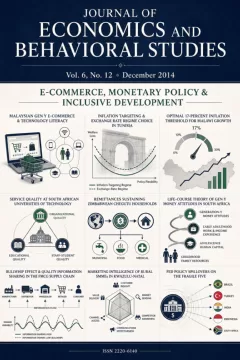 Vol. 6 No. 12 (2014)
E-Commerce, Monetary Policy & Inclusive Development
View issue contents
Published
Submissions
Have research to publish? Journal of Economics and Behavioral Studies welcomes submissions.
Make a Submission