Abstract
The life-course approach is a current use of an interdisciplinary and a multi-theoretical framework to study how childhood experiences, especially family experience affect later-life attitudes and consumer behaviour. One childhood family experience believed to be strongly driving later-life attitudes and values, and studied under the human capital life-course theoretical perspective is family resources received during childhood. This study uses the human capital life-course theoretical perspective to study how family resources received during childhood affect later-life money attitudes of a large and lucrative market segment like Generation Y South Africans, especially as their money attitudes can influence varied consumer behaviour. Survey results from 826 subjects showed that they scored high in the security and budget money attitudes. Family resources received during childhood negatively impacted on their symbolic (status, achievement and worry) money attitudes and had a strong positive impact on their conservative (budget and security) money attitudes.
Keywords
- Money Attitudes Search this journal for Money Attitudes (opens in a new tab)
- Family Resources Search this journal for Family Resources (opens in a new tab)
- Generation Y Search this journal for Generation Y (opens in a new tab)
- Life-Course Theory Search this journal for Life-Course Theory (opens in a new tab)
- South Africa Search this journal for South Africa (opens in a new tab)
References
- Baker, P. M. & Hagedorn, R. B. (2008). Attitudes to money in a random sample of adults: Factor analysis of the MAS and MBBS scales, and correlations with demographic variables. The Journal of Socio-Economics, 37, 1803-1814.
- Bakewell, C. & Mitchell, V. (2003). Generation Y female consumer decision-making styles. International Journal of Retail & Distribution Management, 31(2), 95-106.
- Benmoyal-Bouzaglo, S. & Moschis, G. P. (2009). The effects of family structure and socialization influences on compulsive consumption: a life-course study in France. International Journal of Consumer Studies, 33, 49-57.
- Benmoyal-Bouzaglo, S. & Moschis, G. P. (2010). Effects of Family Structure and Socialization on Materialism: A life Course Study in France. Journal of Marketing Theory and Practice, 18(1), 55-71.
- Bonsu, S. K. (2008). Ghanaian attitudes towards money in consumer culture. International Journal of Consumer Studies, 32,171-178
- Burgess, S. M. (2005). The importance and motivational content of money attitudes: South Africans with living standards similar to those in industrialised Western countries. South African Journal of Psychology, 35(1), 106-126.
- Burgess, S. M. (2007). Toward a Theory on the Content and Structure of Money Attitudes. Advances in Consumer Research, 32, 682-683.
- Burgess, S. M., Battersby, N., Gebhardt, L. & Steven, A. (2005). Money Attitudes and Innovative Consumer Behaviour: Hedge Funds in South Africa. Advances in Consumer Research, 32, 315-321.
- Chase-Lansdale, P. L., Cherlin, A. J. & Kierman, K. E. (1995). The Long-term Effects of Parental Divorce on Mental Health of Young Adults: A Developmental Perspective. Child Development, 66, 1614-1634.
- Cohen, P. & Cohen, J. (1996). Life values and adolescent mental health, Mahwah, NJ: Lawrence Erlbaun.
- De Waal, M. (2013). South Africans are sinking under debt – and the credit amendment bill won’t pull us out. Daily Maverick, 04 June. Available from: http://www.dailymaverick.co.za/article/2013-06-04south-africans-are-sinking-under-debt-and-the-credit-amendment-bill-wont-pull-usout/#.UiLTFWucH_Q (Accessed 31 August 2013).
- Durvasula, S. & Lysonski, S. (2010). Money, money, money – how do attitudes toward money impact vanity and materialism? The case of young Chinese consumers Journal of Consumer Marketing, 27(2), 169179.
- Engelberg, E. & Sjoberg, L. (2007). Money obsession, social adjustment, and economic risk perception. The Journal of Socio-Economics, 36, 686–69.
- Frytak, J., Harley, C. R. & Finch, M. D. (2003). Socio-economic status and health over the life course. In Handbook of the Life Course (Ed. By H.T. Mortimer & M.J. Shanahan), Plenum Publishers, New York, 623–643
- Furnham, A. (1984). Many sides of the coin: The psychology of money usage. Personal and Individual Differences, 5, 501-509.
- Furnham, A. & Okamura, R. (1999). Your Money or Your Life: Behavioural and Emotional Predictors of Money Pathology. Human Relations, 54(9), 1157-1177.
- Gorniak, J. (1999). Attitudes towards Money and Dealing with Money: Selected Results of the Research in Poland. Innovation, 12(4), 633-645.
- Gurney, K. (1988). Your money personality. New York: Doubleday.
- Guven, C. (2012). Reversing the question: does happiness affect consumption and savings behaviour? Journal of Economic Psychology 33(4), 701-717.
- Hanley, A. & Wilhelm, M.S. (1992). Compulsive buying: An exploration into self-esteem and money attitudes. Journal of Economic Psychology, 13, 5-18.
- Hill, M. S., Yeung, W. J. J. & Duncan, G. J. (2001). Childhood family structure and young adult behaviours. Journal of Population Economics, 14, 271-299.
- Jain, A. K. & Joy, A. (1997). Money matters: An exploratory study of the socio-cultural context of consumption, saving, and investment patterns. Journal of Economic Psychology, 18, 649-675.
- Keller, C. & Siegrist, M. (2006). Money Attitude Typology and Stock Investment. The Journal of Behavioural Finance , 7(2), 88–96.
- Kimberly, P. (2010). Talking to Gen Y about the New Culture of Thrift. U.S. News & World Report, March 2010, 147(3), 29-32.
- Kotler, P. & Armstrong, G. (2010). Global and Southern African Perspectives in Principles of Marketing. 1st ed. South Africa: Pearson Hall.
- Lim, V. K. G. & Teo, T. S. H. (1997). Sex, financial hardship, and locus of control: an empirical study of attitudes towards money among Singaporean Chinese. Journal of Economic Psychology , 18, 369–386.
- Martin, C. A. & Turley, L. W. (2004). Malls and Consumption motivation: an exploratory examination of older Generation Y consumers. International Journal of Retail & Distribution Management, 32(10), 464475.
- McClure, R. F. (1984). The relationship between money attitudes and over-all pathology. Psychology: A Quarterly Journal of Human Behaviour, 21, 4-6.
- Medina, J. F., Saegert, J. & Gresham, A. (1996). Comparison of Mexican-American and Anglo American attitudes toward money. The Journal of Consumer Affairs, 30(1), 124–144.
- Mitchell, T. R. & Mickel, A. E. (1999). The Meaning of Money: An Individual Difference Perspective. Academy of Management Review, 24(3), 568-578.
- Moschis, G. P. (2007). Life-course perspectives on consumer behaviour. Journal of the Academy of Marketing Science, 35, 295-307.
- Moschis, G. P., Mathur, A., Kwai, C. F. & Pizzutti, C. (2013). Effects of Family Structure on Materialism and Compulsive Consumption: A Life Course Study in Brazil. Journal of Research for Consumers, 23, 6696.
- Noble, S. M., Haytko, D. L. & Phillips, J. (2009). What drives college Generation Y consumers? Journal of Business Research, 62, 617-628.
- Oleson, M. (2004). Exploring the relationship between money attitudes and Maslow’s hierarchy of needs. International Journal of Consumer Studies, 28(1), 83-92.
- Paul, P. (2001). Getting Inside Gen Y. American Demographics, 23(9), 42-50.
- Prince, M. (1993). Self-concept, money beliefs and values. Journal of Economic Psychology, 14, 161-173.
- Rindfleisch, A., Burroughs, J. E. & Denton, F. (1997). Family structure, materialism and compulsive consumption. Journal of Consumer Research, 23, 312-325.
- Roberts, J. A. & Jones, E. (2001). Money attitudes, credit card use, and compulsive buying among American college students. Journal of Consumer Affairs, 35(2), 213-240.
- Roberts, J. A., Cesar, J. & Sepulveda, M. (1999). Demographics and money attitudes: a test of Yamuachi & Templer’s (1982) money attitude scale in Mexico. Personality and Individual Differences, 27, 19-35.
- Rose, G. M. & Orr, L. M. (2007). Measuring and Exploring Symbolic Money Meanings. Psychology & Marketing, 24(9), 743–761.
- Rousseau, G. G. & Venter, D. J. L. (1999). Measuring Consumer Attitudes toward Money. South African Journal of Economic and Management Studies, 2(3), 407-422.
- Simpson, J. (2011). Recession's aftermath still haunts SA consumers - UCT Unilever study finds. Accessed from: http://www.bizcommunity.com/PressOffice/PressRelease.aspx?i=114337&ai=59131 (Accessed 04 August 2011).
- Siqwana-Ndulo, N. (1998). Rural African family structure in the Eastern Cape Province, South Africa. Journal of Comparative Family Studies, 29(2), 407-417.
- Statistics South Africa. (2011). Distribution of total population by age groups and sex. Accessed from: http://mobi.statssa.gov.za/census2011/Age.html Accessed 31 March 2014).
- Sunil, B. & Kaushik, B. (2010). Modelling Money Attitudes to Predict Loan Default. The IUP Journal of Bank Management, 9(1 & 2), 12-20.
- Tang, T. L. P. & Gilbert, P. R. (1995). Attitudes toward money as related to intrinsic and extrinsic job satisfaction, stress and work related attitudes. Personality and Individual Differences, 19, 327-332.
- Tang, T. L. P. (1993). The meaning of money: Extension and exploration of the money ethic scale in a sample of university students in Taiwan. Journal of Organizational Behaviour, 14, 93-99.
- Wolburg, J. M. & Pokrywczynski, J. (2001). A Psychographic Analysis of Generation Y College Students. Journal of Advertising Research, September/October, 33-50.
- Xanthaki, H. (2000). The judiciary-based system of child support in Germany, France and Greece: an effective suggestion. Journal of Social Welfare and Family law , 22(3), 295-311.
- Yamauchi, K. & Templer, D. (1982). The development of a money attitude scale. Journal of Personality Assessment, 46, 522-528.
- Zelizer, V. A. (1994). The social meaning of money. New York: Basic Books.
Downloads
No downloads have been recorded for this article yet. Figures appear here once readers begin downloading the full text.
How to Cite
Share this article
License
Copyright (c) 2014 Helen I. Duh (Author)

This work is licensed under a Creative Commons Attribution 4.0 International License.
Author (s) should affirm that the material has not been published previously. It has not been submitted and it is not under consideration by any other journal. At the same time author (s) need to execute a publication permission agreement to assume the responsibility of the submitted content and any omissions and errors therein. After submission of revised paper in the light of suggestions of the reviewers, the editorial team edits and formats manuscripts to bring uniformity and standardization in published material.
This work will be licensed under Creative Commons Attribution 4.0 International (CC BY 4.0) and under condition of the license, users are free to read, copy, remix, transform, redistribute, download, print, search or link to the full texts of articles and even build upon their work as long as they credit the author for the original work. Moreover, as per journal policy author (s) hold and retain copyrights without any restrictions.
Keywords
- Money Attitudes Search this journal for Money Attitudes (opens in a new tab)
- Family Resources Search this journal for Family Resources (opens in a new tab)
- Generation Y Search this journal for Generation Y (opens in a new tab)
- Life-Course Theory Search this journal for Life-Course Theory (opens in a new tab)
- South Africa Search this journal for South Africa (opens in a new tab)
Section
Published in
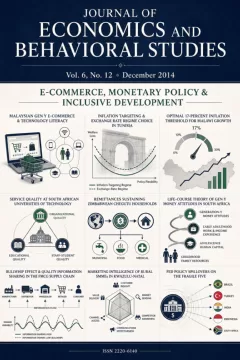 Vol. 6 No. 12 (2014)
E-Commerce, Monetary Policy & Inclusive Development
View issue contents
Published
Submissions
Have research to publish? Journal of Economics and Behavioral Studies welcomes submissions.
Make a Submission