Abstract
Since the Bretton Woods Agreement, the U.S. dollar has played the role of dominant global currency. As a result, the Federal Reserve Bank has many privileges such as the ability to run trade deficits without foreign exchange reserves. In the world, foreign exchange rates of currencies are quoted against the dollar, and majority of currency trading involves the dollar. Besides, international trade in primary commodities, such as oil, wheat, gold and coffee are bought and sold in U.S. dollar. The central banks of countries hold major positions of their international reserves in dollars. Any changes in its interest rates automatically alter the revenues of all world assets. With deregulated financial markets, the spillover effects of the Federal Reserve Bank’s decisions have increased. In this paper, we examine the impacts of Federal Reserve Bank policies over the Fragile Five that is a sub group of the weaker emerging markets namely Brazil, India, Indonesia, South Africa and Turkey. We are mainly focusing on the consequences of changes in Fed’s policies on the fragile five’s basic indicators; exchange rate, interest rate, and the stock exchange indices. All Fragile Five currencies have been depreciated by about 10 to 25% after the Fed tapering decisions. In addition we test for mean and volatility spillover of Wall Street on stock exchange indices of the Fragile Five in GARCH in mean framework and document the existence of such spillovers in almost all cases.
Keywords
- Global Financial Crisis Search this journal for Global Financial Crisis (opens in a new tab)
- Tapering Search this journal for Tapering (opens in a new tab)
- Fragile Five Search this journal for Fragile Five (opens in a new tab)
- Quantitative Easing Search this journal for Quantitative Easing (opens in a new tab)
- Emerging Economies Search this journal for Emerging Economies (opens in a new tab)
- FED Search this journal for FED (opens in a new tab)
- GARCH in Mean Search this journal for GARCH in Mean (opens in a new tab)
References
- Abou-Zaid, A. S. (2011). Volatility Spillover Effects in Emerging MENA Stock Markets. Review of Applied Economics , 7(1-2).
- Albu, L. L., Lupu, R., Călin, A. C. & Popovici, O. C. (2014). The Effect of ECB's Quantitative Easing on Credit Default Swap Instruments in Central and Eastern Europe. Procedia Economics and Finance , 8, 122-128.
- Alom, F., Ward, B. & Hu, B. (2011). Cross country mean and volatility spillover effects of food prices: multivariate GARCH analysis. Economics Bulletin , 31(2), 1439-1450.
- Barkar, M. (2013). Morgan Stanley Presents: 'The Fragile Five' — the Most Troubled Currencies in Emerging Markets. Business Insider, Retrieved from http://www.businessinsider.com/morganstanley-fragile-5-emerging-markets-2013-9?op=1#ixzz31VbPPBZR,
- Burns, A., Kida, M., Lim, J., Mohapatra, S. & Stocker, M. (2014). Unconventional monetary policy normalisation and emerging-market capital flows. Retivered from http://www.voxeu.org/article/tapering-and-emerging-market-capital-flows
- Bhar, R. & Nikolova, B. (2007). Analysis of mean and volatility spillovers using BRIC countries, regional and world equity index returns. Journal of Economic Integration , 22(2), 369-381.
- Carr, D. (2013). QE... Taper...? Does Post-Taper Policy Need a'Big Bang'Return to Normalcy? Taper. Retrieved from http://papers.ssrn.com/sol3/papers.cfm?abstract_id=2349826
- Clarida, R., Gali, J. & Gertler, M. (2002). A simple framework for international monetary policy analysis. Journal of Monetary Economics , 49(5), 879-904.
- Day, M. (2014). After Tough Year for Emerging Markets, Fates of ‘Fragile Five’ Diverge. The Wall Street Journal, Retrieved from http://blogs.wsj.com/moneybeat/2014/03/19/fates-of-fragile-fivediverge-as-emerging-markets-face-tough-year/
- D’Amico, S., English, W. B., Lopez-Salado, D. & Nelson, E. (2012). The Federal Reserve’s Large-Scale Asset Purchase Programs: Rationale and Effects. Working Paper, Federal Reserve Board, p. 1-58.
- Doh, T. (2010). The efficacy of large-scale asset purchases at the zero lower bound. Federal Reserve Bank pp:1-122of Kansas City Economic Review , 95(2), 5-34.
- Eichengreen, B. (2013). Does the Fed Care About the Rest of the World? University of California, Berkeley.
- Eichengreen, B. & Gupta, P. (2014). Tapering Talk: The Impact of Expectations of Reduced Federal Reserve Security Purchases on Emerging Markets. Retrieved from http://mprabuniMuenchende/53040/Ations.
- Fratzscher, M., Duca, M. L. & Straub, R. (2013). On the international spillovers of US quantitative easing. European Central Bank Working Paper Series , 1557, 1-64.
- Gagnon, J., Raskin, M., Remache, J. & Sack, B. (2011). The financial market effects of the Federal Reserve’s large-scale asset purchases. International Journal of Central Banking , 7(1), 3-43.
- Gökay, B. (2009). The 2008 World Economic Crisis: Global Shifts and Faultlines. Centre for Research on Globalization , 15(1).
- Hamao, Y., Masulis, R. W. & Ng, V. (1990). Correlations in price changes and volatility across international stock markets. Review of Financial studies , 3(2), 281-307.
- Hancock, D. & Passmore, W. (2011). Did the Federal Reserve's MBS purchase program lower mortgage rates? Journal of Monetary Economics , 58(5), 498-514.
- Herbst, A. F., Wu, J. S. & Ho, C. P. (2014). Quantitative easing in an open economy—Not a liquidity but a reserve trap. Global Finance Journal , 25(1), 1-16.
- Hoffmann A. (2014). Zero-Interest Rate Policy And The Unintended Consequences In Emerging Markets. International Centre for Economic Research, Working Paper No.2/2014 http://www.icer.it/docs/wp2014/ICERwp02-14.pdf
- Kimura, T. & Nakajima, J. (2013) . Identifying Conventional and Unconventional Monetary Policy-Shocks. Retrieved from http://www.voxeu.org/article/identifying-conventional-and-unconventionalmonetary-policy-shocks.
- Krishnamurthy, A. & Vissing-Jorgensen, A. (2011). The effects of quantitative easing on interest rates: channels and implications for policy (No. w17555). National Bureau of Economic Research. Retrieved from . t http://www.nber.org/papers/w17555
- Mishkin, F. S. (2000). Inflation targeting in emerging market countries (No. w7618). National Bureau of Economic Research.
- Nechio, F. (2014). Fed tapering news and emerging markets. FRBSF Economic Letter, 06. Retrieved from http://www.frbsf.org/economic-research/publications/economic-letter/2014/march/private credit-public-debt-financial-crisis/el2014-06.pdf
- Obstfeld, M. & Rogoff, K. (2002). Global implications of self-oriented national monetary rules. Quarterly Journal of Economics , 3, 503-535.
- Rasmus, J. (2013). From Taper Tantrum & Token Taper to Taper Tomorrow – Fed Policy in Crisis. Retrieved from http://jackrasmus.com/tag/interest-rates/.
- Serin, Z. & Oktay, B. (2014). Global Governance and Turkey’s Position in the Post-Global Crisis Period. Journal of Social and Development Sciences , 5(1), 7-13.
- Subramanian, A. (2014). International Impacts of the Federal Reserve’s Quantitative Easing Program. Retrieved from http://www.cgdev.org/publication/international-impacts-federalreserve%E2%80%99s-quantitative-easing-program
- Taylor, J. B. (2012). Monetary policy rules work and discretion doesn’t: A tale of two eras. Journal of Money, Credit and Banking , 44(6), 1017-1032.
- Wood, C. (2013). Markets Addicted To QE. The Economic times. Retrieved from http://articles.economictimes.indiatimes.com/2013-11-18/news/44202461_1_investmentcycle-curre.
Downloads
No downloads have been recorded for this article yet. Figures appear here once readers begin downloading the full text.
How to Cite
Share this article
License
Copyright (c) 2014 Mehmet ORHAN, Zehra Vildan SERIN, Halil İbrahim ÇELİKEL (Author)

This work is licensed under a Creative Commons Attribution 4.0 International License.
Author (s) should affirm that the material has not been published previously. It has not been submitted and it is not under consideration by any other journal. At the same time author (s) need to execute a publication permission agreement to assume the responsibility of the submitted content and any omissions and errors therein. After submission of revised paper in the light of suggestions of the reviewers, the editorial team edits and formats manuscripts to bring uniformity and standardization in published material.
This work will be licensed under Creative Commons Attribution 4.0 International (CC BY 4.0) and under condition of the license, users are free to read, copy, remix, transform, redistribute, download, print, search or link to the full texts of articles and even build upon their work as long as they credit the author for the original work. Moreover, as per journal policy author (s) hold and retain copyrights without any restrictions.
Keywords
- Global Financial Crisis Search this journal for Global Financial Crisis (opens in a new tab)
- Tapering Search this journal for Tapering (opens in a new tab)
- Fragile Five Search this journal for Fragile Five (opens in a new tab)
- Quantitative Easing Search this journal for Quantitative Easing (opens in a new tab)
- Emerging Economies Search this journal for Emerging Economies (opens in a new tab)
- FED Search this journal for FED (opens in a new tab)
- GARCH in Mean Search this journal for GARCH in Mean (opens in a new tab)
Section
Published in
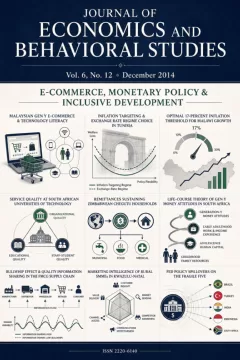 Vol. 6 No. 12 (2014)
E-Commerce, Monetary Policy & Inclusive Development
View issue contents
Published
Submissions
Have research to publish? Journal of Economics and Behavioral Studies welcomes submissions.
Make a Submission