Abstract
This study analyzed the risk-taking propensity amongst the four cultural groups and its impact on the business performance, from a sample of Small and Medium Enterprises (SMEs) within the Gauteng Province of South Africa. The data was collected using two sets of questionnaire measuring risk taking propensity and perceived business performance. 83 responses were returned from 400 respondents. The results indicate that male on average show higher risk taking, while difference in risk taking propensity between male and female was not statistically significant. A very weak or no correlation between risk taking and business performance scores for both the genders were found, indicating that gender and culture does not play a role in the relationship between risk taking and business performance. However study found that there was significant difference in risk taking behavior by different culture groups, Zimbabweans were the highest risk takers, while Chinese, Pakistanis and South Africans differed in their risk taking behavior.
Keywords
- Entrepreneurship Search this journal for Entrepreneurship (opens in a new tab)
- Risk Search this journal for Risk (opens in a new tab)
- Culture Search this journal for Culture (opens in a new tab)
- Business Performance Search this journal for Business Performance (opens in a new tab)
- South Africa Search this journal for South Africa (opens in a new tab)
References
- Autio, E., S. Pathak, & Wennberg, K. (2013). Consequences of Cultural Practices for Entrepreneurial Behaviors. Journal of International Business Studies, 44(2), 334–362.
- Busenitz, L., Gomez, W. J. & Spencer, J. (2000). Country Institutional Profiles: Unlocking Entrepreneurial Phenomena. Academy of Management Journal, 43(5), 994–1003.
- Byrnes, J. P., Miller, D. C. & Schafer, W. D. (1999). Gender differences in risk-taking: a Meta analysis. Psychological Bulletin, 125(3), 367-383
- Cameron, K. S. & Quinn, R. E. (1999). Diagnosing and changing organizational culture: Based on the competing values framework. Reading, MA: Addison-Wesley
- Quinn, J. (1988). Beyond Rational Management John Wiley and Sons.
- Despande, R. & Webster, F. (1989). Organizational Culture and Marketing: Defining the Research Agenda. Journal of Marketing, 53(1), 3-15
- Engelen, A., Flatten, T. C., Thalmann, J. & Brettel, M. (2014). The effect of Organizational Culture on Entrepreneurial Orientation: A Comparison between Germany and Thailand. Journal of Small Business Management, 52(4), 732-752.
- Garg, A. K. & Duvenhage, A. (2014). Risk taking patterns of male and female entrepreneurs in Roodeppoort: A case study. African and Asian Studies, 13(4), 452-478
- Garg, A. K., Joubert, R. J. O. & Pellisier, R. (2004). Measuring business performance: A case study. Southern African Business Review, 8(1), 7-21
- GEM Report. (2014). An alarmingly low level of entrepreneurial activity in spite of high unemployment; available from http://www.gemconsortium.org/country-profile/108
- Kangas, L. (2009). Assessing the Value of the Relationship between Organizational Culture Types and Knowledge Management Initiatives. Journal of Leadership Studies, 3(1), 29-38
- Katepa-Kalala, P. (1999). Assessment report on women and poverty and economic empowerment of woman. http://www.uncca.org.
- Kluckhohn, C. (1951). The Study of Culture. In The Policy Standard. Eds. D. Lerner and H. Lasswell. Cambridge: Harvard University Press: 393-404.
- Kreiser, P. M., Marino, L. D., Dickson, P. & Weaver, K. (2010). Cultural Influences on Entrepreneurial Orientation: The Impact of National Culture on Risk Taking and Proactiveness in SMEs. Entrepreneurship Theory and Practice, 34(5), 959-983.
- Lee, S. M. & Peterson, S. J. (2000). Culture, Entrepreneurial Orientation, and Global Competitiveness. Journal of World Business, 35(4), 401-416
- Mcgrath, R. G., Macmillan, I. C., Yang, E. A. & Tsai, W. (1992). Does Culture Endure, or is it Malleable? Issues for Entrepreneurial Economic Development. J Bus Venturing, (7), 115–135
- Mihet, R. (2013). Effects of culture on firm risk-taking: a cross-country and cross-industry analysis. J Cult Econ., 37, 109-151.
- Mueller, S. L. & Thomas, A. S. (2000). Culture and Entrepreneurial Potential: A Nine Country Study of Locus of Control and Innovativeness. Journal of Business Venturing, 16, 51-75.
- Mungai, E. N. & Ogot, M. (2012). Gender, Culture and Entrepreneurship in Kenya. International Business Research, 5(5), 175-183.
- Stephan, U. & Uhlander, L. M. (2010). Performance-Based vs Socially Supportive Culture: A Cross-National Study of Descriptive Norms and Entrepreneurship. Journal of International Business Studies, 41(8), 1347–1364.
- Schubert, R., Brown, M., Gysler, M. & Brachinger, H. (1999). Financial decision making: are women really more risk averse. American Economic Review, 89, 381.
- Torro, A., Urbano, D. & Peris-Oritz, M. (2014). Culture and innovation: The moderating effect of cultural values on corporate entrepreneurship. Technological Forecasting & Social Change, 88, 360-369.
- Valencia, J., Valley, R. & Jimenz, D. (2010). Organizational Culture as Determinants Product Innovation. European Management Journal, 13(4), 466-480.
- Webster, C. & White, A. (2010). Exploring the National and Organizational Culture Mix in Service Firms. Journal of Academy of Marketing Sciences, 38(6), 691-703.
- Weber, E. U., Blais, A. R. & Betz, E. (2002). A Domain-specific risk-attitude scale: Measuring risk perceptions and risk behaviours. Journal of Behavioural Decision Making, 15, 263-290.
- Zeffane, R. (2015). Trust, personality, risk taking and entrepreneurship. World Journal of Entrepreneurship, Management and Sustainable Development, 11(3), 191-209.
Downloads
No downloads have been recorded for this article yet. Figures appear here once readers begin downloading the full text.
How to Cite
Share this article
License
Copyright (c) 2016 Ajay K Garg, Peter Letsolo (Author)

This work is licensed under a Creative Commons Attribution 4.0 International License.
Author (s) should affirm that the material has not been published previously. It has not been submitted and it is not under consideration by any other journal. At the same time author (s) need to execute a publication permission agreement to assume the responsibility of the submitted content and any omissions and errors therein. After submission of revised paper in the light of suggestions of the reviewers, the editorial team edits and formats manuscripts to bring uniformity and standardization in published material.
This work will be licensed under Creative Commons Attribution 4.0 International (CC BY 4.0) and under condition of the license, users are free to read, copy, remix, transform, redistribute, download, print, search or link to the full texts of articles and even build upon their work as long as they credit the author for the original work. Moreover, as per journal policy author (s) hold and retain copyrights without any restrictions.
Keywords
- Entrepreneurship Search this journal for Entrepreneurship (opens in a new tab)
- Risk Search this journal for Risk (opens in a new tab)
- Culture Search this journal for Culture (opens in a new tab)
- Business Performance Search this journal for Business Performance (opens in a new tab)
- South Africa Search this journal for South Africa (opens in a new tab)
Section
Published in
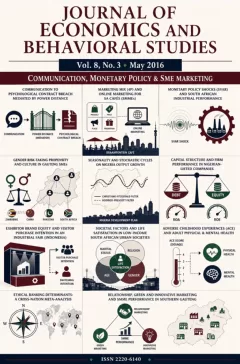 Vol. 8 No. 3(J) (2016)
Communication, Monetary Policy & SME Marketing
View issue contents
Published
Submissions
Have research to publish? Journal of Economics and Behavioral Studies welcomes submissions.
Make a Submission