Abstract
This study aims to assess the impact and spill over effects of the United States (US) Quantitative Easing (QE) to South Africa. Using an event-study analysis on daily data spanning from 25/11/2008 – 12/12/2012 for selected QE dates, the study finds that US Treasury bills fall by 106 basis points on average during QE1, rise by 9 basis points and 8 basis points during QE2 and QE3, respectively. For South Africa, government bonds fall by 61 basis points on average during QE1, 9 basis points during QE2 and 2 basis points during QE3. This leads to the conclusion that UMPs boost the economy in the short run but hurt the economy in the long run, especially when targeting inflation, and used extensively. Therefore, policymakers should concentrate on the overall financial system to measure the financial risk, and thus consistently strengthen macro prudential orientation.
Keywords
- Global Financial Crisis Search this journal for Global Financial Crisis (opens in a new tab)
- Quantitative Easing Search this journal for Quantitative Easing (opens in a new tab)
- Event Study Analysis Search this journal for Event Study Analysis (opens in a new tab)
- Unconventional Monetary Policy Search this journal for Unconventional Monetary Policy (opens in a new tab)
- Interest Rates Search this journal for Interest Rates (opens in a new tab)
References
- Bank of England pamphlet. (2011). Quantitative easing explained. Available at www.bankofengland.co.uk
- Bernanke, B.S. (2009). Federal Reserve Policies to Ease Credit and Their Implications for the Fed’s Balance Sheet. The National Press Club Luncheon, Washington D.C.
- Benninga, S. 2008. Financial Modelling 3rd edition. Boston, MA: MIT Press.
- Bhattarai, S., Chatterjee, A. and Woong, Y. (2015). Effects of US Quantitative Easing on Emerging Market Economies. UNSW Business School Research Paper No. 2015-26. Available at SSRN: https://ssrn.com/abstract=2685500
- Bhattarai, S., Eggertsson, G.B. and Gafarov, B. (2015). Time Consistency and the Duration of Government Debt: A Signalling Theory of Quantitative Easing. National Bureau of Economic Research, 1050 Massachusetts Avenue, Cambridge, MA 02138.
- Borio, C. (2011) Central Banking post-crisis: What compass for unfigured water? Monetary and Economic Department. BIS Working Paper, No.353
- Borio, C. and Zabai, A. (2016). Unconventional Monetary Policies: A re-appraisal. BIS Working Paper, No.570.
- Borio, C.E.V. and Shim I. (2007) What can macro-prudential policy do to support monetary policy? Monetary and Economic Department: BIS working paper, No.242.
- Botezatu, H.P. and Diaconescu, D.R. (2014) Financial Stability Due to the UMPs: International Journal of Business and Management, Vol.2, pp.11-24.
- Chacha, T. (2017). The effect of Fed’s Quantitative Easing Policy on Listed Companies and Sectors in South Africa. University of Cape Town, South Africa
- Cecioni, M., Ferrero, G. and Secchi, A. (2011) Unconventional Monetary Policy in Theory and in Practice, Questioni di Economia e Finanza Occasional papers, No.102, Electronic copy available at: http://ssrn.com/abstract=1998755.
- Chodorow-ReicH, G. (2014). Effects of Unconventional Monetary Policy on Financial Institutions. Brooking papers on economic activity: Harvard University
- Francois, D. and Mathieu, D.A. (2016). Post-crisis monetary policies: Economic Viewpoint, Desjardins Economic Studies, available at: www.desjardins.com/economics.
- Gagnon, J, Raskin, M., Remache, J. and Sack, B. (2011). Large-Scale Asset Purchases by The Federal Reserve: Did They Work? FRBNY Economic Policy Review, Vol.17, No.13, pp.41–59.
- Holler, J. 2014. Event-study methodology and statistical significance, 1st Edition. Germany: O1WIR Publisher for Economics, Computer Science and Law
- Horvath, R. (2017). Side effects of UMP: Policy Department-Economic and Scientific policy. Directorate General for Internal Policies. Available at: https://za.investing.com/rates-bonds/south-africa
- Joyce, M., Miles, D., Scott, A. and Vayanos, D. (2012). Quantitative Easing and UMPs - An Introduction. Economic Journal, Vol.122, pp.271-288.
- Kapetanios, G., Mumtaz, H., Stevens, I. and Theodoridis, K. (2012). Assessing the economy-wide effects of quantitative easing: Bank of England Working Paper, No.443.
- Kenc, T., Turhan, M.I. and Yildirim, O. (2011). The Experience with Macro-Prudential Policies of the Central Bank of the Republic of Turkey in Response to the Global Financial Crisis: Policy Research Working Paper, No.5834.
- Khothari, S.P. and Warner, J.B. (2007). Handbook of Corporate Finance: Empirical Corporate Finance, Vol 1., Elsevier, North Holland.
- Korniyenko, Y. and Loukoianova, E. (2015). The Impact of Unconventional Monetary Policy Measures by the Systematic Four on Global Liquidity and Monetary Conditions: IMF Working Paper, No.287
- Krishnamurthy, A, and Vissing-Jorgensen, A. (2011). The Effects of Quantitative Easing on Interest Rates. https://fisher.osu.edu/blogs/efa2011/files/APE_3_1.pdf/, 22 June 2011.
- Lenza, M., Pill, H. and Reichlin, L. (2010). Monetary policy in Exceptional Times, Journal of Economic Policy, Vol.25, pp.295–339.
- Liber8 Newsletter. (2011). Quantitative Easing Explained: An informative and accessible economic essay with a classroom application. Available at: www.stlouisfed.org/education.
- Meier, A. (2009). 'Panacea, curse, or non-event: unconventional monetary policy in the United Kingdom', IMF Working Paper No.09/163
- Oosthuizen, H. (2016). Policy Implications for South Africa as a result of Quantitative Easing and Monetary Policy Normalisation. Nedbank and Old Mutual Budget Speech Competition, Entry Number: 805. Available at: http://www.budgetspeechcompetition.co.za/wp-content/uploads/2017/10/Hendrik-Oosthuizen.pdf
- Ortiz, G. (2010). The Future of Central Banking under Post-Crisis Mandates: Ninth BIS Annual Conference, 24-25 June.
- Reich, G.C. (2014). The Effect of Unconventional Monetary on Financial Institutions. National Bureau of Economics Research Working Paper.
- Subacchi, P. (2013). Coordinating the Next Move, Monetary Policy in the Post-crisis World: Think Tank 20: The G-20 and Central Banks in the New World of UMP
- Tatiana, F. (2013). The spillover effects of Unconventional Monetary Policies in major developed countries on developing countries, Department of Economic and Social Affairs: Working Paper No. 131 (October 2013) ST/ESA/2013/DWP/131
- Velde, D.W. (2008). The Global Financial Crisis and Developing Countries: Which countries are at risk and what can be done? Overseas Development Institute
- Vinals, J., Blanchard, O. and Tiwari, S. (2013). Global Impact and Challenges of UMPs: IMF Policy Paper, October.
- Weale, M. and Wieladek, T. (2014). What are the macroeconomic effects of asset purchases? External MPC Unit Discussion Paper No.42.
- Yasin, A., Ahmet, F.A. and Arif, O. (2013). Central Banking in making during the Post-Crisis world and the Policy-mix of the Central bank of the Republic of Turley: Journal of Central Banking Theory and Practice, Vol.2, pp.5-18
Downloads
No downloads have been recorded for this article yet. Figures appear here once readers begin downloading the full text.
How to Cite
Share this article
License
Copyright (c) 2020 Baneng Lucas Naape, Mamokgaetji Marius Masoga (Author)

This work is licensed under a Creative Commons Attribution 4.0 International License.
Author (s) should affirm that the material has not been published previously. It has not been submitted and it is not under consideration by any other journal. At the same time author (s) need to execute a publication permission agreement to assume the responsibility of the submitted content and any omissions and errors therein. After submission of revised paper in the light of suggestions of the reviewers, the editorial team edits and formats manuscripts to bring uniformity and standardization in published material.
This work will be licensed under Creative Commons Attribution 4.0 International (CC BY 4.0) and under condition of the license, users are free to read, copy, remix, transform, redistribute, download, print, search or link to the full texts of articles and even build upon their work as long as they credit the author for the original work. Moreover, as per journal policy author (s) hold and retain copyrights without any restrictions.
Keywords
- Global Financial Crisis Search this journal for Global Financial Crisis (opens in a new tab)
- Quantitative Easing Search this journal for Quantitative Easing (opens in a new tab)
- Event Study Analysis Search this journal for Event Study Analysis (opens in a new tab)
- Unconventional Monetary Policy Search this journal for Unconventional Monetary Policy (opens in a new tab)
- Interest Rates Search this journal for Interest Rates (opens in a new tab)
Section
Published in
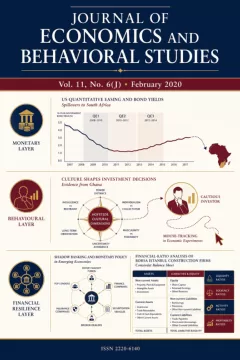 Vol. 11 No. 6(J) (2019)
Monetary Policy, Culture & Financial Resilience
View issue contents
Published
Submissions
Have research to publish? Journal of Economics and Behavioral Studies welcomes submissions.
Make a Submission