Abstract
This study seeks to explore the influence of culture on the investment decisions of Ghanaians. It is motivated by the perception that Ghanaians show no enthusiasm for long-term investments or life insurance products. To explore this problem, we used a random sampling, quantitative cross-sectional technique to administer a set of questionnaires to a cross-section of 120 Ghanaians residing in the City of Columbus, Ohio, U.S.A. Hofstede’s five cultural dimensions were used as the theoretical framework to guide the study. The results showed that Ghanaians prefer short-duration risk-free investments to long-duration risky investments. Ghanaian investors are not aggressive in gathering and analyzing financial information before making investment decisions. Their investment decisions are influenced by others, intuition, comfort and security, and their belief systems, rather than rational analysis of information, and risk-reward relationships derived from financial models. The use of intuition and information passed on from relatives, family members and others in making investment decisions paves the way for cultural factors to influence investment decisions. We conclude that cultural values have significant influence on the investment decisions of Ghanaians. The study seeks to motivate investors to examine and broaden their cultural awareness to enable them develop financial plans to achieve their investment goals. We recommend that to overcome negative cultural influence on investment decision making, financial education should be vigorously pursued to broaden financial literacy.
Keywords
- Cultural Dimensions Search this journal for Cultural Dimensions (opens in a new tab)
- Cultural Factors Search this journal for Cultural Factors (opens in a new tab)
- Investment Decisions Search this journal for Investment Decisions (opens in a new tab)
- Investment Theories Search this journal for Investment Theories (opens in a new tab)
- Ghanaian Cultural Values Search this journal for Ghanaian Cultural Values (opens in a new tab)
References
- Ajzen, I. (1985). From intentions to actions: A theory of planned behavior. In Kuhl, J. and Beckmann, J. (Eds) Action-control: From cognition to behavior, Springer, Heidelberg, 11-39.
- Ajzen, I. (1991). The theory of planned behavior. Organizational Behavior and Human Decision Processes, 50, 179-211.
- Amoah, B. (2018). Mr. Ponzi with fraud scheme is knocking: Investors who may open. G lobal Business Review , 19(5), 1115-1128.
- Aregbeyen, O. & Mbadiugha, S. O. (2011). Factors influencing investors’ decisions in shares quoted companies in Nigeria. Medwell Journal, 6(3), 205-212.
- Arshad, I. & Ibrahim, Y. (2019). Uncertainty avoidance, risk avoidance and perceived risk: A cultural perspective of individual investors. Hasanuddin Economics and Business Review, 3(1), 21-33.
- Babbie, E. (2014). The practice of social research (10th ed.). Belmont: CA: Thompson Wadsworth Learning Inc.
- Baker, H. K. & Nofsinger, J. R. (2002). Psychological biases of investors. Financial Services Review, 11 , 97-116.
- Bierman, H. & Jr. (1997). Portfolio management allocation and the investment horizon. Journal of Portfolio Management, 23(4), 51-55.
- Boye, S. S. (2005). Cultural factors that shape investment decisions. Pakistani Journal of Social Sciences, 3(3), 495-502.
- Dawuda, A. & Azeko, I. (2005). An assessment of financial record keeping behavior of small-scale business in Ghana. A case study of Bolgatanga municipality. International Journal of Finance & Accounting, 4(3), 187-194.
- East, R. (1993). Investment decisions and the theory of planned behavior. Journal of Economic Psychology, 14(2), 337-375.
- Fama, E. F. & French, K. R. (2004). The capital asset pricing model: Theory and evidence. Journal of Economic Perspective , 18(3), 25-46.
- Fama, E. F. & French, K. R. (1993). Common risk factors in the returns on stocks and bonds. Journal of Financial Economics , 33(1), 3-56.
- Fishbein, M. & Ajzen, I. (1975). Belief, attitude, intention and behavior: An introduction to theory and research. Reading, MA: Addison Wesley.
- Govind, H., Chapman, K. S. & Domian, D. L. (2000). Risk tolerance and asset allocation for investors nearing retirement. Financial Services Review, 9(2), 159-170.
- Grable, J. & Lytton, R. H. (1999). Financial risk tolerance revisited: The development of a risk assessment instrument. Financial Services Review, 9(2), 159-170.
- Grinblatt, M. & Keloharju, M. (2001). How distance, language, and culture influence stock holding and trades. Journal of Finance, 56(3), 1053-1073.
- Hofstede, G. (1980). Culture’s consequences: International differences in work-related values. Beverly Hills CA: Sage Publications.
- Hofstede, G. (1984). National cultures and corporate cultures. In L.A. Samovar & R.E. Porter (Eds.), Communication between cultures. Belmont, CA: Wadsworth.
- Ibarra, R. (2013). A spatial dominance approach to evaluate the performance of stocks and bonds: Does the investment horizon matter? Quarterly Review of Economics and Finance, 53(4), 429-439.
- Kesse, B. (2018). Menzgold customer mourns 8.5 Billion cedis he invested. Ghana News. [Online]. Accessed 27/11/2018.
- Khairullah, D. H. Z. & Khairullah, Z. Y. (2013). Cultural influence and decision-making in China. International Journal of Business, Humanities and Technology, 3(2), 1-11.
- Lederach, J. P. (1995). Preparing for peace: Conflict transformation across cultures. Syracuse, NY: Syracuse University Press.
- Lee, C. Y. (2012). Korean culture and its influence on business practices in South Korea. Journal of International Management Studies, 7(2), 184-191.
- Leonard, K. M., Slaubaugh, M. & Wang, H. C. (2010). Cultural effects on accounting practices and investment decisions. International Journal of Accounting and Finance, 2(2), 156-168.
- Li, W., Masuda, T. & Russel, M. J. (2014). Culture and decision-making: Investigating cultural variations in the East Asian and North American online decision-making processes. Asian Journal of Social Psychology , 18(3), 183-191.
- Malkiel, B. G. (1973). A random walk down Wall Street . New York, NY: Norton
- Markowitz, H. M. (1991). Foundations of portfolio theory. Journal of Finance, 46(2), 469-477.
- Nazemi, S., Rahimnia, F., Lagzian, M. & Ghayour, S. (2012). Investigating cultural influences on investing process in stock exchange. Management Science Letters, 2(8), 3041-3048.
- Osei, K. A. (1998). Analysis of factors affecting the development of an emerging capital market: The case of the Ghana Stock Market, AERC Research Paper 76, African Economic Research Consortium, Nairobi.
- Rafiee, V. & Sarabdeen, J. (2012). The cultural influence in the practice of corporate governance in emerging markets. Communication of IBIMA, 12 , 1-10.
- Rahimi, A., Mousai, M., Azad, N. & Syedaliakbar, S. M. (2014). Impacts of economic, cultural, social, individual and environmental factors on demands for cinema: A case study of Tehran. African Journal of Business Management , 8(13), 480-494.
- Reily, K. F. & Brown, C. K. (2003). Investment analysis & portfolio management (7th ed.). Mason: OH: SouthWestern Inc.
- Schwartz, S. H. (1992). Universals in the content and structure of values: Theoretical advances and empirical tests in 20 countries. Advances in Experimental Social Psychology , 25, 1-65.
- Schwartz, S. H. (2012). An overview of the Schwartz Theory of basic values. Online Readings in Psychology and Culture, 2(1), 3-20.
- Sharpe, W. F. (1964). Capital Asset Prices: A theory of market equilibrium under conditions of risk. Journal of Finance, 19(3), 425-442.
- Sondari, M. C. & Sudarsono, R. (2015). Using theory of planned behavior in predicting intention to invest. International Academic Research Journal of Business and Technology, 1(2), 137-141.
- Suresh, A. S. (2013). A study on fundamental and technical analysis. International Journal of Marketing , Financial Services & Management Research , 2(5), 44-59.
- Trompenaars, F. & Hampden-Turner, C. (1997). Riding the waves of culture: Understanding diversity in global business. New York, NY: McGraw-Hill.
- Tversky, A. & Kahneman, D. (1974). Judgment under uncertainty: Heuristics and biases. Science, 185(4157), 1124-1131.
- Yeboah, M. A. (2014). Analysis of entrepreneurship: How does culture influence risk-taking in SMEs in the Sekondi-Takoradi Metropolis of Ghana? American International Journal of Contemporary Research, 4(2), 131-140.
- Zhao, L. (2014). The influence of the culture on managers’ capital budgeting decisions. International Journal of Accounting and Taxation , 2(4), 49-55.
Downloads
No downloads have been recorded for this article yet. Figures appear here once readers begin downloading the full text.
How to Cite
Share this article
License
Copyright (c) 2020 Adu K. Bonna, Robert Awobgo-Moah Amoah (Author)

This work is licensed under a Creative Commons Attribution 4.0 International License.
Author (s) should affirm that the material has not been published previously. It has not been submitted and it is not under consideration by any other journal. At the same time author (s) need to execute a publication permission agreement to assume the responsibility of the submitted content and any omissions and errors therein. After submission of revised paper in the light of suggestions of the reviewers, the editorial team edits and formats manuscripts to bring uniformity and standardization in published material.
This work will be licensed under Creative Commons Attribution 4.0 International (CC BY 4.0) and under condition of the license, users are free to read, copy, remix, transform, redistribute, download, print, search or link to the full texts of articles and even build upon their work as long as they credit the author for the original work. Moreover, as per journal policy author (s) hold and retain copyrights without any restrictions.
Keywords
- Cultural Dimensions Search this journal for Cultural Dimensions (opens in a new tab)
- Cultural Factors Search this journal for Cultural Factors (opens in a new tab)
- Investment Decisions Search this journal for Investment Decisions (opens in a new tab)
- Investment Theories Search this journal for Investment Theories (opens in a new tab)
- Ghanaian Cultural Values Search this journal for Ghanaian Cultural Values (opens in a new tab)
Section
Published in
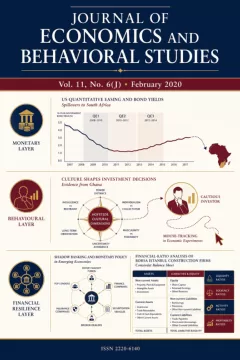 Vol. 11 No. 6(J) (2019)
Monetary Policy, Culture & Financial Resilience
View issue contents
Published
Submissions
Have research to publish? Journal of Economics and Behavioral Studies welcomes submissions.
Make a Submission