Abstract
Computer education is increasing steadily because it is well-recognized as a major indicator of the successful acceptance of information technology applications in an organization. Despite the advantages associated with computer education, there is a relative scarcity of empirical studies on the potential role of computer education in the behavioural intentions of staff to use information technology applications, particularly in healthcare settings. Thus, this research is aimed to investigate the role of computer education to the behavioural intentions of staff to use information technology applications in the hospitals in Kumasi. Guided by Davis technology acceptance model, five hypotheses were stated and examined through structural equation modeling. Utilizing stratified sampling, data were gathered via a survey questionnaire from a sample of 154 staff in the hospitals in Kumasi. The research revealed that computer education contributes positively to the behavioural intentions to use via the impact of perceptions of ease of use of technology applications in the hospitals in Kumasi. The research, therefore, recommends that the management should consider computer education in the adoption of technology systems to enhance the staff perceptions of ease of use and hence, their intentions to use to improve health care in the Metropolis.
Keywords
- Computer Education Search this journal for Computer Education (opens in a new tab)
- Behavioural Intentions Search this journal for Behavioural Intentions (opens in a new tab)
- Information Technology Search this journal for Information Technology (opens in a new tab)
- Hospitals Search this journal for Hospitals (opens in a new tab)
References
- Abookire, S. A., Teich, J. M., Sandige, H., Paterno, M. D., Martin, M. T., Kuperman, G. J. & Bates, D. W. (2000). Improving allergy alerting in a computerized physician order entry system. P aper presented at AMIA Symposium ( https://www.ncbi.nlm.nih.gov/pmc/articles/PMC2243998/pdf/procamiasymp00 0030037.pdf: Accessed October 2018).
- AbuShanab, E. & Pearson, J. M. (2007). Internet banking in Jordan: The unified theory of acceptance and use of technology (UTAUT) perspective. Journal of System Information Technology , 9(1), 78–97.
- Ajami, S. & Arab-Chadegani, R. (2013). What are the most important barriers to implement Radio Frequency Identification Device (RFID) in Health System? Journal of Information Technology Software Engineering , 4(7), 7- 19.
- Ajzen, I. (1991). The theory of planned behaviour. Organizational Behaviour and Human Decision Processes , 50(2), 179-211.
- Al-Gahtani, S. S. & King, M. (1999). Attitudes, satisfaction and usage: factors contributing to each in the acceptance of information technology . Behaviour Information Technology, 18(4), 277– 297.
- Atilgan, E., Aksoy, S. & Akinci, S. (2005). Determinants of Brand Equity: A Verification Approach in the Beverage Industry in Turkey. Marketing Intelligence & Planning, 23(3), 237- 248.
- Bagozzi, R. P. & Yi, Y. (1988). On the Evaluating Structural Equation Models. Journal of Academy of Marketing Research, 16(1), 074-094.
- Burton-Jones, A. & Hubona, G. S. (2006). The mediation of external variables in the technology acceptance model. Information & Management , 43, 706 –717.
- Byrne, B. M. (2016). Structural Equation Modeling with AMOS: Basic Concepts, Applications and Programming (3rd ed.), New York: Taylor & Francis.
- Creswell, J. W. (2014). Research Design: Qualitative, Quantitative, and Mixed Methods Approaches (4th ed.), California: SAGE Publications Inc.
- Davis, F. D. (1989). Perceived usefulness, perceived ease of use and user acceptance of information technology . Management Information Systems Quarterly , 13, 319–339.
- Davis, F. D. & Venkatesh, V. (1996). A critical assessment of potential measurement biases in the technology acceptance model: three experiments. International Journal of Human-Computer Studies , 45, 19-45.
- dos Reis, R. A. & Freitas, M. d. C. D. (2014). Critical Factors on Information Technology Acceptance and Use: An Analysis of Small and Medium Brazilian Clothing Industries. Information Technology and Quantitative Management , 31, 105–114.
- Floyd, F. J. & Widaman, K. F. (1995). Factor Analysis in the Development and Refinement of Clinical Assessment Instrument. Psychological Assessment, 7(3), 286-299.
- Fornell, C. & Larcker, D. F. (1981). Evaluating Structural Equation Models with Unobservable Variables and Measurement Error. Journal of Marketing Research, 18(1), 39-50.
- Hair, J. H., Black, W. C., Babin, B. J. & Anderson, R. E. (2010). Multivariate Data Analysis: A Global Perspective (7th ed.), New York: Pearson Prentice Hall.
- Handy, J., Hunter, I. & Whiddat, R. (2001). User Acceptance of inter-organizational electronic medical records. Australasian Journal of Information Systems , 7(2), 103–107.
- Hu, L. & Bentler, P. M. (1999). Cut-off Criteria for Fit Indexes in Covariance Structure Analysis: Conventional Criteria versus New Alternatives. Structural Equation Modeling Multidisciplinary Journal , 6 (1), 1- 55.
- Hennington, A. & Janz, B. D. (2007). Information systems and healthcare XVI: physician adoption of electronic medical records: applying the UTAUT model in a healthcare context. Journal of Health Management , 19(5), 243–269.
- Johnson, R. (2003). Health Care Technology: A history of clinical care innovation, USA: Washington National Press.
- Kaye, R., Kokia, E., Shalev, V., Idar, D. & Chinita, D. (2010). Barriers and success factors in health information technology; A practitioner’s perspective. Journal of Management & Marketing in Healthcare , 3(3), 163-175.
- Kijsanayotin, B., Pannarunothai, S. & Speedie, S. M. (2009). Factors influencing health information technology adoption in Thailand’s community health centres: Applying the UTAUT model. International Journal of Medical Information , 78(6), 404–416.
- Kline, R. B. (2005). Principles and Practice of Structural Equation Modelling (2nd ed.), New York: Guilford Press.
- KMA. (2018). Republic of Ghana: The Composite Budget of Kumasi Metropolitan Assembly for 2018 Fiscal Year ( http://www.mofep.gov.gh/sites/default/files/budget/2014/AR/kumasi.pdf: Accessed September 2018).
- Krejcie, R. V. & Morgan, D. W. (1970). Determining Sample Size for Research Activities. Educational & Psychological Measurement , 30, 607– 610.
- Laudon, K. C. & Laudon, J. P. (2000). Essentials of Management Information Systems: Managing the Digital Firm (5th ed.), New York: Pearson Education Inc.
- Lean, O. K., Zailani, S., Ramayah, T. & Fernando, Y. (2009). Factors influencing intention to use e-government services among citizens in Malaysia. International Journal of Information Management, 29(6), 458– 475.
- Legris, P., Ingham, J. & Collerate, P. (2003). Why do people use information technology? A critical review of the technology acceptance model. Information & Management , 40(3), 191-204.
- Mackenzie, N. & Knipe, S. (2006). Research Dilemmas: Paradigms, Methods and Methodology. Issues in Educational Research, 16, 193–205.
- Malhotra, N. K. & Birks, D. F. (2007). Marketing Research: An Applied Approach (3rd ed.), England: Pearson Education Limited.
- Miles, M. B. & Huberman, A. M. (1994). Qualitative Data Analysis, New Delhi: SAGE Publications.
- Miller, M. R., Elixhauser, A., Zhan, C. & Meyer, G. S. (2001). Patient safety indicators: Using administrative data to identify potential patient safety concerns. Health Services Research , 36(2), 110–132.
- MOH (2009). Ghana e-health strategy ( https://www.isfteh.org/files/media/ghana_national_ehealth_strategy.pdf: Accessed September 2018).
- Noblin, A. M., Wan, T. T. H. & Fottler, M. (2013). Intention to use a personal health record: a theoretical analysis using the technology acceptance model. International Journal of Healthcare, Technology & Management, 14(2), 73-89.
- Oppong, P. K. & Phiri, M A. (2019). The Link between Brand Equity and Loyalty: Evidence from Traditional Medicine Market in Kumasi Metropolis, Ghana. Journal of Economics and Behavioral Studies , 11(1), 11–21.
- Pallant, J. (2013). SPSS Survival Manual: A Step by Step Guide to Data Analysis using IBM SPSS (5th ed.), New York: McGraw-Hill Education.
- Peker, C. (2010). An Analysis of the Main Critical Factors that Affect the Acceptance of Technology in Hospital Management Systems (Unpublished Doctoral Thesis). Middle East Technical University, Turkey ( https://etd.lib.metu.edu.tr/upload/12612453/index.pdf: Accessed June 2018).
- Stol, I. S., Ehrenfeld, J. M. & Epstein, R. H. (2014). Technology diffusion of anesthesia information management systems into academic anesthesia departments in the United States. Anesthesia & Analgesia , 118(3), 644–650.
- Surendran, P. (2012). Technology Acceptance Model: A Survey of Literature. International Journal of Business & Social Research, 2(4), 175-178.
- Tavakol, M. & Dennick, R. (2011). Making Sense of Cronbachs Alpha. International Journal of Medical Education, 2, 53-55.
- Venkatesh, V. & Davis, F. D. (2000). A theoretical extension of the technology acceptance model: four longitudinal field studies. Management Science , 46(2), 186–204.
- Wu, J. H., Wang, S. C. & Lin, L. M. (2007). Mobile computing acceptance factors in the healthcare industry: A structural equation model. International Journal of Medical Information , 76, 66–77.
Downloads
No downloads have been recorded for this article yet. Figures appear here once readers begin downloading the full text.
How to Cite
Share this article
License
Copyright (c) 2020 Ernest Osei, Peter Kwasi Oppong (Author)

This work is licensed under a Creative Commons Attribution 4.0 International License.
Author (s) should affirm that the material has not been published previously. It has not been submitted and it is not under consideration by any other journal. At the same time author (s) need to execute a publication permission agreement to assume the responsibility of the submitted content and any omissions and errors therein. After submission of revised paper in the light of suggestions of the reviewers, the editorial team edits and formats manuscripts to bring uniformity and standardization in published material.
This work will be licensed under Creative Commons Attribution 4.0 International (CC BY 4.0) and under condition of the license, users are free to read, copy, remix, transform, redistribute, download, print, search or link to the full texts of articles and even build upon their work as long as they credit the author for the original work. Moreover, as per journal policy author (s) hold and retain copyrights without any restrictions.
Keywords
- Computer Education Search this journal for Computer Education (opens in a new tab)
- Behavioural Intentions Search this journal for Behavioural Intentions (opens in a new tab)
- Information Technology Search this journal for Information Technology (opens in a new tab)
- Hospitals Search this journal for Hospitals (opens in a new tab)
Section
Published in
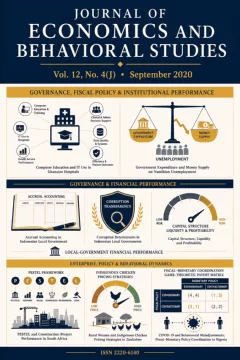 Vol. 12 No. 4(J) (2020)
Governance, Fiscal Policy & Institutional Performance
View issue contents
Published
Submissions
Have research to publish? Journal of Economics and Behavioral Studies welcomes submissions.
Make a Submission