Abstract
This study is based on the Government Regulation No 71 of 2010 concerning Government Accounting Standards which have been enacted since 2015. In the period of this regulation enactment, there are obstacles that occur and it causes culpabilities in accrual basis accounting reporting. The objective of this study is to discover the factors which affect the accrual basis accounting implementation. Utilizing institutional theory as the theoretical basis to establish the framework that correlate training, communication, educational background, organizational culture, and implementation of accrual basis accounting. This study was conducted using quantitative method in local government of Bekasi. Therefore, this study contributes to regional government in order to able to provide the input in implementing a policy, specifically the Government Accounting Standards; provide information in regard to the obstacles and solutions which affects the implementation accrual basis accounting in Regional Government; and be able to evolve and intensify the application of public sector governance, and also can be function as a suggestion for the public in creating policies and to ensure the fully-implementation in Regional Government.
Keywords
- Training Search this journal for Training (opens in a new tab)
- Communication Search this journal for Communication (opens in a new tab)
- Educational Background Search this journal for Educational Background (opens in a new tab)
- Organizational Culture Search this journal for Organizational Culture (opens in a new tab)
- Implementation of Accrual Basis Accounting Search this journal for Implementation of Accrual Basis Accounting (opens in a new tab)
References
- Abouzahra, M. (2011). Causes of failure in Healthcare IT projects. 3rd International Conference on Advanced Management Science , 19, 46–50.
- Adhikari, P. & Gårseth-Nesbakk, L. (2016). Implementing public sector accruals in OECD member states: Major issues and challenges. Accounting Forum , 40(2), 125–142.
- Ahn, P., Jacobs, K., Lim, D. W. & Moon, K. (2014). Beyond self-evident: Recognising the problematic political context of accrual accounting adoption in South Korea. Financing, Accounting & Management, 30(1), 25–48.
- Al-Mashari, M. & Al-Mudimigh, A. (2003). ERP implementation: Lessons from a case study. Information Technology & People , 16(1), 21–33.
- Almajed, A. I. & Mayhew, P. (2013). The critical success factors of IT projects in Saudi Arabian public organizations. Entrepreneurship Vision 2020: Innovation, Development Sustainability, and Economic Growth - Proceedings of the 20th International Business Information Management Association Conference, IBIMA 2013 , 1, 849–856.
- Annamalai, C. & Ramayah, T. (2013). Does the organizational culture act as a moderator in Indian enterprise resource planning (ERP) projects? Journal of Manufacturing Technology Management , 24(4), 555– 587.
- Aswar, K. & Saidin, S. Z. (2018). The Influencing Factors on the Level of Accrual Accounting Adoption: A Conceptual Approach. Romanian Economic Business Review , 13(2), 30–36.
- Aswar, K. & Saidin, S. Z. (2018b). Accrual Accounting Adoption in Java Municipalities: An Empirical Investigation. International Journal of Business and Economic Sciences Applied Research (IJBESAR) , 11(3), 24–30.
- Aswar, K. (2019). Factors on the accrual accounting adoption: Empirical evidence from Indonesia. International Journal of Business and Economic Sciences Applied Research (IJBESAR) , 12(3), 36–42.
- Aswar, K. & Ermawati, E. (2019). Pengadopsian akuntansi akrual di pemerintah daerah (Studi kasus pada provinsi Banten). Equity , 22(1), 62-74.
- Badan Pemeriksa Keuangan Republik Indonesia. (2016). Ikhtisar Hasil Pemeriksaan Keuangan Semester I 2016, 420.
- Badan Pemeriksa Keuangan Republik Indonesia. (2018). Ikhtisar Hasil Pemeriksaan Keuangan Semester I 2018. Indeks Hasil Pemeriksaan Semester 1 Tahun 2018, 470.
- Badan Pemeriksa Keuangan Republik Indonesia. (2019). Ikhtisar Hasil Pemeriksaan Keuangan Semester I, 426.
- Dezdar, S. (2012). Strategic and tactical factors for successful ERP projects: insights from an Asian country. Management Research Review , 35(11), 1070–1087.
- Dianto, A. W. & Aswar, K. (2020). Assessing accrual accounting implementation in Cianjur regency: An empirical investigation. International Journal of Business and Economic Sciences Applied Research (IJBESAR) , 13(1), 7–13.
- DiMaggio, P. (1991). Constructing an organizational field as a professional project: The case of US art museums. In Powell, W.W. and DiMaggio, P. (Eds.), Institutional Theory in Organization Studies, the University of Chicago Press, Chicago, 267-292.
- DiMaggio, P. J. & Powell, W. W. (1983). The iron cage revisited: Institutional isomorphism and collective rationality in organizational fields. American Sociological Review, 48(2), 147-160.
- Eriotis, N., Stamatiadis, F. & Vasiliou, D. (2012). Assessing Accrual Accounting Reform in Greek Public Hospitals: An Empirical Investigation. SSRN Electronic Journal , 4(1), 153–184.
- Fadelelmoula, A. A. (2018). The Effects of the Critical Success Factors for ERP Implementation on the Comprehensive Achievement of the Crucial Roles of Information Systems in the Higher Education Sector. Interdisciplinary Journal of Information, Knowledge, and Management, 13, 021–044.
- Gray, R. (2006). Social environmental and sustainability reporting and organizational value creation? Whose value? Whose creation? Accounting, Auditing and Accountability Journal , 19(6), 793–819.
- Hopwood, A. G. (2000). Understanding financial accounting practice, Accounting, Organizations and Society, 25, 763–766.
- Jacobs, K. (2012). Making sense of social practice: theoretical pluralism in public sector accounting research. Financial Accountability & Management , 28(1), 1- 25.
- Jorge, S. M., da Costa Carvalho, J. B. & Fernandes, M. J. (2007). Governmental accounting in Portugal: why accrual basis is a problem. Journal of Public Budgeting, Accounting & Financial Management, 19(4), 411-446.
- Kusuma, M. I. Y. & Fuad. (2013). Analisis faktor-faktor yang mempengaruhi tingkat penerapan akuntansi akrual pada pemerintah , 2(3), 1–14.
- Leksono, B. & Haryanto, H. (2017). Evaluasi Penerapan Standar Akuntansi Pemerintahan (SAP), Akrual Dalam Penyusunan Laporan Keuangan Tahun 2014 Dan 2015 Pada Pemerintah Daerah Di Indonesia , 6(1), 15–21.
- Mbelwa, L. (2015). Factors influencing the use of accounting information in Tanzania local government authorities (LGAs): an institutional theory approach. Research in Accounting in Emerging Economies, 15, 143-177.
- Modell, S. (2013). Making sense of social practice: Theoretical pluralism in public sector accounting research: A comment. Financial Accountability & Management , 29(1), 99–110.
- Mondy, R. W. (2008). Manajemen Sumber Daya Manusia. Jakarta: Erlangga.
- Ouda, H. A. G. (2008). Towards A Generic Model for Government Sector Reform: The New Zealand Experience. International Journal on Governmental Financial Management , 2, 91.
- Oulasvirta, L. (2014). The reluctance of a developed country to choose International Public Sector Accounting Standards of the IFAC. A critical case study. Critical Perspectives on Accounting , 25(3), 272–285.
- Pollanen, R. & Loiselle-Lapointe, K. (2012). Accounting reform in the government of Canada: Exploratory evidence on accrual accounting adoption and impact. Financial Accountability and Management , 28(4), 359–377.
- Ram, J., Corkindale, D. & Wu, M. L. (2013). Implementation critical success factors (CSFs) for ERP: Do they contribute to implementation success and post-implementation performance? International Journal of Production Economics , 144(1), 157–174.
- Scapens, R. (2006). Understanding management accounting practices: a personal journey. The British Accounting Review , 38(1), 1-30.
Downloads
No downloads have been recorded for this article yet. Figures appear here once readers begin downloading the full text.
How to Cite
Share this article
License
Copyright (c) 2020 Albertus Theo Jonathan, Khoirul Aswar, Ermawati (Author)

This work is licensed under a Creative Commons Attribution 4.0 International License.
Author (s) should affirm that the material has not been published previously. It has not been submitted and it is not under consideration by any other journal. At the same time author (s) need to execute a publication permission agreement to assume the responsibility of the submitted content and any omissions and errors therein. After submission of revised paper in the light of suggestions of the reviewers, the editorial team edits and formats manuscripts to bring uniformity and standardization in published material.
This work will be licensed under Creative Commons Attribution 4.0 International (CC BY 4.0) and under condition of the license, users are free to read, copy, remix, transform, redistribute, download, print, search or link to the full texts of articles and even build upon their work as long as they credit the author for the original work. Moreover, as per journal policy author (s) hold and retain copyrights without any restrictions.
Keywords
- Training Search this journal for Training (opens in a new tab)
- Communication Search this journal for Communication (opens in a new tab)
- Educational Background Search this journal for Educational Background (opens in a new tab)
- Organizational Culture Search this journal for Organizational Culture (opens in a new tab)
- Implementation of Accrual Basis Accounting Search this journal for Implementation of Accrual Basis Accounting (opens in a new tab)
Section
Published in
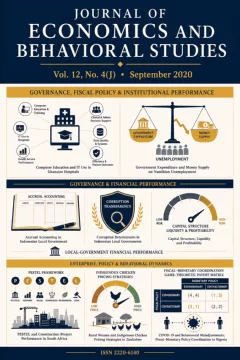 Vol. 12 No. 4(J) (2020)
Governance, Fiscal Policy & Institutional Performance
View issue contents
Published
Submissions
Have research to publish? Journal of Economics and Behavioral Studies welcomes submissions.
Make a Submission