Abstract
This paper examines how government expenditure and money supply affect unemployment in Namibia. It employs the ARDL and ECM estimation techniques to establish the underlying relationship for the period 1980-2018. The results support the hypothesis that government expenditure and money supply can be used to contain unemployment. Additionally, an evidence of both long and short-run causality from government expenditure and money supply to unemployment is found. Practical policy implications indicate that in order to effectively combat unemployment problem in Namibia, the study recommends that there is a need for policy makers to ensure that the goal of employment creation is mainstreamed in all relevant fiscal and monetary policies responses in the country. Moreover, there is also a need to identify and propose policies that can help to do away with the lack of effective policy interventions.
Keywords
- Namibia Search this journal for Namibia (opens in a new tab)
- Unemployment Search this journal for Unemployment (opens in a new tab)
- Government Expenditure Search this journal for Government Expenditure (opens in a new tab)
- Money Supply Search this journal for Money Supply (opens in a new tab)
- Cointegration Search this journal for Cointegration (opens in a new tab)
References
- Alexius, A. & Holmlund, B. (2007). Monetary Policy and Swedish Unemployment Fluctuations: Economics Discussion Papers, No 2007-34. Retrieved from Kiel Institute for the World Economy.
- Arevuo, M. (2012). Review: Keynes Hayek, The clash that Defined Modern Economics.
- Attamah, N., Anthony, I. & Ukpere, W. I. (2015). The impact of fiscal and monetary policies on unemployment problem in Nigeria. Risk Governance & Control: Financial Markets Institutions , 5(2), 101-109.
- Bank of Namibia. (1991). Annual Report. Windhoek: Bank of Namibia.
- Bank of Namibia. (2001). Annual Report. Windhoek: Bank of Namibia.
- Bank of Namibia. (2011). Annual Report. Windhoek: Bank of Namibia.
- Bank of Namibia. (2016). Annual Report. Windhoek: Bank of Namibia.
- Bank of Namibia. (2017). Annual Report. Windhoek: Bank of Namibia.
- Byrne, J. P. & Perman, R. (2007). Unit roots and structural breaks: A survey of the literature In B. B. Rao (ed.), Cointegration for the Applied Economist, (2nd Ed). New York: Palgrave Macmillan.
- Dwivedi, D. (2005). Macroeconomics: Theory and Policy. New Delhi: Tata McGraw-Hill Publishing Company Ltd.
- Eita, J. H. & Ashipala, J. M. (2010). Determinants of unemployment. International Journal of Business and Management , 5(10), 92-104.
- Etale, L. M. & Ujuju, L. E. (2016). The Effect of Government Expenditure and Money Supply on Unemployment in Nigeria. International Journal of Management Studies , 3(10), 80-88.
- Humphrey, T. (1974). The Quantity Theory of Money: Its Historical Evolution and Role in Policy Debates. Federal Reserve Bank of Richmond Economic Review , 60(3), 2-19.
- Jacobs, J. P. A. M., Kuper, G. H. & Sterken, E. (2003). A structural VAR model of the euro area. CPB Workshop on Economic Policy Modelling, 1-26. Jelilov, G., Obasa, O. J. & Isik, A. (2016). The impact of inflation on unemployment in Nigeria (2001–2013). Sacha Journal of Policy and Strategic Studies , 6(1), 28-34.
- Ka-Fu, W. (2000). Variability in the effects of monetary policy on economic activity. Journal of Money, Credit, and Banking , 32(2), 179-198.
- Li, W. K. (2004). Diagnostic Checks in Time Series. Chapman & Hall: Boca Raton, FL.
- Mankiw, N. G. & Taylor, M. P. (2007). Macroeconomics. European edition (6th Ed). New York: Worth Publishers.
- Ministry of Finance. (2016). Budget Statement. Windhoek: Ministry of Finance.
- Mwinga, M. S. (2012). Unemployment in Namibia: Measurement problems, causes and policies. Retrieved from First Capital Working Paper Series: https://www.nmanamibia.com/fileadmin/user_upload/pdf/ Unemployment_in_Namibia_May_2012.pdf
- Nakale, S., Sikanda, M. & Mabuku, M. (2015). Fiscal Policy and the National Economy: Working Paper. 10.13140/RG.2.1.4942.9847. Retrieved from www.npc.gov.na/?wpfb_dl=234
- Namibia Statistic Agency. (2016). The Namibia Labour Force Survey 2016 Report. Windhoek: Namibia Statistics Agency.
- Namibia Statistics Agency. (2018). The Namibia Labour Force Survey 2018 Report. Windhoek: Namibia Statistics Agency.
- Nwosa, P. I. (2014). Government expenditure, unemployment and poverty rates in Nigeria. Journal of Research in National Development , 12(1), 77-84.
- Onodugo, V. A., Obi, K. O., Anowor, O. F., Nwonye, N. G. & Ofoegbu, G. N. (2017). Does public spending affect unemployment in an emerging market? Risk governance & control: Financial markets & institutions , 7(1), 32-40.
- Pesaran, M. H., Shin, Y. & Smith, R. J. (2001). Bounds testing approaches to the analysis of level relationships. Journal of applied econometrics , 16(3), 289-326.
- Sanz-Bas, D. (2011). Hayek’s Critique of the General Theory: A New View of the Debate between Hayek and Keynes. The Quarterly Journal of Austrian Economics , 14(3), 288-310.
- Schiller, R. B. (2016). The Economy Today (10th ed). New York: McGraw-Hill.
- Sebuliba, N. (2017). Monetary and Fiscal Policy Effects on Unemployment and Inflation in Uganda. Nelson Mandela Metropolitan University.
- Shifotoka, H. (2015). Investigating the relationship between bank rate, unemployment and inflation: The Phillips curve in Namibia. Retrieved from University of Namibia: http://repository.unam.na/ bitstream/handle/11070/1679/Shifotoka_2015.pdf?sequence=1&isAllowed=y
- Sodipo, O. A. & Ogunrinola, O. I. (2011). Employment and Economic Growth Nexus in Nigeria. International Journal of Business and Social Science , 2(1), 232-239.
- Sunde, T. & Akanbi, O. A. (2016). Sources of unemployment in Namibia: an application of the structural VAR approach. International Journal of Sustainable Economy , 8(2), 125-143.
- Sunde, T. (2015). The effects of monetary policy on unemployment in Namibia. Journal of Economic and Social Thought , 2(4), 256-274.
- Tagkalakis, A. (2013). The unemployment effects of fiscal policy: recent evidence from Greece. IZA Journal of European Labour Studies , 2(1), 1-32.
- Wickens, M. (2008). Macroeconomic Theory. A Dynamic General Equilibrium Approach. New Jersey: Princeton.
Downloads
No downloads have been recorded for this article yet. Figures appear here once readers begin downloading the full text.
How to Cite
Share this article
License
Copyright (c) 2020 Wilhelmine Naapopye Shigwedha, Teresia Kaulihowa (Author)

This work is licensed under a Creative Commons Attribution 4.0 International License.
Author (s) should affirm that the material has not been published previously. It has not been submitted and it is not under consideration by any other journal. At the same time author (s) need to execute a publication permission agreement to assume the responsibility of the submitted content and any omissions and errors therein. After submission of revised paper in the light of suggestions of the reviewers, the editorial team edits and formats manuscripts to bring uniformity and standardization in published material.
This work will be licensed under Creative Commons Attribution 4.0 International (CC BY 4.0) and under condition of the license, users are free to read, copy, remix, transform, redistribute, download, print, search or link to the full texts of articles and even build upon their work as long as they credit the author for the original work. Moreover, as per journal policy author (s) hold and retain copyrights without any restrictions.
Keywords
- Namibia Search this journal for Namibia (opens in a new tab)
- Unemployment Search this journal for Unemployment (opens in a new tab)
- Government Expenditure Search this journal for Government Expenditure (opens in a new tab)
- Money Supply Search this journal for Money Supply (opens in a new tab)
- Cointegration Search this journal for Cointegration (opens in a new tab)
Section
Published in
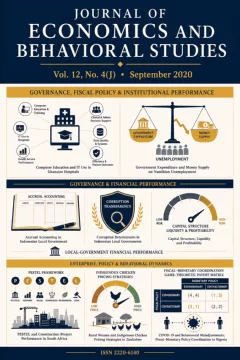 Vol. 12 No. 4(J) (2020)
Governance, Fiscal Policy & Institutional Performance
View issue contents
Published
Submissions
Have research to publish? Journal of Economics and Behavioral Studies welcomes submissions.
Make a Submission