Abstract
The paper discusses the fiscal-monetary coordination and the resultant outcomes in macroeconomic aggregates from theoretical and empirical perspectives. The game-theoretic technique was also used to analyse the policy mix conundrum vis-a-vis the fiscal-monetary policies interaction and how that translates into optimal outcomes in an economy. However, the situation of making or forcing monetary policy to be subordinate to fiscal policy may still not generate socially optimal results. This is not far-fetched as the payoffs in the game-theoretic model suggest the presence of minimal coordination problem but high policy conflict even if both authorities are disciplined. Coordination problem and goal conflict seem to be nonexistent - when both fiscal and monetary policy blocks are committed and responsible in their choices. Further analyses indicate that the policy mix of both fiscal and monetary authorities for inflation seemed complementary. Inflation responded negatively to the shock of debt in the short run. However, in the medium term, the shock becomes positive and later returns to the initial state. The study suggests that policy designs in Nigeria must harmonise both stabilisation and growth objectives to have optimal outcomes.
Keywords
- Macroeconomic Policymaking Search this journal for Macroeconomic Policymaking (opens in a new tab)
- Game Theory Search this journal for Game Theory (opens in a new tab)
- Policy Coordination Search this journal for Policy Coordination (opens in a new tab)
- Nigeria Search this journal for Nigeria (opens in a new tab)
References
- Acemoglu, D., Johnson, S. & Robinson, J. A. (2005). Institutions as the Fundamental Cause of Long-Run Growth, in Aghion, P. & Durlauf, S. (eds.), Handbook of Economic Growth, Amsterdam: North-Holland , (1), 385– 472.
- Arestis, P. (2012). Fiscal Policy: A Strong Macroeconomic Role. Review of Keynesian Economics Inaugural Issue (Autumn), (1), 93-108. Central Bank of Nigeria. Annual Reports and Statement of Accounts., Statistical Bulletin and Monetary Policy Reviews (various issues).
- Chang, H. (2006). Understanding the Relationship between Institutions and Economic Development. UNIWIDER, Finland.
- Debt Management Office. (2003). Fiscal Adjustment in Nigeria: The Problem of Fiscal Dominance, the Bullion, 27(2), 1-7.
- Dixit, A. & Lambertini, L. (2001). Monetary-Fiscal Policy Interactions and Commitment versus Discretion in a Monetary Union, European Economic Review, 45, 1977-1987.
- Ezema, C. C. (2007). An Assessment of Monetary-Fiscal Mix and Inflation Performance: Evidence from the U.S., IGIER Working Paper Series No, 234.
- Fatas, A. & Mihov, I. (2003). The Case for Restricting Fiscal Policy Discretion. The Quarterly Journal of Economics, 118(4), 1419 - 1447.
- Federal Ministry of Finance. (2010, 2011). Medium-Term Expenditure Framework and Fiscal Strategy Paper and National Development Plan Documents.
- Franta, M., Libich, J. & Stehlik, P. (2011). The Big Picture of Monetary-Fiscal Interactions, Economic Papers , 30(1), 6-14.
- Gali, J., Lopez-Salido, J. D. & Valles, J. (2007). Understanding the Effects of Government Spending on Consumption. Journal of the European Economic Review, 5(1), 227 - 270.
- Gali, J. & Gertler, M. (1999). Inflation Dynamics: A Structural Econometric Analysis, Journal of Macroeconomics, (44), 195-222.
- Idowu, A. E. (2010). Fiscal Operations and the Efficacy of Monetary Management in Nigeria, Central Bank of Nigeria Bullion Volume , 34(1).
- Iyeli, I. I., Uba, E. B. & Akpan, E. (2012). The Relative Effectiveness of Monetary and Fiscal Policies in Economic Stabilisation in a Developing Economy: An Empirical Evidence from Nigeria, Annals of Humanities and Development Studies , 3(1), 87-138.
- La Porta, R., Lopez-de-Salinas, F. & Schleifer, A. (2008). The Economic Consequences of Legal Origins, Journal of Economic Literature , 46(2), 285–332.
- Muscatelli, V. A., Tirelli, P. & Trecroci, C. (2003). Can Fiscal Policy Help Macroeconomic stabilisation? Evidence from a Neo-Keynesian Model with Liquidity Constraints, CESIFO Working Paper, 1171.
- North, D. C. (1989). Institutions and Economic Growth: An Historical Approach, World Development, September.
- Onyido, B. C. (2001). A Review of Nigeria's Monetary Policy Experience', in Man and the Management of the Macroeconomy, eds. Bamidele A. and O. J. Bogunjoko. The Nigerian Economic Society.
- Panico, C. & Suárez M. V. (2008). A Scheme to Coordinate Monetary and Fiscal Policies in the Euro Area. In: Ferreiro J., Fontana G., Serrano F. (eds) Fiscal Policy in the European Union. Palgrave Macmillan, London. https://doi.org/10.1057/9780230228269_9
- Pesaran, H. M., Shin, Y. & Smith, R. J. (2001). Bounds Testing Approaches to the Analysis of Level Relationships. Journal of Applied Econometrics, 16(3), 289 - 326.
- Pisani-Ferry, J. (2002). Fiscal Discipline and Policy Coordination in the Eurozone: Assessment and Proposals. Paper prepared for the European Commission President’s Group of Economic Analysis.
- Sargent, T. & Wallace, N. (1981). Some Unpleasant Monetarist Arithmetic, Federal Reserve Bank of Minneapolis Quarterly Review, 5(3), 1-17.
- Sims, C. A. (2011). Stepping on a rake: The Role of Fiscal Policy in the Inflation of the 1970s. European Economic Review, 55, 48-56.
- Sims, C. A. (1994). A Simple Model for Study of the Determination of the Price Level and the Interaction of Monetary and Fiscal Policy, Economic Theory , 4(3), 381-399.
- Taylor, J. B. & Woodford, M. (1999). Handbook of Macroeconomics, Amsterdam, 1671-1745.
- Van Der Merwe, E. & Mollentze, S. (2010). Monetary Economics in South Africa ; Oxford University Press, 405-418.
Downloads
No downloads have been recorded for this article yet. Figures appear here once readers begin downloading the full text.
How to Cite
Share this article
License
Copyright (c) 2020 ADEGBOYE Abiodun Adewale (Author)

This work is licensed under a Creative Commons Attribution 4.0 International License.
Author (s) should affirm that the material has not been published previously. It has not been submitted and it is not under consideration by any other journal. At the same time author (s) need to execute a publication permission agreement to assume the responsibility of the submitted content and any omissions and errors therein. After submission of revised paper in the light of suggestions of the reviewers, the editorial team edits and formats manuscripts to bring uniformity and standardization in published material.
This work will be licensed under Creative Commons Attribution 4.0 International (CC BY 4.0) and under condition of the license, users are free to read, copy, remix, transform, redistribute, download, print, search or link to the full texts of articles and even build upon their work as long as they credit the author for the original work. Moreover, as per journal policy author (s) hold and retain copyrights without any restrictions.
Keywords
- Macroeconomic Policymaking Search this journal for Macroeconomic Policymaking (opens in a new tab)
- Game Theory Search this journal for Game Theory (opens in a new tab)
- Policy Coordination Search this journal for Policy Coordination (opens in a new tab)
- Nigeria Search this journal for Nigeria (opens in a new tab)
Section
Published in
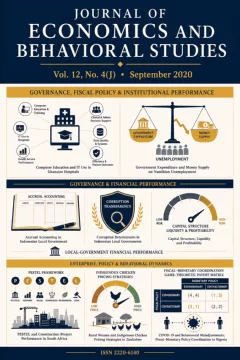 Vol. 12 No. 4(J) (2020)
Governance, Fiscal Policy & Institutional Performance
View issue contents
Published
Submissions
Have research to publish? Journal of Economics and Behavioral Studies welcomes submissions.
Make a Submission