Abstract
The objective of this study was to analyze the money demand function for Zambia for the period 1978 – 2018 using annual time series data. The study employed the Gregory Hansen cointegration technique. The study also employed Hendry’s General to Specific technique to estimate the error correction model by obtaining a parsimonious model. The results of the Gregory Hansen test confirmed the presence of a cointegrating relationship and selected the GH-2 model as the most plausible model with a level shift and a trend. The results also endogenously determined 1994 as the break year in the money demand function. Other interesting results obtained by the study suggest that inflation and interest rate are the robust determinants of real money demand both in the short and long run. Furthermore, unlike many other developing countries, the results show that money is a necessity in Zambia. The other interesting results suggested by the study are that the financial sector reforms of 1994 diminished the demand for real money; however, the positive time trend suggests that there has been an increase in real money holdings over time in Zambia. The low-interest elasticity of money demand also potentially compromises the effectiveness of money supply as a monetary policy tool for economic stabilization. The results of the CUSUM and CUSUMSQ confirm the stability of the money demand function in Zambia.
Keywords
References
- Asongu, S., Folarin, O. & Biekpe, N. (2019). The long-run stability of money demand in the proposed West African monetary union. Munich Personal RePEc Archive, (92343), 1-28.
- Adam, C. S. (1999). Financial liberalization and currency demand in Zambia. Journal of African Economics, 8(3), 268-306.
- Al Rasasi, M. H. (2016). On the stability of money demand in Saudi Arabia. WP/16/6. Saudi Arabia Monetary Agency.
- Bank of Zambia. (2012). Monetary Policy Statement.
- Baumol, W. J. (1952). The Transactions demand for cash: An Inventory Theoretic Approach. Quarterly Journal of Economics, 66, 545-556.
- Cinar, S. & Nur, H. B. (2018, July). Determinants and stability demand for money: A sample of BRIC-T countries. The Empirical Economics Letters , 17(7), 852-862.
- Cziráky, D. & Gillman, M. (2006). Money demand in an EU Accession country: A VECM study of Croatia. Bulletin of Economic Research, 58(2), 105-127.
- Doguwa, S. I., Olorunsola, O. E., Uyaebo, S. O., Adamu, I. & Bada, A. S. (2014). Structural breaks, cointegration and demand for money in Nigeria. CBN Journal of Applied Statistics , 5(1), 15-33.
- Friedman, M. (1956). The quantity theory of money; A restatement. Studies in Quantitive Theory of Money, 5, 3-31.
- Friedman, M. (1970). A theoretical framework for monetary analysis. Journal of Political Economy, 78(2), 193238.
- Gregory, A. W. & Hansen, B. E. (1992, 1996). Practitioners Corner: Tests for cointegration in models with regime and trend shifts. Oxford Bulletin of Economics and Statistics, 58(3), 555-565.
- Halicioglu, F. & Ugur, M. (2005). On stability of the demand for money in a developing OECD country: The case of Turkey. Global Business and Economics Review, 5(2), 203-213.
- Hamdi, H., Said, A. & Sbia, R. (2015). Empirical evidence on the long-run money demand function in the Gulf Cooperation Council countries. International Journal of Economics and Financial Issues, 5(2), 603-612.
- Kalyalya, D. H. (2001). Monetary Policy framework and implementation in Zambia. South African Reserve Bank Conference on Monetary Policy Frameworks in Africa, 17-19.
- Kjosevski, J. (2013). The determinants and stability of money demand in the Republic of Macedonia. Zbornik radova Ekonomskog fakulteta u Rijeci: časopis za ekonomsku teoriju i praksu, 31(1), 35-54.
- Kumar, S., Webber, D. J. & Fargher, S. (2013). Money demand stability: A case study of Nigeria. Journal of Policy Modeling, 35(6), 978-991.
- Lestano, L., Jacobs, J. & Kuper, G. H. (2011). Money demand stability in Indonesia. Working Paper.
- Lungu, M., Simwaka, K., Chiumia, A., Palamuleni, A. & Jombo, W. (2012). Money demand function for Malawi: Implications for monetary policy conduct. Banks and Bank Systems, 7(1), 50-63.
- MacKinnon, J. G. (1991). Critical values for cointegration tests. (J. G. MacKinnon, Ed.) Long-run Economic Relationships: Readings in cointegration relationships.
- Maimbika, S. & Mumangeni, J. N. (2016). Analysis of the effects of financial liberalization on Zambia's economic growth. International Review of Research in Emerging Markets and the Global Economy, 2(2), 840-854.
- Mansaray, M. & Swaray, S. (2012). Financial liberalization, monetary policy and money demand in Sierra Leone. Journal of Monetary and Economic Integration, 12(2), 62-90.
- Mutoti, N., Kapambwe, C. M. & Zgambo, P. (2012). Inflation targeting in Zambia. Unpublished Bank of Zambia Working Paper.
- Nachega, J. C. (2011). A cointegration analysis of broad money in Cameroon. International Monetary Fund, WP/01/26.
- Narayan , P. K., Narayan, S. & Mi, V. (2009). Estimating money demand functions for South Asian countries. Empirical Economics, 36(3), 658-696.
- Narayan, S., Narayan, P. K. & Mishra, V. (2009). Estimating money demand functions for South Asian countries. Empirical Economics, 36(3), 685-696.
- Nduka, K. E. (2014). Structural breaks and the long-run stability of demand for real broad money function in Nigeria: A Gregory-Hansen Approach. The Economics and Finance Letters, 1(8), 79-89.
- Nyong, M. O. (2014). The demand for money, structural breaks and monetary policy. Developing Country Studies, 4(19), 93-106.
- Nyumuah, F. S. (2017). An investigation into the interest elasticity of demand for money in developing countries: A panel data approach. International Journal of Economics and Finance, 9(3), 69-80.
- Omotor, D. G. (2011). Structural breaks, demand for money and monetary policy in Nigeria. Ekonomski Pregled, 62(9-10), 559-582.
- Pera, A. (1989). Deregulation and privatization in an economy-wide context. OECD Economic Studies, 12, 159204.
- Pesaran, H. M., Shin, Y. & Richard, S. J. (2001). Bounds testing approaches to the analysis of level relationships. Journal of Applied Econometrics, 16(3), 289-326.
- Sadeghi, A. & Ramakrishna, G. (2014). An empirical analysis of imports of Iran: A Gregory Hansen method of cointegration. American Journal of Business, Economics and Management, 2(4), 105-112.
- Simawu, M., Mlambo, C. & Murwirapachena, G. (2018). An investigation into the demand for broad money in South Africa. International Business & Economics Research Journal, 13(6), 1419-1436.
- Soto, R. & Tapia, M. (2001). Seasonal cointegration and the stability of the demand for money: A seasonal cointegration approach. Banco Central de Chile.
- Subramanian, S. S. (1999). Survey of literature on demand for money: Theoretical and empirical work with special reference to error-correction models. International Monetary Fund.
- Tobin, J. (1956). The interest elasticity of the transactions demand for cash. Review of Economics and Statistics, 38, 241-247.
- Tobin, J. (1958). Liquidity preference as behavior towards risk. The Review of Economic Studies, 25(2), 65-86.
- Vega, J. L. (1998). Money demand stability: Evidence from Spain. Empirical Economics, 23(3), 387-400.
- Yesigat, A., Rao, K. T. & Nagaraja, G. (2018). Determinants of demand for money and its stability in Ethiopia. International Journal of Research and Analytical Reviews, 5(4), 349-360.
- Zgambo, P. & Chileshe, P. M. (2014). Empirical analysis of the effectiveness of monetary policy in Zambia. COMESA Committee of Central Bankers (pp. 1-50). COMESA Monetary Institute.
Downloads
No downloads have been recorded for this article yet. Figures appear here once readers begin downloading the full text.
How to Cite
Share this article
License
Copyright (c) 2021 Peter Nsokolo Mumba, Emmanuel Ziramba (Author)

This work is licensed under a Creative Commons Attribution 4.0 International License.
Author (s) should affirm that the material has not been published previously. It has not been submitted and it is not under consideration by any other journal. At the same time author (s) need to execute a publication permission agreement to assume the responsibility of the submitted content and any omissions and errors therein. After submission of revised paper in the light of suggestions of the reviewers, the editorial team edits and formats manuscripts to bring uniformity and standardization in published material.
This work will be licensed under Creative Commons Attribution 4.0 International (CC BY 4.0) and under condition of the license, users are free to read, copy, remix, transform, redistribute, download, print, search or link to the full texts of articles and even build upon their work as long as they credit the author for the original work. Moreover, as per journal policy author (s) hold and retain copyrights without any restrictions.
Keywords
Section
Published in
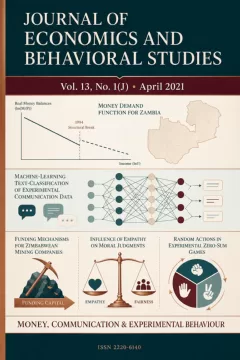 Vol. 13 No. 1(J) (2021)
Money, Communication & Experimental Behaviour
View issue contents
Published
Submissions
Have research to publish? Journal of Economics and Behavioral Studies welcomes submissions.
Make a Submission