Abstract
Empathy is expected to correlate with pro-social attitude s, but what effect does empathy have on judgments of distributive fairness? In our study, we found that participants with higher empathy scores on the Interpersonal Reactivity Index (IRI) were more likely to: (a) favor the use of egalitarian distribution when the joint effort is involved, and (b) deem overly self-interested or opportunistic behavior unfair. Female participants were more consistent in the exercise of moral judgments across diverse scenarios. Furthermore, empathy has several dimensions (e.g., perspective-taking or empathetic concern) and we observed that they interacted with gender and the nature of the hypothetical problem differently in some cases. Although the findings of the study are not counterintuitive, it has identified some avenues for further explorations and highlighted some potential methodological shortcomings of the IRI as a measure of empathetic traits.
Keywords
- Empathy Search this journal for Empathy (opens in a new tab)
- Perspective Taking Search this journal for Perspective Taking (opens in a new tab)
- Fairness Search this journal for Fairness (opens in a new tab)
- Gender Search this journal for Gender (opens in a new tab)
- Distributive Justice Search this journal for Distributive Justice (opens in a new tab)
- Social Norms Search this journal for Social Norms (opens in a new tab)
References
- Asma, S. T. & Gabriel, R. (2019). The Emotional Mind: The Affective Roots of Culture and Cognition. Cambridge, MA: Harvard University Press.
- Bosman, R., Sonnemans, J. & Zeelenberg, M. (2001). Emotions, rejections, and cooling off in the Ultimatum Gam e. Working paper, University of Amsterdam.
- Cappelen, A. W., Astri D. H., Erik, Ø. S. & Bertil, T. (2007). The Pluralism of Fairness Ideals: An Experimental Approach. American Economic Review, 97(3), 818–27.
- Christov-Moore, L., Simpson, E. A., Coudé, G., Grigaityte, K., Iacoboni, M. & Ferrari, P. F. (2014). Empathy: Gender effects in brain and behavior. Neuroscience and biobehavioral reviews , 46(4), 604–627.
- Côté, S., Piff, P. K. & Willer, R. (2013). For whom do the ends justify the means? Social class and utilitarian moral judgment. Journal of personality and social psychology , 104(3), 490.
- Decety, J. & Michalska, K. J. (2010). Neurodevelopmental changes in the circuits underlying empathy and sympathy from childhood to adulthood. Developmental Science , 13(6), 886–899.
- Damasio, A. R. (1994). Descartes' error: emotion, reason, and the human brain. New York: G.P. Putnam,
- Davis, M. H. (1983). Measuring individual differences in empathy: Evidence for a multidimensional approach. Journal of Personality and Social Psychology , 44, 113-126.
- Decety, J. (2007). A social cognitive neuroscience model of human empathy, in Fundamentals of Social Neuroscience, ed. E. Harmon-Jones and P. Winkielman. New York: Guilford Press.
- Decety, J. & Jackson, P. L. (2004). The functional architecture of human empathy. Behavioral and Cognitive Neuroscience Reviews , 3, 71-100.
- Decety, J. & Cowell, J. M. (2014). The complex relation between morality and empathy. Trends in Cognitive Sciences , 18(7), 337-339.
- De Oliveira-Souza, R., Zhan, R. & Moll, J. (2014). Neural Correlates of human morality: An overview. In Decety, J. & Wheatley, T. (Eds.), The Moral brain, a multidisciplinary perspective (pp. 183-195). Cambridge, MA.: MIT Press.
- de Waal, F. B. M. (1996). Good Natured: The Origins of Right and Wrong in Humans and Other Animals (Cambridge, MA: Harvard University Press).
- de Waal, F. B. M. (2007). The 'Russian doll' model of empathy and imitation. In S. Bråten (Ed.), Advances in consciousness research: Vol. 68. On being moved: From mirror neurons to empathy (pp. 49-69). Amsterdam, Netherlands: John Benjamins Publishing Company.
- Dunbar, R. I. M. (1998). The social brain hypothesis. Evol Anthropol , 6, 178-190.
- Efferson, C., Lalive, R. & Fehr, E. (2008). The Coevolution of Cultural Groups and Ingroup Favoritism. Science , 321(5897), 1844–1849.
- Faravelli, M. (2007). How Context Matters: A Survey Based Experiment on Distributive Justice. Journal of Public Economics, 91(7–8), 1399–1422.
- Fong, C. M. (2007). Evidence from an Experiment on Charity to Welfare Recipients: Reciprocity, Altruism and the Empathic Responsiveness Hypothesis. The Economic Journal, 117(522), 1008–24.
- Forsyth, D. (2019). Making Moral Judgments: Psychological Perspectives on Morality, Ethics, and Decisionmaking. Routledge.
- Frohlich, N., Joe A., Oppenheimer C, L. & Eavey. (1987). Choices of Principles of Distributive Justice in Experimental Groups. American Journal of Political Science, 31(3), 606.
- Heberlein, A. S. & Saxe, R. R. (2005). Dissociation between emotion and personality judgments: Convergent evidence from functional neuroimaging. Neuroimage , 28, 770–777.
- Hoffman, E., Matthew, L. & Spitzer. (1985). Entitlements, Rights, and Fairness: An Experimental Examination of Subjects’ Concepts of Distributive Justice. The Journal of Legal Studies, 14(2), 259–97.
- Houser, D. & McCabe, K. (2014). Experimental economics and experimental game theory. In Neuroeconomics (pp. 19-34). Academic Press.
- Kandel, E. & Edward, P. (1992). Peer Pressure and Partnerships. Journal of Political Economy, 100(August 1992), 801–17.
- Kirman, A. & Miriam, T. (2010). Selfish or Selfless? The Role of Empathy in Economics. Philosophical Transactions of the Royal Society B: Biological Sciences, 365(1538), 303–17.
- Klimecki, O. M., Sarah, V., Mayer, A. J., Jonathan, S. & Michael, S. (2016). Empathy Promotes Altruistic Behavior in Economic Interactions. Scientific Reports, 6(1), 1-5.
- Lawler, E. J., Shane, R. & Thye, J. Y. (2008). Social Exchange and Micro Social Order. American Sociological Review , 73(4), 519–42.
- Page, K. (2002). Empathy Leads to Fairness. Bulletin of Mathematical Biology, 64(6), 1101–16.
- Preston, S. D. & de Waal, F. B. M. (2002). Empathy: Its ultimate and proximate bases. Behavioral & Brain Sciences , 25, 1–72.
- Sautter, J. A., Levente, L. & Brennen, B. (2007). A Dual-Edged Sword: Empathy and Collective Action in the Prisoner’s Dilemma. The ANNALS of the American Academy of Political and Social Science, 614(1), 154–71.
- Singer, T. & Ernst, F. (2005). The Neuroeconomics of Mind Reading and Empathy. American Economic Review, 95(2), 340–45.
- Stark, O. & Ita, F. (2000). Transfers, Empathy Formation, and Reverse Transfers. In The Economics of Reciprocity, Giving and Altruism , edited by L. A. Gérard-Varet, S. C. Kolm, and J. Mercier Ythier, 174– 81. London: Palgrave Macmillan UK.
- Sterelny, K. (2016). Cooperation, Culture, and Conflict, British Journal for the Philosophy of Science , 67(1), 3158.
- Strayer, J. (1987). Affective and cognitive processes in empathy. In N. Eisenberg & J. Strayer (Eds.), Empathy and its development (pp. 218– 244). New York, NY: Cambridge University Press.
- Singer, P. (ed.) (1977). Animal Liberation. NY: Avon Books.
- Cosmides, L. & Tooby, J. (1992). Cognitive adaptations for social exchange. In J. H. Barkow, L. Cosmides, & J. Tooby (Eds.), The adapted mind: Evolutionary psychology and the generation of culture (p. 163– 228). Oxford University Press.
- Thompson, E. (2005). Empathy and human experience, in Science, Religion, and the Human Experience, ed. J.D. Proctor (New York: Oxford University Press).
- Zahavi, D. (2014). Empathy and Other-Directed Intentionality, Topoi, 33, 129–142.
Downloads
No downloads have been recorded for this article yet. Figures appear here once readers begin downloading the full text.
How to Cite
Share this article
License
Copyright (c) 2021 Rojhat Avsar, Rami Gabriel (Author)

This work is licensed under a Creative Commons Attribution 4.0 International License.
Author (s) should affirm that the material has not been published previously. It has not been submitted and it is not under consideration by any other journal. At the same time author (s) need to execute a publication permission agreement to assume the responsibility of the submitted content and any omissions and errors therein. After submission of revised paper in the light of suggestions of the reviewers, the editorial team edits and formats manuscripts to bring uniformity and standardization in published material.
This work will be licensed under Creative Commons Attribution 4.0 International (CC BY 4.0) and under condition of the license, users are free to read, copy, remix, transform, redistribute, download, print, search or link to the full texts of articles and even build upon their work as long as they credit the author for the original work. Moreover, as per journal policy author (s) hold and retain copyrights without any restrictions.
Keywords
- Empathy Search this journal for Empathy (opens in a new tab)
- Perspective Taking Search this journal for Perspective Taking (opens in a new tab)
- Fairness Search this journal for Fairness (opens in a new tab)
- Gender Search this journal for Gender (opens in a new tab)
- Distributive Justice Search this journal for Distributive Justice (opens in a new tab)
- Social Norms Search this journal for Social Norms (opens in a new tab)
Section
Published in
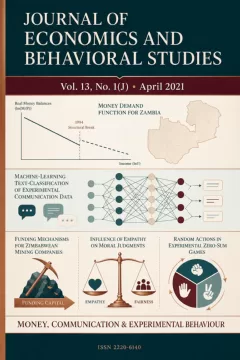 Vol. 13 No. 1(J) (2021)
Money, Communication & Experimental Behaviour
View issue contents
Published
Submissions
Have research to publish? Journal of Economics and Behavioral Studies welcomes submissions.
Make a Submission