Abstract
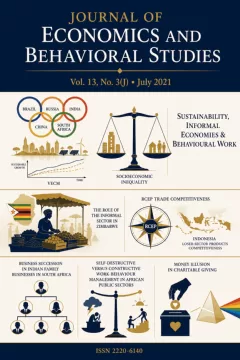
A major problem to the BRICS goal of achieving sustainable economic growth for members is the increasing level of socioeconomic inequality in the bloc. Consequently, the purpose of this study is to understand the influence of economic growth on socio-economic sustainability in the BRICS countries , using a yearly dataset from 1990 to 2019. A multivariate co-integration technique by Johansen and Juselius and Granger causality test were used to establish the relationships. Findings confirmed co-integration and shortrun causal relationships. The most interesting results were the negative influence of economic growth on socio-economic inequality, tacit support for the resource curse hypothesis. The paper concluded that a common policy option was not possible and that for the block to pursue its economic prosperity goals without compromising individual countries' needs for socioeconomic sustainability, varied policy options were inevitable. The policy implications and recommendations are straightforward: the radical legal basis for the transition from natural resource export, as well as, sweeping regulation for the sustainable usage of natural resources protection, strict penalties on violations of environment-related laws and policies to enhance, general country-wide support. In addition, there may be an urgent need to define the active role of NGOs and other independent institutions in promoting socioeconomic equality (sustainability) practices and concepts at both local and national levels, enhanced social programs; market development, Integration of existing policies and creation of societal culture. Consequently, to the best of the researcher’s knowledge, no study has investigated comprehensibly (along with multiple determinants) the sustainability of growth policy options within BRICS with an aim to proposing socioeconomic sustainability and growth policy options.
Keywords
- Socioeconomic Inequality Search this journal for Socioeconomic Inequality (opens in a new tab)
- Economic Growth Search this journal for Economic Growth (opens in a new tab)
- Cointegration Search this journal for Cointegration (opens in a new tab)
- Vector Error Correction Modeling Search this journal for Vector Error Correction Modeling (opens in a new tab)
- BRICS Search this journal for BRICS (opens in a new tab)
References
- Adelakun, O. J. (2011). Human capital development and economic growth in Nigeria, European Journal of Business and Management, 3(9), 29-38.
- Adelowokan, O. A. (2012). Growth effect of Education and Health Expenditure in Nigeria (1970-2010), African Journal of Scientific Research, 10(1), 510-528.
- Agarwal, G. & Khan, M. A. (2011). Impact of FDI on GDP: A comparative study of China and India, International Journal of Business and Management , 6(10), 71-79.
- Agrawal, G. (2015). Foreign Direct Investment and Economic Growth in BRICS Economies: A Panel Data Analysis, Journal of Economics, Business and Management, 3(4), 421-424.
- Akaike, H. (1974). A new look at statistical model identification. IEEE Transactions on Automatic Control, 19(1), 716-723.
- Akinola G. W. & Bokana K. G. (2017). Human Capital, Higher Education Enrolment and Economic Growth in the SSA Countries (Panel Model Approach), Journal of Economics and Behavioral Studies , 9(6), 215226.
- Anyanwu, J. C. (2012). Why does foreign direct investment go where it goes? New evidence from African countries, Annals of Economics and Finance , 13(2), 433-470.
- Aregbesola, A. R. (2014). Foreign direct investment and institutional adequacy: New Granger-causality evidence from African countries, South African Journal of Economic and Management Sciences , 17(5), 557-568.
- Arellano, M. & Bond, S. (1991). Some Tests of Specification for Panel Data: Monte Carlo Evidence and an Application to Employment Equations. The Review of Economic Studies, 58(2), 277-297.
- Asteriou, D. & Hall, S. G. (2007). Applied Econometrics: A Modern approach (revised ed.), NY: Palgrave Macmillan.
- Awan, A. G. (2013). Diverging trends of human capital in BRICS countries, International Journal of Asian Social Science , 2(12), 2195-2219.
- Awolusi, O. D. & Mbonigaba, J . (2020). Socioeconomic sustainability and economic growth in BRICS: relationships and policy options, International Journal of Services, Economics and Management , 11(4), 390–429.
- Kautsiro, F. & Awolusi, O. D. (2020). Loyalty Programs for the Passenger Transportation Industry: A Study of Zimbabwean Companies, Journal of Education and Vocational Research, 11(1), 5–22.
- Awolusi, O. D. (2019). Human Capital Development and Economic Growth in BRICS Countries: Controlling for Country Differences, Journal of Economics and Behavioral Studies , 11(4), 1-17.
- Awosusi, O. O. & Awolusi, O. D. (2014). Technology Transfer, Foreign Direct Investment and Economic Growth in Nigeria, Africa Development, 39(2), 1 – 20.
- Azevedo, V. G., Sartori, S. & Campos, L. M. (2018). CO2 emissions: A quantitative analysis among the BRICS nations, Renewable and Sustainable Energy Reviews , 81(1), 107–115.
- Barro, R. J. (1990). Government spending in a simple model of endogenous growth, Journal of Political Economy , 98(5), S103-S125.
- Bilgili, F., Koçak, E. & Bulut, U. (2016). The dynamic impact of renewable energy consumption on CO2 emissions: A revisited Environmental Kuznets Curve approach, Renewable and Sustainable Energy Reviews, 54(1), 838–845.
- Bindi, G. (2018). The resource curse hypothesis: an empirical investigation, a thesis submitted for the Master’s Programme in Economics, School of Economics and Management, Lund University
- Błazejowski, M., Kwiatkowski, J. & Gazda, J. (2019). Sources of Economic Growth: A Global Perspective, Sustainability , 11(1), 275-288.
- Blundell, R. & Bond, S. (1998). Initial conditions and moment restrictions in dynamic panel data models. Journal of Econometrics , 87(4), 115-143.
- Breitenbach, M. C., Tipoy, C. K. & Zerihun, M. F. (2017). Equilibrium Exchange Rates and Misalignments: The Case of Homogenous Emerging Countries, Economic Research Southern Africa (ERSA) working paper, 713.
- Bryman, A. (2012). Social research methods (4thed.). New York, NY: Oxford University
- Carnoy, M. (2006). Higher education and economic development: India, China, and the 21st Century, working paper no. 297 presented at the Pan Asia Conference: Focus on Economic Challenges, Stanford Center for International Development May 31- June 3
- Carnoy, M., Loyalka, P., Androushchak, G. & Proudnikova, A. (2012). The economic returns to higher education in the BRIC countries and their implications for higher education expansion, basic research program working papers series: Education WP BRP 02/EDU/2012, the National Research University Higher School of Economics (HSE)
- David E., Bloom, D. E. & Canning, D. (2008). Population Health and Economic Growth, Working Paper no. 24: The International Bank for Reconstruction and Development / The World Bank On behalf of the Commission on Growth and Development, 1-27.
- De Bruyn, S. M., Van den Bergh, J. C. & Opschoor, J. B. (1998). Economic growth and emissions: reconsidering the empirical basis of environmental Kuznets curves, Ecological Economics , 25(1), 161–175.
- De Mello, L. R. (1996). Foreign direct investment, international knowledge transfers, endogenous growth: Time series evidence. Department of Economics, University of Kent, 234-240.
- Diesendorf, M. (2000). Sustainability and sustainable development, in Dunphy, D, Benveniste, J, Griffiths, A and Sutton, P (eds) Sustainability: The corporate challenge of the 21st century, Sydney: Allen & Unwin, chap, 2(1), 19-37.
- Eggoh, J., Houeninvo, H. & Sossou, G. (2015). Education, Health and Economic Growth in African Countries, Journal of Economic Development , 40(1), 93-111.
- El-Wassal, K. A. (2012). Foreign direct investment and economic growth in Arab Countries (1970-2008): An inquiry into determinants of growth benefits, Journal of Economic Development , 37(4), 79-100.
- Fan C. & Zheng, X. (2013). An empirical study of the environmental Kuznets curve in Sichuan Province, China, Environmental Pollution , 2(3), 107-125.
- Fedderke, J. & Romm, A. T. (2005). Growth impact and determinants of foreign direct investment into South Africa, 1956-2003 . Economic Modelling , 23(2), 738-760.
- Felipe, J. (1997). Total factor productivity growth in East Asia: A critical survey, Economics and Development Research Center Report Series No. 65, Asian Development Bank, 233-235.
- Frenkel, M., Funke, K. & Stadtmann, G. (2004). A panel analysis of bilateral FDI flows to emerging economies, Economic System , 28(3), 281-300.
- Goldman Sachs. (2001). Building better global economic BRICs. Accessed from http://www.goldmansachs.com/our-thinking/topics/brics/brics-reports-pdfs/build-better-brics.pdf as of 18th December 2014
- Grossman, G. M. & Helpman, E. (1990). Trade, innovation, and growth, The American Economic Review , 80(2), 86-91.
- Gur, B. (2015). An Analysis of Unemployment Determinants in BRIC Countries, International Journal of Business and Social Science, 6(1), 192-198.
- Hailu, Z. A. (2010). Demand-side factors affecting the inflow of foreign direct investment to African Countries: Does the capital market matter? International Journal of Business and Management , 5(5), 104-116.
- Hamilton, K. (2015). Sustainable development, the Hartwick rule and optimal growth, Environmental and Resource Economics , 21(1), 393-411.
- Hayek, F. A. (1960). The constitution of liberty. Routledge, London
- Hayek, F. A. (1973). Law, legislation and liberty, vol 1. Routledge, London
- Hochestler, K. (2014). Infrastructure and sustainable development goals in the BRICS-Led New development bank, Policy Brief No. 46, Centre for International Governance Innovation: NY
- Hofkes, M. W. (2017). Modeling sustainable development: an economy-ecology integrated model, Economic modeling , 13(1), 333-353.
- Hussin, M. Y. M., Muhammad, F., Abu, M. F. & Awang, S. A. (2012). Macroeconomic Variables and Malaysian Islamic Stock Market: A Time Series Analysis, Journal of Business Studies Quarterly, 3(4), 1-13.
- ISSA. (2017). BRICS countries: Sustainability challenges for social security systems, International Social Security Association: NY
- Javeria, M., Ashok, M. & Vishal, S. (2017). C02 Emissions, Energy Consumption and Economic growth in BRICS: An empirical analysis, IOSR Journal of humanities and social science , 22(2), 53-58.
- Jamel, L. & Maktouf, S. (2017). The nexus between economic growth, financial development, trade openness, and CO2 emissions in European countries , Cogent Economics & Finance, 5(1), 134-145.
- Johansen, S. & Juselius, K. (1990). Maximum likelihood estimation and inference on Cointegration – with application to the demand for money, Oxford Bulletin of Economics and Statistics , 52(2), 169-210.
- Kwiatkowski, D., Phillips, P. C. B., Schmidt, P. & Shin, Y. [KPSS] (1992). Testing the Null Hypothesis of Stationary against the Alternative of a Unit Root’, Journal of Econometrics , 54(1), 159-178.
- Lee, H. H. & Tan, H. B. (2006). Technology transfer, FDI and economic growth in the ASEAN Region, Journal of the Asia Pacific Economy, 11(4), 394–410.
- Licumba, E. A., Dzator, J. & Zhang, X. (2016). Health and economic growth: are there gendered effects? Evidence from selected southern Africa development community Region, The Journal of Developing Areas , 50(5), 215-227.
- Mahe, S. A. (2005). Is globalization capable of raising living standards, through international trade in Nigeria? Downloaded from http://www.hollerafrica.com/showArticle.php?artId=143&catId=2 on 21 July 2008.
- Mankiw, N. G., Romer, D. & Weil, D. N. (1992). Contribution to the empirics of economic growth, The Quarterly Journal of Economics , 107(2), 407-437.
- Menon, A. A. (2017). Performance of Economic Growth in BRICS Countries, International Journal of Informative & Futuristic Research, 4(5), 6200-6203.
- Mosteanu, N. R. (2019). Regional development and economic growth approach in Europe and GCC countries, ECOFORUM, 8(2-19), 1-12.
- Nkoro, E. & Uko, A. K. (2016). Autoregressive Distributed Lag (ARDL) cointegration technique: application and interpretation, Journal of Statistical and Econometric Methods , 5(4), 63-91.
- North, D. C. (1971). Institutional change and economic growth, Journal of Economic History , 31(1), 118–125.
- North, D. C. (1989). Institutions and economic growth: a historical introduction, World Development , 17(9), 1319–1332.
- North, D. C. (2005) Understanding the process of economic change. Princeton University Press.
- Princeton Odunlami, S. A. & Awolusi, O. D. (2015). Multinational Corporation and economic development in Nigeria, American Journal of Environmental Policy and Management , 1(2), 16-24.
- Ogasawara, K. (2018). Health and education during industrialization: Evidence from early twentieth-century Japan, International Journal of Educational Development , 61(1), 40–54.
- Oladipo, O. S. (2008). Foreign direct investment flow: Determinants and growth effects in a small open economy, Proceedings of the Northeast Business & Economics Association, Northeast Business & Economics Association 35th Annual Conference, Long Island, New York, 6-8 November.
- Omer, A. M. (2008). Energy, Environment and Sustainable Development, Renewable and Sustainable Energy Reviews , 12(9), 2265-2300.
- Ozturk, I. (2007). Foreign direct investment-growth nexus: A review of the recent literature, International Journal of Applied Econometrics and Quantitative Studies, 4(2), 79-98.
- Pelinescu, E. (2015). The impact of human capital on economic growth, Procedia Economics and Finance , 22(1), 184-190.
- Pereira, C. A., Ferraz, J. F., Araujo, E. & Machado-Taylor, M. (2018). The Brazilian higher education evaluation model: “SINAES” sui generis, International Journal of Educational Development , 61(3), 128–137.
- Pistorius, C. (2004).The competitiveness and innovation, Elektron , 2(3), 234-245.
- Polasky, S., Kling, C. L., Levin, S. A., Carpenter, S. R., Daily, G. C., Ehrlich, P. R., Heal, G. M. & Lubchenco, J. (2019). “Role of economics in analyzing the environment and sustainable development”, Colloquium Introduction , 116(12), 5233–5238.
- Riley, G. (2012). Economic growth - the role of human & social capital, competition & innovation. Accessed from http://www.tutor2u.net/economics/revisionnotes/a2-macro-economic-growth-capital.html, 16 April 2014.
- RSA. (2013). South Africa’s positions in BRICS, Quarterly Bulletin- January to March 2013. Gauteng Provincial Treasury, Republic of South Africa.
- Sesay, B., Yulin, Z. & Wang, F. (2018). Does the national innovation system spur economic growth in Brazil, Russia, India, China and South Africa economies? Evidence from panel data, South African Journal of Economic and Management Sciences, 21(1), 16-47.
- Strittmatter, A. & Sunde, U. (2011). Health and Economic Development: Evidence from the Introduction of Public Health Care, Discussion Paper No. 5901: The Institute for the Study of Labor (IZA), 1-53.
- Spangenberg, J. H. (2004). Reconciling Sustainability and growth: Criteria, Indicators, Policies, Sustainable Development, 12(1), 74–86.
- Temple, J. (1999). A positive effect of human capital on growth, Economics Letters, 65(3), 131-134.
- United Nations. (2013). Sustainable Development Challenges, World Economic and Social Survey, 2013; World Economic and Social Survey, The Department of Economic and Social Affairs of the United Nations, United Nations publication: NewYork
- UNCSD. (2012). The future we want, the outcome document of the 2012 United Nations Conference on Sustainable Development, United Nations: Geneva
- Wilhelms, S. K. S. (1998). Foreign Direct Investment and its determinants in emerging economies, African Economic Policy Paper Discussion Paper Number 9, July
- World Bank Group. (2018). Global Economic prospects: Broad-Based Upturn, but for How Long? A World Bank Group flagship report: NW, Washington
- Younsi, M. & Bechtini, M. (2018). Economic Growth, Financial Development and Income Inequality in BRICS Countries: Evidence from Panel Granger Causality Tests, Munich Personal RePEc Archive (MPRA) Paper No. 85249
- Zha, J., Tan, T., Yuan, W., Yang, X. & Zhu, Y. (2019). Decomposition analysis of tourism CO2 emissions for sustainable development: A case study of China, Sustainable Development , 10(1), 1–18.
Downloads
No downloads have been recorded for this article yet. Figures appear here once readers begin downloading the full text.
How to Cite
Share this article
License
Copyright (c) 2021 Olawumi D. Awolusi (Author)

This work is licensed under a Creative Commons Attribution 4.0 International License.
Author (s) should affirm that the material has not been published previously. It has not been submitted and it is not under consideration by any other journal. At the same time author (s) need to execute a publication permission agreement to assume the responsibility of the submitted content and any omissions and errors therein. After submission of revised paper in the light of suggestions of the reviewers, the editorial team edits and formats manuscripts to bring uniformity and standardization in published material.
This work will be licensed under Creative Commons Attribution 4.0 International (CC BY 4.0) and under condition of the license, users are free to read, copy, remix, transform, redistribute, download, print, search or link to the full texts of articles and even build upon their work as long as they credit the author for the original work. Moreover, as per journal policy author (s) hold and retain copyrights without any restrictions.
Keywords
- Socioeconomic Inequality Search this journal for Socioeconomic Inequality (opens in a new tab)
- Economic Growth Search this journal for Economic Growth (opens in a new tab)
- Cointegration Search this journal for Cointegration (opens in a new tab)
- Vector Error Correction Modeling Search this journal for Vector Error Correction Modeling (opens in a new tab)
- BRICS Search this journal for BRICS (opens in a new tab)
Section
Published in
 Vol. 13 No. 3(J) (2021)
Sustainability, Informal Economies & Behavioural Work
View issue contents
Published
Submissions
Have research to publish? Journal of Economics and Behavioral Studies welcomes submissions.
Make a Submission