Abstract
Family businesses play a pivotal role economically and socially in most countries. The study aimed to identify and understand the experiences of Indian family businesses in South Africa with regard to business succession. A quantitative research approach was used with data collected through Google forms online survey. Data was collected from sixty (60) business people from Indian-owned family businesses in South Africa. The study interrogated the following factors which have an influence on family business succession: business ownership influence in succession, business readiness for the exit of owner and succession, the role of the owner after exit from business and selection criteria of the right successor. Findings revealed that the majority of families (86.27%) said it is important to have a hundred percent or full ownership of the business and that a successor should be selected within the family from their bloodline. Findings also revealed that the majority of businesses (86.27%) were not fully ready for the exit of the owner or current leader of the business and that on the exit of the owner; a majority (90.2%) of businesses will prefer to have the owner playing an active advisory role in the business. It is recommended that familyowned businesses should plan for succession on time and draft a well-planned strategic succession plan for the business. It is also recommended that an objective criterion be used in selecting a successor who will take the business forward. Healthy business continuity should be the ultimate goal of succession and families should not sacrifice successful business continuity because of their, internal differences and conflict, culture, blood relations, gender or religion.
Keywords
- Indian Businesses Search this journal for Indian Businesses (opens in a new tab)
- Family Businesses Search this journal for Family Businesses (opens in a new tab)
- Succession Planning Search this journal for Succession Planning (opens in a new tab)
- Business Continuity Search this journal for Business Continuity (opens in a new tab)
- South Africa Search this journal for South Africa (opens in a new tab)
References
- Bennedsen, M., Nielsen, K. M., Pérez-González, F. & Wolfenzon, D. (2007). Inside the family firm: The role of families in succession decisions and performance , 111(1), 647-691.
- Bozer, G., Levin, L. & Santora, J. C. (2017). Succession in family business: multi-source perspectives. Journal of Small Business and Enterprise Development.
- Brockhaus, R. H. (2004). Family business succession: Suggestions for future research. Family Business Review , 17(2), 165-177.
- Brun de Pontet, S., Wrosch, C. & Gagne, M. (2007). An exploration of the generational differences in levels of control held among family businesses approaching succession, Family Business Review , 10(4), 337354.
- Cabrera-Suárez, K. (2005). Leadership transfer and the successor’s development in the family firm. The Leadership Quarterly, 16(1), 71–96.
- Chirico, F. & Nordqvist, M. (2010). Dynamic capabilities and trans-generational value creation in family firms: The role of organizational culture. International Small Business Journal, 18(5), 487–504.
- Chaimahawong, V. & Sakulsriprasert, A. (2013). Family business succession and post succession performance: Evidence from Thai SMEs. International Journal of Business and Management , 8(2), 19.
- Chua, J. H., Chrisman, J. J. & Sharma, P. (1999). Defining the Family Business by Behavior. Entrepreneurship theory and practice , 13, 19–40.
- Churchill, N. C. & Hatten, K. J. (1987). Non-market-based transfers of wealth and power: A research framework for family businesses. American Journal of Small Business, 11(3), 51–66.
- Diwisch, D. S., Voithofer, P. & Weiss, C. R. (2009). Succession and firm growth: Results from a non-parametric matching approach. Small Business Economics , 31(1), 45-56.
- Fahed-Sreih, J. (2018). Conflict in Family Businesses. Palgrave Macmillan
- Family Firm Institute. (2009). Global data points. Retrieved 16 August 2016, from http://www.ffi.org.
- Feltham, T. S., Feltham, F. & Barnett, J. J. (2005). The dependence of family businesses on a single decisionmaker. Journal of Small Business Management , 17, 158–170.
- Handler, W. C. (1990). Succession in Family Firms: A Mutual Role Adjustment between Entrepreneur and Next-Generation Family Members. Entrepreneurship Theory and Practice , 15(1), 37–51.
- Handler, W. C. (1994). Succession in family business: A review of the research. Family business review, 7(2), 133-157.
- Janjuha-Jivraj, S. & Woods, A. (2001). Succession Issues within Asian Family Firms: Learning from the Kenyan Experience. International Small Business Journal , 10(1), 77–94.
- Kets De Vries, M. F. R. (1977). The Entrepreneurial Personality: A Person At The Crossroads. Journal of Management Studies, 14(1), 34–57.
- Kiwia, R. H., Bengesi, K. M. & Ndyetabula, D. W. (2019). Succession planning and performance of family-owned small and medium enterprises in Arusha City–Tanzania. Journal of Family Business Management.
- Lansberg, I. & Astrachan, J. H. (1994). Influence of Family Relationships on Succession Planning and Training: The Importance of Mediating Factors. Family Business Review, 7(1), 39–59.
- Lansberg, I. I. S. (1983). Managing Human Resources in Family Firms: The Problem of Institutional Overlap. Organizational Dynamics , 11(1), 39–46.
- Lansberg, I. I. S. (1988). The Succession Conspiracy. Family Business Review, 1(1), 119–143.
- Levinson, H. (1971). Conflicts that plague family businesses. Harvard Business Review, March-April, 90– 95.
- Le Breton–Miller, I., Miller, D. & Steier, L. P. (2004). Toward an integrative model of effective FOB succession. Entrepreneurship theory and practice , 18(4), 305-318.
- Miller, D., Steier, L. & Le Breton-Miller. (2003). Lost in Time: Intergenerational Succession, Change, and Failure in Family Business. Journal of Business Venturing , 18(4), 513-531.
- Morris, M., Williams, R., Allen, J. & Avila, R. (1997). Correlates of Success in Family Business Transitions. Journal of Business Venturing , 11(5), 385–401.
- Neubauer, F. & Lank, A. G. (1998). The Family Business: Its, Governance for Sustainability, London: McMillan Press.
- Sharma, P. & Rao, A. S. (2000). Successor attributes in Indian and Canadian family firms: A comparative study. Family Business Review , 13(4), 313–330.
- Steen, A. (2018). Family-owned businesses and our national economy’ Retrieved 03 October 2018, < https://www.familyownedbusinessadvisors.com/1018/04/family-owned-businesses-and-ournational-economy/>
- Thurloway, L. (2014). Management research challenge: Selected readings. Sage.
- Virick, M. & Greer, C. R. (2012). Gender diversity in leadership succession: Preparing for the future. Human Resource Management , 51(4), 575-600.
Downloads
No downloads have been recorded for this article yet. Figures appear here once readers begin downloading the full text.
How to Cite
Share this article
License
Copyright (c) 2021 Yaaser Mahomed, Vuyokazi Mtembu (Author)

This work is licensed under a Creative Commons Attribution 4.0 International License.
Author (s) should affirm that the material has not been published previously. It has not been submitted and it is not under consideration by any other journal. At the same time author (s) need to execute a publication permission agreement to assume the responsibility of the submitted content and any omissions and errors therein. After submission of revised paper in the light of suggestions of the reviewers, the editorial team edits and formats manuscripts to bring uniformity and standardization in published material.
This work will be licensed under Creative Commons Attribution 4.0 International (CC BY 4.0) and under condition of the license, users are free to read, copy, remix, transform, redistribute, download, print, search or link to the full texts of articles and even build upon their work as long as they credit the author for the original work. Moreover, as per journal policy author (s) hold and retain copyrights without any restrictions.
Keywords
- Indian Businesses Search this journal for Indian Businesses (opens in a new tab)
- Family Businesses Search this journal for Family Businesses (opens in a new tab)
- Succession Planning Search this journal for Succession Planning (opens in a new tab)
- Business Continuity Search this journal for Business Continuity (opens in a new tab)
- South Africa Search this journal for South Africa (opens in a new tab)
Section
Published in
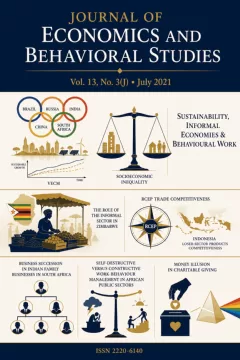 Vol. 13 No. 3(J) (2021)
Sustainability, Informal Economies & Behavioural Work
View issue contents
Published
Submissions
Have research to publish? Journal of Economics and Behavioral Studies welcomes submissions.
Make a Submission