Abstract
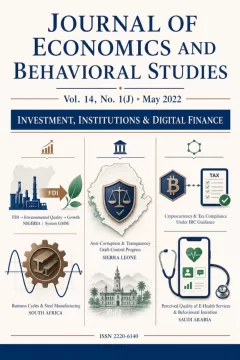
This paper examines the effect of foreign direct investment through economic activities on the environmental quality of the Nigerian economy by using annual data from 1981 to 2020. Our estimation of the simultaneous equation model was done through system GMM where we estimate the scale, technique and composition effects of foreign direct investment. Our results reveal that foreign direct investment improves economic activities through the scale effect and damages the environmental quality through technique and composition effects. The contribution of physical and human capital investment becomes more prominent in attracting direct investment inflow in the country. This however suggests that our institution should be strengthened to ensure the adoption of technology that poses little harm to the environment in the production process by the investors. Also, more investment should be made in physical and human capital in the country to attract more overseas investment.
Keywords
References
- Abdouli, M. & Hammami, S. (2015). The impact of FDI inflows and environmental quality on economic growth: an empirical study for the MENA countries. J Knowl, Econ; Faculty of Economics and Management of Sfax, Sfax, Tunisia. https://doi.org/10.1007/s13132-015-0323-y
- Akintoye, V., Adejumo. & Asongu, A. (2019). Foreign direct investment, domestic investment and green growth in Nigeria: any spill-over? European Xtramile Contre of African Studies, 19(working paper/078).
- Ali, N., Phoungthong, K., Techato, K., Ali, W., Abbas, S., Dhanraj, J. A. & Khan, A. (2022). FDI, Green Innovation and Environmental Quality Nexus: New Insights from BRICS Economies. Sustainability , 14(2181), 1– 17.
- Awolusi O. D. (2012). Foreign direct investment and economic growth in Nigeria: a vector error correction modeling. Journal of Research in Economics and International Finance , 2(3), 58–69.
- Azam, M. & Ahmed, A. M. (2015). Role of human capital and foreign direct investment in promoting economic growth. International Journal of Social Economics , 42(2), 98–111.
- Bao, Q., Chen, Y. & Song, L. (2011). Foreign direct investment and environmental pollution in China: a simultaneous equations estimation. Environment and Development Economics, 71–92.
- Cole, M. A., Elliott, R. J. R. & Zhang, J. (2011). Growth, foreign direct investment, and the environment: evidence from Chinese cities. J. Reg. S. C. , 51(4), 121e138.
- Evans, E., Opoku, O., Adams, S. & Adewale, O. (2021). The foreign direct investment-environment nexus : Does emission disaggregation matter ? Energy Reports , 7, 778–787.
- Frank Wogbe Agbola. (2013). Does human capital constrain the impact of foreign direct investment and remittances on economic growth in Ghana? Applied Economics , 45(19), 2853 2862.
- Hitam, M. & Borhan, H. (2012). FDI, growth and the environment: impact on quality of life in Malaysia. Procedia-Social and Behavioural Science , 50, 333–342.
- Hussaini, M. & Kabuga, N. A. (2016). Foreign direct investment and economic growth in Nigeria: a vector error correction modeling. Bayero Journal of Social and Management Studies , 9(2), 58–69.
- Kankou Hadia Fofana. (2018). Dynamic Relationship between Chinese FDI, Agricultural and Economic Growth in West Africa: An Application of the Pool Mean Group Model. J. Phys.: Conf. Ser., 1060(012066).
- Khuda Bakhsh, Sobia Rose, M. F. A. & Ahmad, N. (2017). Economic growth, CO2 emissions, renewable waste and FDI relation in Pakistan: New evidence from 3SLS, Journal of environmental management. Journal of Environmental Management , 196, 627–632.
- Li, K., Gong, W. C. & Choi, B. R. (2021). The Influence of Trade and Foreign Direct Investment on Green Total Factor Productivity: Evidence from China and Korea *. Journal of Korea Trade , 25(2), 95–110.
- Majeed M. T. & Ahmed, E. (2008). Human capital development and FDI in developing countries. journal of Economic Cooperation , 129(3), 79–104.
- Mankiw, N., Romer, D. & Weil, D. (1992). A contribution to the empirics of economic growth. Quarterly Journal of Economics , 107, 407–437.
- Omri, A., Nguyen, D. K. & Rault, C. (2014). Causal interactions between CO2 emissions, FDI, and economic growth: evidence from dynamic simultaneous-equation models. IEcon. Model , 42(2), 382-389.
- Wang, S., Wang, H. & Sun, Q. (2020). The Impact of Foreign Direct Investment on Environmental Pollution in China : Corruption Matters. Environmental Research and Public Health , 17(6477), 1–20.
- Yimer, A. (2017). Macroeconomic, political and institutional determinants of FDI inflows to Ethiopia: an ARDL approach. Africa Business Research, Addis Ababa University, Addis Ababa, Ethiopia , 7(354), 9.
- Zhang, J., Wuand, G. & Zhang, J. (2004). Estimation on China’s regional physical capital stock. Econ. Res , 10, 3545.
- Zhu, H., Duan, L., Guo, Y. & Yu, K. (2016). The effects of FDI, economic growth and energy consumption on carbon emission in ASEAN-5: evidence from panel quantile regression. Journal of Economic Modelling , 58, 237–248.
Downloads
No downloads have been recorded for this article yet. Figures appear here once readers begin downloading the full text.
How to Cite
Share this article
License
Copyright (c) 2022 Yinka Sabuur Hammed, Omosola Arawomo (Author)

This work is licensed under a Creative Commons Attribution 4.0 International License.
Author (s) should affirm that the material has not been published previously. It has not been submitted and it is not under consideration by any other journal. At the same time author (s) need to execute a publication permission agreement to assume the responsibility of the submitted content and any omissions and errors therein. After submission of revised paper in the light of suggestions of the reviewers, the editorial team edits and formats manuscripts to bring uniformity and standardization in published material.
This work will be licensed under Creative Commons Attribution 4.0 International (CC BY 4.0) and under condition of the license, users are free to read, copy, remix, transform, redistribute, download, print, search or link to the full texts of articles and even build upon their work as long as they credit the author for the original work. Moreover, as per journal policy author (s) hold and retain copyrights without any restrictions.
Keywords
Section
Published
Submissions
Have research to publish? Journal of Economics and Behavioral Studies welcomes submissions.
Make a Submission